Search This Blog

Friday, September 10, 2010

Pack Monadnock Hawk event this Sat.

Cooper's Hawk

Sat. tomorrow, at Pack Monadnock Raptor Observatory in Peterborough, NH there will be a big event for New Hampshire Audubon Society, with a rehabilitated raptor release at 1 pm. Shuttles, starting at 11 am, will take people to the summit in vans from the lower parking lot. This should be a lot of fun, with great weather forecast to see some migrating raptors. We'll be there also, with an advance copy of our new field guide.

Thursday, September 09, 2010

Carolina Wren


This morning the first bird sound that greeted us was a Carolina Wren singing and giving many calls. For a moment we thought we were in the South, for that is where we hear so many Carolina Wrens. Bird sound can be so evocative of time and place. But this is New Hampshire and a Carolina Wren is not a common bird here. The wren was loud and busy, hopping all over the garden, on the deck and in the shrubs. It investigated a hummingbird feeder, scolded a lot, then got the House Wren scolding too and a Red-eyed Vireo chimed in from the woodland edge. So there was much commotion and it was very entertaining. We sat, drank coffee, and watched the show.

From these photos you can see this bird looked a little ratty, that's because it's in molt. All birds molt at least once a year, usually in fall. After birds have bred and gotten their young independent, they then change their feathers. In fall you can see many molting birds who look like they are missing some feathers, or who have ragged looking feathers. Look for this now in your yard and appreciate the fact these birds may only get one set of clothes for the year!

Tuesday, September 07, 2010

Semipalmated Plover Yoga

Don't try this at home


We went birding on the NH coast yesterday (and left before the traffic got really bad). I photographed this wonderful Semipalmated Plover doing yoga. Actually, it was doing a preening, scratching movement, but look how it has dropped its wing and lifted its leg over the wing to reach up to its head and scratch.

Semipalmated Plovers are one of the smaller plovers and many are migrating now. In summer plumage they have a dark ring around their neck, in winter their neckband is browner and may be incomplete. In juvenile plumage, as shown in these birds, there are fine pale margins to the wing and crown feathers. The name semipalmated means having the front three toes partly webbed. You can see it in the bottom photo, look at the webbing between the toes.

Friday, September 03, 2010

Prairie Warbler

Yesterday, we had more warblers on our property. I saw this Prairie Warbler, 1st-winter female in one of our birch trees. Young warblers can be a tricky ID because they have paler colors than the breeding adults, yet there is always a hint of the facial pattern and body colors and markings of the adults of their species. If you painted black, the line through her eye, the grey moustachial crescent on her cheek and the streaks on her sides, and made her throat bright yellow, she would look much more like a breeding male. Learning what breeding warblers look like helps you ID the paler young birds in fall.

Wednesday, September 01, 2010

Warblers

Warblers are on the move and several were in our yard this morning. Here's a Black-throated Green Warbler showing veiled feather tips on the black in the throat. We also saw Pine Warblers and Yellow-rumped Warblers. Keep looking in your yard, you may find some warblers. They often hang out with the chickadee flocks during the day, then resume their migration at night.

Tuesday, August 31, 2010

Loon Magic

Common Loon

The pair on the lake have a growing baby.

The adult took turns minding the young. One adult would go off and feed,

and one of them was always by its side. Wonder what the young is saying? Caption anyone?

The loons were very comfortable with me. One swam towards me.

It then began to snorkle, looking for fish.

Then it took time out to preen. What a very special treat, just being with the loons.

Loon Magic, that is what I experienced on Sunday. I sat quietly in my kayak with my telephoto lens, at a distance from the loons (on a pond where lots of people kayak, so the loons are used to it.) I just watched and enjoyed and immersed myself in the loon's world.

It was such a thrill to see these magnificent birds, going about their lives and raising their young. At one point an adult who was feeding at a distance from the other adult and young gave the wail call. Sent chills through me. Loon calls have got to be one of the great bird sounds, evoking the wildest of the wild.

This was a late nesting. Another kayaker I spoke with said they had seen the young diving, a good sign and essential in learning to feed itself, even though the adults will feed it for two to three months or longer. The young loon must grow and ready itself to leave the lake before winter sets in and migrate with the others to the coast.

Sunday, August 29, 2010

Loons!

Today I has an awesome time photographing loons. Here is a preview, more coming soon.

Friday, August 27, 2010

They're Migrating

Common Yellowthroat

Ruby-throated Hummingbird

Migration is going on and increasing. This is a great time of year to see new birds. Above are two that were in our yard yesterday. Last night there was a near full moon and we stood outside and heard the chips of migrating songbirds over our heads, how cool is that! Most small birds migrate at night and don't fly at high altitude.

Warblers, Hummingbirds, Nighthawks, Vireos, Raptors, Shorebirds (if near water or the shore) all are moving. So get those binos out, even if you're just in your yard and start looking. Have a great weekend.

Wednesday, August 25, 2010

Mourning Warbler ID


This Mourning Warbler was on our deck on Sunday. It's rare to get such a good look, as it's a skulking bird that usually stays low to the ground in dense vegetation. Mourning Warblers breed across much of the upper Northeast and upper Midwest and across Canada. This warbler migrates in the fall starting in August, with many arrivals in the Northeast and upper Midwest by the third week in August, with migration peaking at the end of August and dribbling off in the beginning of Oct. So it was right on time for our area of NH. This bird had hit our window, not hard (perhaps it was chased?) and it was foggy out. It stayed a few minutes then flew off and was OK. I was outside and took the photos with a telephoto lens.

Telling Mourning Warblers from the similar looking western species, the MacGillivray's Warbler is a tough challenge, especially with young birds in the fall. When IDing these fall warblers (or all birds for that matter) you must look closely at everything you can see. Look at the overall shape of the bird, the facial pattern and eye-rings, the color of the throat and the breast and whether the throat color extends onto the breast, and the length the tail extends past the undertail coverts.

Young Mourning Warblers have thin eye-rings that are whitish or yellowish white and can be broken or almost complete, a brownish-olive hood, throat color varies from bright yellow to grayish buff. Throat color breaks through onto yellow of underparts giving a broken bib effect. Some 1st-winter males may show some mottled dark feathers on the breast, as this bird does. It is not always possible to tell imm. male from imm. female. Note the long yellow undertail coverts and the fact the tail does not extend that much past the undertail coverts. The MacGilllivray's tail extension would be longer. A bird bander, holding this bird in the hand, would also be looking closely at the primary coverts and shape of tail feathers to age this bird. Even in the photo you can see that the tail feathers seem very pointed, which is a sign of a young bird.

Young MacGillivray's Warblers would have thick, white eye crescents which may, in rare instances, form a nearly complete eye-ring. The olive brown hood becomes grayish and extends solidly across the upper breast with no extension of the throat color onto breast. The throat is usually pale gray or gray-buff and rarely, in imm. female is yellowish.

Another similar species in the East is the Connecticut Warbler. Young Connecticuts have buffy complete eye-rings (which on rare occasions can be thinly broken in the rear), the male with varying amounts of gray on forehead and breast, whitish or grayish throats. Some imm. females have very brownish hoods and buffy or yellow-buff throats. Connecticuts have very long undertail coverts and a short extension of the tail past the coverts.

Yes, we said these warblers were a challenging ID issue, but that's the fun of it also. Hope this helps you look very, very closely the next time you see one. (Much more on this with lots of photos will be included in our new The Stokes Field Guide to the Birds of North America, coming out very soon.)

Tuesday, August 24, 2010

Ruby-throated Hummingbird, juv. male


Ruby-throated Hummingbird, juv. male

It's so fun to watch hummingbirds this time of year at feeders. You have the maximum number of hummingbirds because there are both the adults and all the young birds. Many hummingbirds have begun migrating and this also swells the number of hummers you will see.

At our feeder is this Ruby-throated Hummingbird in juvenile plumage, the plumage they have when they leave the nest. They will start to molt this plumage in September and continue to molt into the following March, at which time all of their feathers will have been replaced. Usually the last feathers to be molted are the primaries (outer wing feathers) and gorget (throat feathers).

In general, both sexes of juvenile Ruby-throated Hummingbirds look a lot like the adult female at this time of year — they have whitish throats and white tips to their outer tail feathers.

At this time of year, it is easy to recognize juvenile hummingbirds because their plumage is all fresh and pristine, they often have paler edges to their crown feathers creating a scaled look, and sometimes their bills are slightly shorter than those of the adults. On the other hand, the adults’ feathers are worn (for the feathers are a year old) and the birds are beginning to molt, so they can look rather ratty.

You can tell that this juvenile is a male by seeing the little telltale blotch of red at the base of the throat (a sign of what is to come in the flashy red throat of the adult male). When he is an adult he will have a full red throat.

Check the hummers out at your feeder and see if you can spot the juveniles and adults.

Thursday, August 19, 2010

The Stokes Field Guide To The Birds of North America


Bestseller !
The Stokes Field Guide to the Birds of North America
Buy it now click Here or from your local bookstore


Review:

"Birders worldwide will eagerly welcome this comprehensive and all-inclusive new field guide from Donald and Lillian Stokes. Brimming with 3400 stunning photographs illustrating 854 species, this is unequivocally the most spectacular compendium of North American bird identification photographs ever assembled between two covers. With high-quality depictions of the essential plumages of virtually every species and subspecies currently on the American Birding Association (ABA) Checklist, this monumental volume offers birders the most up-to-date information on field identification of North American birds currently available. .... this volume significantly resets the bar for North American field guides."
Wayne Petersen, Director, Mass. Important Bird Areas Program, Massachusetts Audubon Society

New, The Stokes Field Guide To The
Birds of North America

The biggest, most complete, national photographic field guide ever published!

The ultimate field guide birders have been waiting for, there is nothing like it!!! It has more species, identification text and photos than any other photo field guide and a cutting edge emphasis on quantitative shape that will fast forward your birding to the next level, no matter what level you're on. Size 5 1/2 by 8 1/2 inches. Note, Retail price, $24.99, 815 pages. Pub. Little, Brown & Co.


We are so very excited that our all new, national bestseller, The Stokes Field Guide To The Birds Of North America, is now in its third printing. This is a completely all new book and not a revision to our existing regional guides, Stokes Field Guide to the Birds, eastern and western regions. This is the most comprehensive national photographic bird guide ever published, all in one volume. Great for all levels of birding. Features include:

- 854 North American bird species, including everything from beloved backyard favorites to the latest high-interest rarities birders most want to see. This is 100 more ABA checklist species than in almost all other field guides, drawn or photographic)

- Well over 3,400 stunning color photographs (over 1000 more than any other photo field guide) from America’s top bird photographers, including many from Lillian, are clearly presented in an uncluttered, beautiful, easy-to-view format. Photos cover ALL significant plumages, including: male, female, summer, winter, immature, morphs, important subspecies, and birds in flight. Difficult species are shown from every important angle. The date and location each photo was taken are included with each photograph.

- Includes bonus CD of the songs and calls of 150 common species (over 600 sounds), a sampling from our Stokes Field Guide to Bird Song CDs by Lang Elliott and Kevin Colver.

- We give MORE (not less) space, photos and identification information for the hard-to-identify species because that is what birders want and need.

- The most up-to-date, detailed and complete identification clues of any North American field guide. Finally birders will have all they need to know in one place.

- The FIRST field guide to include ALL subspecies with complete information on their range, identification and common and scientific names. This will help birders understand important regional variation in a species’ appearance.

- The FIRST national field guide to emphasize "quantitative shape" as a new cutting-edge method of bird identification. The comprehensive account of each species shape and proportions provides a more accurate and understandable way to use shape in identifying birds.

- The newest range maps available detail species winter, summer, and year-round ranges as well as migration routes and extra-limital vagrancies.

- Special help for identifying birds in flight through important clues of behavior, plumage, and shape.

- The very newest scientific and common names, splits and lumps. And yes, we have included Pacific Wren.

- Detailed descriptions of the song and calls, important behavioral information, and key habitat preferences of each species.

- Other user-friendly features that will help birders and much, much more.

Tuesday, August 17, 2010

Nighthawks are migrating

Common Nighthawk

Common Nighthawk

On Sunday night, while eating dinner on the deck (grilled salmon, heirloom tomatoes, and a crisp, white wine) we looked up and both shouted,
"Nighthawks!!!!"
Three Common Nighthawks cruised by right over the river in our view. We sat and counted until 8 pm and saw 18 nighthawks. More will be migrating in the coming weeks and we usually see from several hundred to 1000 in a season.

Each year at this time we get excited by the prospect of nighthawk migration, and look for and record our sightings. We are lucky to live on a river corridor (actually a dammed up portion of the river which creates a large pond) because river corridors are good migration routes for nighthawks who eat the flying insects often found over water. Keep looking for nighthawks at dusk and if you live in MA or NH you can send your observations into this website here.


Friday, August 13, 2010

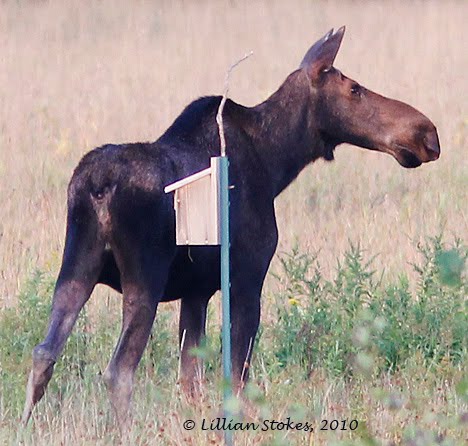
Moose Moose!!

She walked by our deck, gently gliding through the evening, oblivious to us, only 300 ft. away.

We were sitting on our deck at 7:20 pm. eating dinner and sipping wine, the Corgis lying at our feet.

Being a Corgi (who are herding dogs) owner often requires quick thinking and subterfuge. I very quietly said, "Don, don't look now but help get the Corgis into the house", and I calmly called, "Abby, Phoebe want a cookie, let's go in."
Corgis safely inside, I said, "Moose, Moose, look there's a Moose."

And we watched her move out into our landscape and pause next to our bluebird house, just long enough for me to get this image with a telephoto lens.

Tuesday, August 10, 2010

Scissor-tailed Flycatcher

Scissor-tailed Flycatcher, juvenile

Scissor-tailed Flycatcher, adult female

Scissor-tailed Flycatchers are beautiful long-tailed flycatchers who breed in the lower middle part of the country, but can be vagrants, showing up just about anywhere else in the country. One just showed up recently at Sandy Point State Reservation in Ipswich, MA and was seen there as recently as this Monday.
Here are two of Lillian's photos from our new Stokes Field Guide To The Birds Of North America (to be pub. this Oct.). In general, the male Scissor-tailed Flycatcher has the longest tail, the female's is slightly shorter (although there is overlap), and the juvenile's is shortest, relatively speaking since they are all very long--tailed birds. Juveniles have a brownish wash to upperparts, adults are paler on head and breast with dark wings.
One may show up near you, you never know.

Monday, August 09, 2010

Flying Bird Seed


Really now, must you toss the bird seed? This is a photo of our Red-breasted Nuthatch, male, at our bird feeder. The bottom photo was taken a millisecond after the top photo (love my Canon 1D Mark IV camera). I think he just tossed the seed. Whoopeee!
Wait, you're supposed to eat that!
What do you think the captions for this should be?

Friday, August 06, 2010

What bird is that?


What bird is this you may wonder. It sure does't look like a Red-winged Blackbird. Where's the red, where's the black?

This is a juvenile Red-winged Blackbird. The term “juvenile” refers to the first full plumage that a bird has when leaving the nest. You can see that this bird looks a little like an adult female, but has a more rich golden-buff ground color to its body and head (an adult female has a paler, whiter ground color to its body and head). Also, young birds at this time of year (late summer) have all new fresh feathers with little or no wear; adult birds at this same time have worn feathers, often looking very frayed at the edges. In juvenile plumage, the male and female look alike.

This juvenile will go through a molt from July to November, replacing most of its feathers. When done, male and female will look different, the female streaked brownish and whitish and the male more blackish with paler mottling.

You can really learn a lot by looking closely at the birds in your yard. Now is a good time to be on the lookout for juvenile birds.

What's that sound we hear?? Could it be the sound of a printing press, printing out a book? Guess whose book it is.

Have a great weekend.

Thursday, August 05, 2010

Spicebush Swallowtail

Spicebush Swallowtail butterfly


When the birding is slow, another wonderful thing to do is look for butterflies. We don't have to go far, as we have lots of flowers planted all around our house. This Spicebush Swallowtail was sipping nectar from our purple bee balm flowers right in front of our deck. You can see the long mouthpart extending into the tube. The larvae of Spicebush Swallowtails feed on spicebush and sassafrass.
Spicebush Swallowtails can be told from other big, dark swallowtails by their single row of prominent white dots inside the margin of their forewings. We are at the northern limit of this butterfly's range, here in NH. It is unusual to see them here. So this was a special sighting. We have heard of other more southern butterflies being seen now in northern states, this may be a trend.
For more info. on butterflies see our Stokes Butterfly Book

Wednesday, August 04, 2010

Hummingbird Joy

Ruby-throated Hummingbird
Canon 1D MarkIV, Canon 300mm IS lens, 1.4 teleconverter, 420mm hand-held, f/5.6, 800 ISO
1/1300 sec.

Just got this photo of a Ruby-throated Hummingbird in my veggie garden this morning, sipping a nasturtium. It was magic. The hummingbird was lit in the early morning August sun. Not an easy shot to get, as it was flying freely, and only hovering for seconds at the flowers. Many gorgeous hummingbird shots you see in books and magazines are taken at feeders, where the photographer has a set-up with a flower covering the glass tube of the hummer feeder, and high speed flash lights to freeze the wings. Those are beautiful shots too, and take skill. But what I like about this is that it captures a wild moment in natural light.


Another way we get to be with hummingbirds, as in this video, is watching them come to our hummingbird feeders which we place within 10 feet of our chairs on the deck. We can hear the buzz of the wings and see their throats move as they lick up the nectar at about 13 licks per second. For us, hummingbirds are one of the great joys of the summer. It's not too late to put up hummingbird feeders now, as many hummingbirds have already begun their migrations.

Monday, August 02, 2010

Rose-breasted Grosbeak

Rose-breasted Grosbeak, immature male


Here's a Rose-breasted Grosbeak, immature male, that has been coming to our feeder. In the photos you can see a blush of pink on his breast. He will have a white breast with a bright rose triangle when he becomes an adult. What a subtly beautiful bird.

Thursday, July 29, 2010

Best of Mt. Desert island, Maine

We had a great trip to Mt. Desert Island last weekend. Some of our favorite things were Acadia National Park with it's spectacular scenery. We visit there every year.

Black Guillemots were just about everywhere we looked out at the water. Very cool little sea birds, Black Guillemots are in the family Alcidae, as are Atlantic Puffins. You can frequently see them from shore from New England and north.

Peregrine Falcons nest on the same cliffs in the park each year, building their nest in different spots. This year, their first nest was abandoned and park rangers through they would not have a successful nesting. To their surprise, the peregrines re-nested but it was not discovered until they say one fledgling. So once again, peregrines produced young in Acadia.

We got one very brief distant view of a peregrine.

Across the street, several Red-eyed Vireos were constantly singing back and forth. One came lower down from its tree-top perch and eyed me.

Jordan Pond and the Bubbles mountains are a much photographed view. Don't miss the A-game popovers and lobster stew (which we're addicted to) served at Jordan Pond House restaurant which overlooks this view. We hiked around the pond, an easy hike on a well-mantained, level, crushed stone path, edged with pink granite. We saw so many people, young, old, middle, parents pushing strollers, people with dogs on leash, even many people from foreign countries were walking on the path, enjoying nature. Acadia is one of the crown jewels of the national park system and one of the most visited. What a grand treasure, there for all to enjoy.
We are avid gardeners, as well as birders so we stopped at Asticou Azalea Garden in Northeast Harbor on Mt. Desert Island. This is a garden in with a strong japanese influence, yet using many native plants. It is open to the public all summer.

I love to walk across the stepping blocks that cross the stream.

A bonus was the bi-annual garden tour, sponsored by The Garden Club of Mt. Desert Island where you can see the private gardens of spectacular mansions. One had an incredible, recently restored, Italianate garden, one of the highlights for us. Maine gardens make excellent use of their native materials of moss, ferns, shrubs, it gave us a renewed interest in incorporating even more of these type elements into our gardens than we already do.

Italianate garden with yellow Ligularia in foreground.