Search This Blog

Tuesday, April 19, 2022

STOKES GUIDE TO FINCHES OF NORTH AMERICA in progress!

Evening Grosbeak
Purple Finch
Just finished a looong working weekend with my coauthor to Stokes Guide to Finches of North America, Matthew A. Young, doing our best to bring you an awesome guide to all things finch!! Coming in 2023.


Friday, April 15, 2022

Pine Warblers Are Arriving!!

Yes, they eat suet. Pine Warbler on my suet feeder a few years ago. When some of the early migrants, like Pine Warbler, arrive there may not be a lot of insects around, especially if it is cold or bad weather. So they can take advantage of a high-calorie food source like suet. Welcome all the migrants with feeders well-feeders with suet and a variety of seeds, as well as hummingbird nectar and orange halves for the catbirds and orioles. The great migration push is beginning, embrace the wonder.


Tuesday, April 05, 2022

The Common Birds Still Excite!


 I get asked whether the common birds excite me anymore. The assumption is that only the rare is valued and thrilling and I am jaded to the ordinary. My answer is hell yes, I get as excited by the common and known birds as much as I did the day I first saw them. Rare birds are exotic, fun, and pulse-quickening. But I look at all birds as mini-miracle bundles of wonder, there to be focused on and cherished.

Thursday, March 24, 2022

Greater Prairie-Chickens Booming!


We left at 3:30 a.m. to arrive predawn and stealthily crept through the chill darkness to wait at our blind. The faintest light appeared...slowly the males came...the dancing and the booming, reverberating-through-your-body, other-worldly sounds began. We were watching the lek mating rituals of Greater Prairie-Chickens.
Males gather and display at their mating grounds each spring. They rapidly stamp their feet and produce the booming sounds by inflating the orange air sacs on the sides of their neck, the sound comes from air passing through the syrinx and is amplified by the sacs, an extension of the esophagus. Males also make cackling and whooping noises. Females then arrive and decide which male to mate with, while the males compete for females. Females usually choose older, more experienced males with longer legs, larger eye combs, and the best territories within the lek. After mating the females nest and raise the young themselves.
This took place a number of years ago (when we were with our friends Gary and Diane Cole) at the Prairie Ridge Natural Area, Illinois, the only remaining place east of the Mississippi where Greater Prairie-Chickens, a declining species, can be found on their historical grounds.
You can listen to the sound of the Greater Prairie-chicken here https://www.allaboutbirds.org/.../Greater.../overview


Monday, March 14, 2022

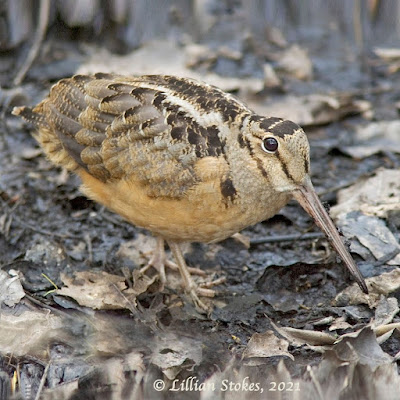
American Woodcock Astounding Behavior!!


 "Peent!!" Go listen for the nasal call of American Woodcocks, who are returning to their breeding grounds across much of the eastern U.S. and very southern Canada. Wow, what a great bird!! Those shoe button eyes on top of its head allow it to look for predators while it feeds on earthworms with its bill stuck in the ground.

One of the most astounding things about woodcocks is the males' courtship display. After giving multiple "peents" he rises in the air in a spiral, hundreds of feet high and you could hear his wings making a twittering sound. At the very top of his flight, he makes a canary-like chirping for several seconds, as he begins his descent. After landing, he begins his "peent" calls again.
Male woodcocks do courtship displays, at dusk and dawn, in open fields, hoping to attract as many females as they can. Females go to the fields, choose and mate with a male, then go into the woods and nest and raise the young by themselves. The young are born fully feathered and can walk and soon feed themselves.
If you live near open fields you can go and listen for woodcock displays and witness this amazing woodcock behavior for yourself. Getting more deeply into the lives and behavior of the birds around you takes you out of your world and connects you to something larger. Enjoy!

Thursday, March 10, 2022

Red-winged Blackbirds have returned!!


 Here's how I was greeted this morning, "okaleeee." A Red-winged Blackbird made my day. Birds have a way of doing that, embrace it!

Monday, March 07, 2022

Purple Finches are On the Move!!


                                     Purple Finch eBird map March 2022
                                                  House Finch males
Purple Finches and goldfinch at top.

Beautiful Purple Finches seem to be on the move. Purple Finches breed across Canada, the upper Midwest, the northeastern quadrant of the U.S., and down West Coast areas. However, they winter down through the Gulf Coast states. Here's an eBird map of where they are now. Don't be fooled into thinking you have Purple Finches when you are seeing House Finches. House Finch males have more heavily streaked flanks and red color more limited to head and breast, females have plain brown faces, not the whitish eyebrow line of female Purple Finches.

Wednesday, March 02, 2022

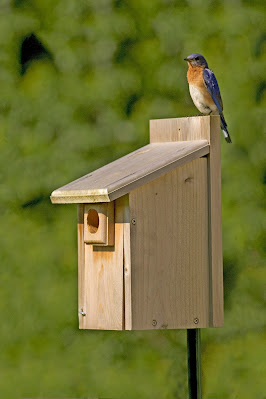
Happy Bluebirds!


Come along with me my love,
And we will roam the sky;
We'll fly across the meadows,
And soar o'er mountains high.
We'll drink of streams' pure waters;
Chase butterflies and bees;
And when we tire of this, my love,
We'll rest in shady trees.
Then we will search in earnest,
Each nook and cranny wide;
Where we can raise our family,
Together, side by side.
There it is, my dearest love,
Well, goodness! Bless my soul!
Just waiting there for us, dear one,
Our house upon a pole.
A kind and careful craftsman
Has built it strong and true;
DO enter into it, my love,
And I will follow you.
Katherine M. Braun
"Bluebird Honeymoon"
And from Henry David Thoreau, Journals–March 2, 1859
"Princes and magistrates are often styled serene, but what is their turbid serenity to that ethereal serenity which the bluebird embodies? His Most Serene Birdship! His soft warble melts in the ear, as the snow is melting in the valleys around. The bluebird comes and with his warble drills the ice and sets free the rivers and ponds and frozen ground. As the sand flows down the slopes a little way, assuming the forms of foliage where the frost comes out of the ground, so this little rill of melody flows a short way down the concave of the sky."
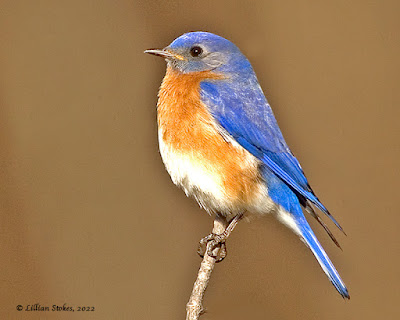
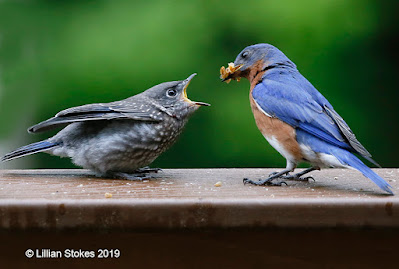
When I wrote Stokes Bluebird Book: The Complete Guide to Attracting Bluebirds in 1991, I included some poetry and special quotes on bluebirds in an early chapter because bluebirds are one of the most beloved songbirds who inspire and enchant millions. Birds are so much more than just their colors, wing measurements, sounds, life history information; they're winged spirits who touch our souls.


Monday, February 14, 2022

HAPPY VALENTINE'S DAY!

                                   Roseate Spoonbill preening heart shape
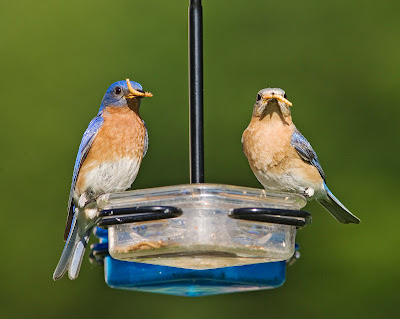
Bluebird pair
                                  

                     Happy Valentine's Day. 

This is also my blogger anniversary. I have been doing Stokes Birding Blog for 16 years. Hope you have enjoyed it. Have a great day!

Saturday, January 08, 2022

Christmas Bird Count Jan. 3rd 2022 Great Fun!!

Hooded Merganser
Red-bellied Woodpecker and Carolina Wren
Song Sparrow
Hooded Merganser
Horned Lark

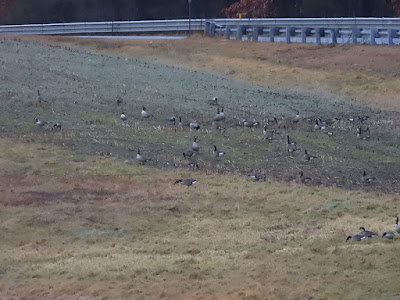
Canada Geese in field where lark was

Spoiler Alert: these will be the suckiest Christmas Bird Count (now in its 122nd year) photos you will see, so look no further if you're used to viewing the gorgeous eye-candy photos from other photographers. But the purpose of the Christmas Bird Count is to count every bird and have fun, and fun I had, even if the weather was rainy, gray and cold. I participated on Sunday in the Greater Concord, MA Christmas Bird Count (which includes sections of a number of towns) and had a territory with diverse habitat, including wetlands and fields. I brought my Nikon P950 point-and-shoot superzoom camera which is no DSLR, but the superzoom of 2000mm allows record shots. What I loved best is that every bird counts, whether rare or common, something to be celebrated when often birding's emphasis is on rarities (which I do love seeing!). During 24 hours, by car and on foot, every species, with numbers seen, is recorded. In the early, dark morning I managed to get a photo of the special Horned Larks in the big field with geese. It was raining, I was soaked, standing in the mud with my fingers numb, and loved every second of it. Isn't that what life is about, feeling alive and loving every second of it? Later, during mid-day, it stopped raining and I worked hard in an area where diverse habitats come together and I saw the most birds, scanning, trying for photos, recording, and just feeling a sense of exhilaration to be immersed with birds in the experience. Nothing else mattered and I truly was "in the moment." I miraculously managed to get both Red-bellied Woodpecker and Carolina Wren in the same photo. In a water area later, the beautiful male Hooded Merganser swam away from me, his white flag erect like the head of an arrow piercing a pattern in the still, deep, dark water. At the end of the day, participants turn in their numbers to compilers. Last night was the countdown zoom, where you hear about all that was seen. I am always so impressed by the skill and effort put in by so many participants, plus a sense of birding community on this special day. Over 31,000 individual birds were counted, of about 90 give or take species (some numbers are still being confirmed). Life is about the gift of every moment and birds are a big present.

Saturday, December 18, 2021

Moon Magic Full Moon

Moon magic last night. While tonight is the peak full moon, I took his last night because there will be a storm here in MA tonight. This is called the Cold Moon, because of the season. Other Native American names for this moon are, Drift Clearing Moon (Cree), Frost Exploding Trees Moon (Cree) (love it!), Moon of the Popping Trees (Oglala), Hoar Frost Moon (Cree), Snow Moon (Haida, Cherokee), and Winter Maker Moon (Western Abenaki). This moon sits above the earth for the longest period of time. I always try and photograph the full moon when it is visible to me and embrace its magic. We all share the moon, celebrate it. (Nikon P950 camera)


Tuesday, December 07, 2021

European Goldfinch Magic!


The finches keep calling me. Yesterday morning it was raining. I am in MA, and, on a hunch, I checked Massbird to see what was around. A European Goldfinch was being discussed. What!! I was just close to writing the chapter on European Goldfinch in my new book, with co-author Matthew A. Young, Stokes Guide to Finches of North America. I looked up the sighting’s map, and next to the area it was being seen, the road sign said Lillian Rd. No way, you can't make this stuff up. Was this to be one of those special finch moments I keep having, like the Montague Magic moment I had when I met Matt for the first time, Red Crossbills descended on us, and, as I drove away, the road sign said Lillian's Way?
I loaded the car with binoculars and cameras, and we took off, hoping for clearing weather. When we arrived, the rain had stopped, but the wind began. The area was Lexington Community Farm, a large area with back woods and lots of weeds and tangles. A birder walking towards me said that he had the bird earlier, but it had flown. For those of you that have gone after an unusual bird, you know the feeling, the you-should-have-been-here-an-hour-ago sinking feeling in the pit of your stomach. I desperately wanted to see and photograph this bird. It took a few hours and 5 birders. First, a pair of birders saw it briefly down low and back in tangles, but it flew. The wind was likely keeping it well under cover and deterring it from vocalizing. Then Don briefly spotted a bird with black and white that flew. Then my friend, Dave, saw it, and he and I moved a bit and got on it. To my astonishment, this European Goldfinch proceeded to feed in front of me, visible without much obscuring vegetation. I became lost in an adrenaline rush, altered state of consciousness, through my camera lens. I call it "becoming one with the bird." I fired and got as many photos as possible.
Wow! At an incredibly challenging time in my life, I just had an uplifting, almost spiritual experience in which the stars aligned. Through time and space, I had connected with this amazing finch who lifted my spirits—what a gift. Lessons from finches; experiences like this are open to all who trust that the improbable is possible. Yes, finches keep calling me and I keep answering.
And FYI, a European Goldfinch is not a native bird. It is native to Europe, North Africa, and parts of Asia and likely does not cross the Atlantic. Sold as a caged bird in this country, the European Goldfinch often can escape or be released and possibly live in the wild. There have been 3 times when populations of it have bred in the wild. In southern California, it has bred a few times; in Brooklyn, N.Y., there are a few dozen breeding around parks. Around the Great Lakes, however, they seem to be taking off. The population in WI may be expanding to Chicago and MI. Evidently, eBird may be revised to class the Great Lakes population as Provisional. This MA European Goldfinch is thought to be an escapee. However, finches are full of surprises. They can move distances. Who knows how the future will play out for this species.

Friday, November 19, 2021

Lunar Eclipse 2021, Spectacular!

Spectacular lunar eclipse last night. I got up at 5 a.m. because the weather forecast here in MA said rain last night then clearing. I lucked out and saw this amazing sight in a clear sky filled with stars. The lunar eclipse was the longest one in over 500 years. This moon is called the Frost Moon or Beaver Moon because it is the time of year when frosts occur and busy beavers are actively storing a large cache of favorite tree branches secured in the mud underwater near their lodge entrance. I embrace the full moon's energy and always try to take its photo. (Photo with Nikon P950 on moon setting, slightly cropped, but other than that, untouched).


Monday, October 25, 2021

It's Golden Eagle Time!!


Where eagles fly, it's Golden Eagle time! I am blessed to live where I can see eagles and they have special meaning for me as the Bald Eagle is my first spark bird. While Bald Eagles are common here in NH and nest relatively close by me, Golden Eagles are a rare migrant. We are approaching prime time for them to migrate past Pack Monadnock Raptor Migration Observatory and none has been seen yet. After the weather clears get out there if you can, and dress warmly!! Fyi, the Red Crossbill is my second spark bird and has set me on a new course, can you guess, lol, writing a finch guide! (photo from another time)

Thursday, October 21, 2021

23,357 record number White-winged Crossbill migration yesterday!


 23,357 was the total number of White-winged Crossbills that migrated past the Dunes de Tadoussac bird observatory, in Quebec on the St. Lawrence river, yesterday, a record. They also had 2,230 Pine Siskins migrate. You can see amazing photos and video from then at this eBird checklist.

https://ebird.org/qc/checklist/S96486498...

Meanwhile, I can always hope that finch dreams become a reality and that some of them show up in NH this winter, preferably at my feeders, as this one did in 2011!

Sunday, October 17, 2021

Black-bellied Plover and other shorebirds still coming through NH!


Black-bellied Plovers and other shorebirds are still migrating through NH. Look for them at the coast and also inland water areas with exposed shorelines and flats.

Friday, October 08, 2021

Pine Grosbeak Beauty

It's Finch Friday. Today's finch is a Pine Grosbeak, male. These beautiful birds live in the boreal forest and western mountains of North America, irrupting south in years of food shortage. Then you might see them in parking lots eating crabapples in winter (where I photographed this one).


Thursday, October 07, 2021

October Big Day, Global Bird Weekend, is here!

This weekend. Sat. Oct. 9th is October Big Day! All you have to do is count birds wherever you are, even at your feeders and submit your list to eBird. You will also be part of the Global Bird Weekend where thousands of birders across the globe participate, read more here,
Have fun!!


Tuesday, October 05, 2021

Yellow-rumped Warblers a.k.a. "butterbutts"


Yellow-rumped Warblers are one of the commonest migrating fall warblers. Just saw this one on my deck in NH. Also know as "butterbutts," these photos show you why.