Search This Blog

Sunday, October 21, 2012

Eastern Red Bat photo in flight!

Eastern Red Bat

Eastern Red Bat

Eastern Red Bat

Just in time for Halloween, a bat appeared in our yard yesterday. I just photographed this migrating Eastern Red Bat in flight as it foraged over our house. We watched it for about 10 minutes as it swooped over the trees and fields, catching insects. So cool!! But what is even more fun is looking at the photos. In the middle photo you can see the ear, lit by the sun. In the bottom photo you can see the outline of the bones.

These bats live in trees in wooded areas and roost up in the foliage curled up in their furry tail membrane. They are mainly solitary, just getting together to mate and during migration. They eat lots of moths as well as other insects. They live throughout the eastern half of the country. In fall the more northern ones migrate to southern areas, often using the same migratory routes along the eastern seaboard as some birds do.
We were so lucky to see it!

To learn more about bat conservation go here


and see out Stokes Beginner's Guide to Bats, written by Rob Mies and Kim Williams.


Friday, October 19, 2012

Rare Wood Sandpiper in RI is in The Stokes Field Guide to the Birds of North America!


Lesser Yellowlegs, might be confused with Wood Sandpiper. The Stokes Field Guide to the Birds of North America will help you sort out the differences in the most complete way of any other field guide.

A rare bird, a Wood Sandpiper, is now in Rhode Island and birders are flocking to see it. Although this species is a regular visitor to western AK, it is only a rare vagrant to the Northeast Coast and this is only the 7th time it has appeared in the lower 48! We are happy to say this species is included in our new
The Stokes Field Guide to the Birds of North America. It is not included in many other field guides and our guide has the most extensive photos and text on this species of any other guide. We show all of the major plumages of the Wood Sandpiper: summer adult, winter adult, juvenal, and in flight. So, If you are a birder looking for how to identify this rarity, ours is your go-to guide. To quote the Stokes guide,

Wood Sandpiper

Tringa glareola L 8"


“Fairly regular visitor to w. AK; vagrant down West Coast and along Northeast Coast. Shape: Much like Solitary Sandpiper but with slightly longer legs. Primary extension past tertials very short, less than 1/4 bill length (almost length of bill in similar Lesser Yellowlegs).
Ad. Summer: In all plumages, broad whitish eyebrow (from forehead to nape) contrasts with dark caplike crown and dark eye-stripe. Upperparts dark grayish brown with bold white notches along feather edges (similar Lesser Yellowlegs has finer spotting); head and neck finely streaked; breast and flanks lightly barred; legs yellowish green. Bill with paler base (all black and longer and thinner in Lesser Yellowlegs). May bob front or rear of body. 
Ad. Winter: Like ad. summer but with muted markings; spotting smaller on upperparts; neck and breast indistinctly streaked and washed with brownish gray. Bill with paler base.
Juv: (Jul-Aug) Like ad. summer but back dark brown with finer buffy spotting.
Flight: Dark wings and back; no wing-stripe; rump white; white tail with narrow barring. Toes extend fully beyond tail.
Hab: Bogs, marshes in summer; inland wetlands in winter. Voice: High-pitched mellow dewdewdew or slowly repeated jit.
Subssp: Monotypic."

Hope you get a chance to see and enjoy the Wood Sandpiper and, if not, keep looking at those Lesser Yellowlegs and Solitary Sandpipers to be sure they are not a rare Wood Sandpiper!


For more photos of the RI bird go
here.
and here.
For updates on where to find it go here.

Good Birding!

Thursday, October 18, 2012

Evening Grosbeaks, Irrupting, Coming Your Way Too!


We keep telling you the big news in birding circles is this is going to be a big irruptive year for certain birds. It's true for Evening Grosbeaks. These birds only show up certain years when their winter range food crops are low. So we are seeing them repeatedly come to our bird feeders now in NH. These two female Evening Grosbeaks were enjoying the sunflower seed, their fav, this morning. Look how they dwarf the goldfinches feeding with them!
Keep a look out and your feeders well stocked with sunflower and perching room and let us know when you see Evening Grosbeaks.

Tuesday, October 16, 2012

Lots of Pine Siskins Here, More Coming Your Way.

How many Pine Siskins can fit in one feeder?

Line up for the bird barh.

Had over 60 Pine Siskins here yesterday. They are coming your way, this is a big invasion year for Pine Siskins, who make irruptive migrations out of their normal winter range when food is low there. Stay tuned and watch your feeders! How many are you seeing?

Friday, October 12, 2012

Misty Morning Moose


This morning at dawn, we looked out our bedroom window and saw this moose walking across our field into our shrub area, following close behind a female moose. OMG was our first response. Then, photographer that I am, I ran downstairs and, fortunately, the camera was already set up on the tripod inside the house. In the dim light I shot this photo at 10,000 ISO (yes that is the correct number, my Canon 1D Mark IV will shoot even higher ISOs than that) with a Canon 500mm lens plus 1.4 teleconverter, from about 300 ft. away.

This is a young bull moose, you can tell by his antlers. Quoting from our Stokes Guide to Animal Tracking and Behavior,
"There is no way to determine the age of a moose by counting the points on the antlers. The only clue that antlers give to age is the diameter at the base of the antlers, which gets larger each year. Bull calves have only short spikes for their first fall. Yearling and 2-year-old bulls can have either simple spikes or branched antlers, but generally their antlers are not flattened like those of older bulls."
So he is about 1-2 years old, and he is about to get lucky, because he was walking behind a cow moose (she had already moved into the shrub area and I did not get her photo.)
"Once a cow in estrus and a bull have found each other, they stay together for 1-2 weeks. During this time there are three phases of behavior. In the first phase the bull simply stands sideways, several yards in front of the cow, for long periods. When she moves, he moves again to stand in front of her. In the next phase the bull follows a few steps behind the cow, moving when she moves. Finally the female stands still and lets the bull mount and mate with her. They may mate several times over the course of a day or two. Following this, the bull leaves in search of another cow in estrus."
We watched them browse in the dense shrubs at the edge of our woods. The cow then moved on, and he followed close behind her and they disappeared out of sight (dang)......

Wow, we never know what cool natural history event we will see here at Bobolink Farm, our 48 acre NH property. This was one of those very special moments.

Tuesday, October 09, 2012

Ruby-crowned Kinglets are migrating now!


We're seeing a lot of Ruby-crowned Kinglets migrating through here right now. They're a cute, very small bird, as hyper as a warbler on caffeine, and give a little, high-pitched call. Note the yellow-greenish color on the edges of the wing feathers. We see them flitting along the woodland edges here.

They really do have a ruby crown, but they keep it mostly hidden. When alarmed they can raise their head feathers and show the ruby. They may give a  harsh chidit call or ch'ch'ch'ch. Look for them now in woods, or in your yard, they're a treat, not a trick.

Monday, October 08, 2012

Amazing Nuthatch Photos!!

White-breasted Nuthatch, male

Red-breasted Nuthatch, male

Check out these amazing photos of Red-breasted and White-breasted Nuthatches. There's nothing like digital photography to add to your birding experiences and make you see things in a new way. I just love it when I capture action shots of birds at my feeders. Sometimes I don't realize I'm getting the photo when shooting, my camera just fires away quickly. When I look at the photos later, I see birds caught flying away or landing, as here. The White-breasted Nuthatch had just taken a seed and was leaving. The Red-breasted Nuthatch was landing at an open spot on a feeder filled with Purple Finches above.

You can see such cool things about these photos. Look at the tail of the White-breasted Nuthatch and notice the white outer feathers, the black lines, and the dark spots on the outer edge. This fancy tail is not just for fun. It can be used in communication with other Nuthatches, or, possibly distracting a predator by making it focus on the tail spots. Nuthatches have a "Tail-fan-back-ruffle" display (see Stokes Guide to Bird Behavior Vol. 2) in which they ruffle their back, raise and fan their tail, and droop their wings when they are in conflicts with other nuthatches.

The Red-breasted Nuthatch photo shows how far under and up the rufous goes. The dramatic black-and-white head pattern could be disruptive coloration. It masks the eye and the true shape of the head, breaking up the image a predator may look for. By the way, there is a big irruption of Red-breasted Nuthatches into the East and Southeast happening, so be on the lookout.

Digital photography opens up a whole new world of birding and bird appreciation. It can capture a bird at a moment of time, freezing for our eyes, the wonder and amazement of this winged creature. I love it!

Friday, October 05, 2012

Northern Harrier, raptors still migrating


Had a Northern Harrier fly over our fields, plus had 2 Sharp-shinned Hawks in our yard this morning, scaring the feeder birds. Hawk migration is still going on. Broad-winged Hawks have mainly cleared out of New England, but Sharp-shinned, Cooper's and Red-tailed Hawks as well as American Kestrels, Merlins, and more are still coming.
Have a great weekend and see some birds!

Wednesday, October 03, 2012

Pine Siskin Invasion is Starting!!


Pine Siskins at our feeders

Update, just took this photo today, there are 50 plus siskins in our yard.

Pine Siskins have started invading New England. We had a flock of 25 at our feeders yesterday and we are getting reports from other birders in New Hampshire of Pine Siskin flocks at their feeders..
According to the Winter Finch Forecast given each year by Ron Pittaway of the Ontario Field Ornithologists, there is a "widespread tree seed crop failure in the Northeast...Both coniferous and hardwood tree seed crops are generally poor from northeastern Ontario extending eastward across Quebec to Newfoundland south through the Maritime Provinces, New York and New England states" and each irruptive bird species will deal with it differently.
Thus, Pine Siskins in the Northeast could move south this fall and winter due to poor cone crops. They may show up in numbers at bird feeders.

Green-morph Pine Siskin is very rare. A small percentage of male siskins (maybe only 1%) can show and abnormal amount of yellow in their plumage and appear greenish on their back. They are called "green-morph" Pine Siskins. We had one show up at our feeders in 2009.

Here is another photo of the green-morph. So look closely at the siskin flocks at your feeders, to see if you have one.


This could be a big year for irruptive winter finches in the Northeast and beyond.  We have also has a flock of Evening Grosbeaks visit our feeders yesterday and we have many Purple Finches at our feeders too. Keep your feeders stocked, as finches like lots of perching room, keep an eye out to see who shows up, and let us know.

Monday, October 01, 2012

Sparrow ID at Your Bird Feeder, New Way


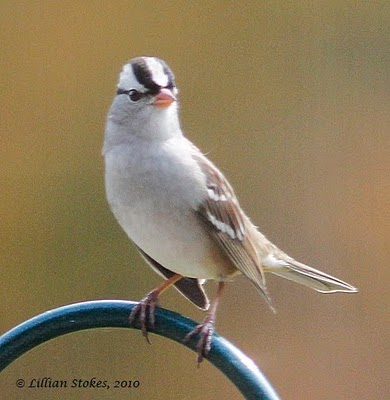
White-throated Sparrows, Zonotrichia albicollis, come in two morphs. One morph has brown head stripes, as here;


the other morph has black-and-white head stripes, as here. There is much individual variation. They all have white throats and are very common at many feeders in winter.


White-crowned Sparrows, Zonotrichia leucophrys, in their first winter have rufous brown head stripes


and no white throat.


The dramatic adult White-crowned Sparrow has beautiful black head stripes and a white central crown stripe.

One of the best ways to approach sparrow identification is to learn what sparrow is in what genus and the distinctive characteristics of that genus, especially regarding shape. Shape is one of the best ways to identify sparrows, since these mostly brown birds can look alike. Becoming familiar with these shapes can help you place an individual sparrow into one of these groups, or genera; then you can look for plumage clues to complete your identification. 


There are 12 genera of sparrows in North America. Only 5 have 3 or more species, and these are the ones that are most useful to know to use in this generic approach.


In our new best-seller, The Stokes Field Guide to the Birds of North America, in addition to extensive photos and plumage information on all the sparrows, we give you a whole section on Identification Tips for Sparrows, including all the sparrow genera, go to page 656.

Tip: Your bird feeder is a great place to start to learn sparrow identification. Look at sparrows through your binoculars at your bird feeder and learn the characteristics of the shape of each genus. You will get better at ID-ing them and it will set you up to learn the sparrows in other genera. Here are some sparrows you might see at your feeder.

White-throated Sparrows are migrating and coming to bird feeders across much of the country now. Somewhat less common here in NH, White-crowned Sparrows are also migrating and coming to feeders. Both these species winter across much of the country and you may have them at your bird feeders all winter. We recently had 5 first-winter White-crowned Sparrows at our feeder amongst the many, many White-throated Sparrows.

Make, near your feeders, a brush pile, with open spaces below and cover above, and sprinkle millet seed mix on the ground below. Sparrows love to feed there.

These sparrows and other sparrows love to feed on the ground on millet or seed mixes containing millet. We make a special sparrow feeder by building a big brush pile and sprinkling the seed in front and under the pile. It's a sparrow magnet and provides perching spots and cover from predators. The big bonus for us is that we get to see lots of fall sparrows.

If you live in the far western part of the country, you will get lovely Golden-crowned Sparrows visiting your bird feeders. They have a golden forecrown, surrounded on the front and sides by black or brown.

All these sparrow species are in the genus Zonotrichia.  On p. 656, on our Stokes Field Guide to the Birds of North America, we discuss the Zonotrichia genus and say these are "large deep-bellied, broad-necked sparrows with a fairly small conical bill, rounded crown and fairly long, slightly notched tail." In addition to White-throated, Golden and White-crowned Sparrows, the Zonotrichia genus includes Harris's Sparrows.

Below are some sparrows in the Melospiza genus. 

Song Sparrow, Melospiza melodia, frequently comes to feeders.

Swamp Sparrow, Melospiza georgiana, often found in swampy areas, not so much at feeders.

Lincoln's Sparrow, Melospiza lincolnii, not much seen at feeders, but may hang out with other sparrows. We saw three on our property the other day.


Swamp Sparrows are in the genus Melospiza, along with Song and Lincoln's Sparrows. In The Stokes Field Guide to Birds of North America, we say of the Melospiza genus,

"* Melospiza: Medium-sized to large sparows with rather average proportions: they are slightly deep-bellied and have a medium-sized bill, rounded crown, and fairly long rounded tail. These sparrows are easily seen in brushy areas and marshes; when flused or curious they tend to fly up to higher perches for long periods and give short alarm calls. Some (Song Sparrow) come regularly to bird feeders. Includes Song, Lincoln's, and Swamp."

So get out there, build a brush pile sparrow feeder, use the genus and shape approach, and improve your sparrow identification skills!


Friday, September 28, 2012

Finch Feast


Right now we have lots of young American Goldfinches and we also have Purple Finches, here they are at our feeder, feasting. Goldfinches like to feed as a group and their favorite foods are sunflower and thistle (Nyjer) seeds. Tip: provide feeders with plenty of restaurant seating and you'll keep the finches.
TGIF, have a great weekend, fill your feeders, and enjoy the birds!

Friday, September 21, 2012

Sharp-shinned Hawks and more, are still migrating!

Sharp-shinned Hawk, juv.

Sharp-shinned Hawk, juv. sitting near our bird feeders.

Here's a photo of some Sharp-shinned Hawks near our bird feeders yesterday, and this morning. Sharpies are still migrating, and so are many other species of hawk. Broad-winged Hawks are still being seen in New England, but the majority have gone by and will be seen over hawk watch sites south of here.
Sharpshins (and their larger relative, Cooper's Hawks) eat other birds, so they can migrate and make frequent stops for a snack.
Keep watching for hawks!

Tuesday, September 18, 2012

Broad-wingd Hawk migration video


Click on arrow to view Broad-winged Hawk video

Yesterday we saw 2,618 raptors, most of them Broad-winged Hawks, migrate past Pack Monadnock Raptor Migration Observatory, in southern NH, it was awesome! To give you a little taste of what it is like to see Broad-winged Hawks circling in a rising thermal then peel off and glide, I took this video while we were watching one of the "kettles" (rising groups) of Broad-winged Hawks yesterday late in the day. This is only part of the kettle, which had over 180 birds in it. In the background, official hawk counter for the day, Ian MacCleod, and Don, are heard describing how we count migrating Broadwings. (Note, to view this video again, not the other youtube videos, hit the left most reverse arrow symbol, in the video bar). Broad-winged Hawks soar up on rising thermals of hot air, then glide to the next thermal, as an energy efficient method of getting to their wintering grounds in Central and South America.

Here's a close-up of a Broad-winged Hawk, adult.

Here's part of a "kettle" of Broadwings rising on a thermal. Some of the kettles had over 150 birds in them.

It was fabulous to see so many migrating hawks, we're happy birders!

Julie Brown (monitoring site coordinator for the Hawk Migration Association of North America) and daughter, Laurel, were spotting the hawks.

On Saturday, Henry Walters, one of the official counters for NH Audubon's Pack Monadnock Raptor Migration Observatory, release a rehabilitated Broad-winged Hawk at Pack. The enthusiastic crowd was thrilled to see a Broadwing close-up.

Many of these hawks will be passing hawk migration sites south of NH, so get out and look, you might become addicted to hawk watching, like we are! Support your local hawk watch and also become a member of the Hawk Migration Association of North America.


Thursday, September 13, 2012

2,507 Hawks over Pack Monadnock Raptor Migration Observatory, NH, yesterday

Large group of soaring Broad-winged Hawks rising in a thermal.

Adult Broad-winged Hawk

Broad-winged Hawk, juv. soaring over the mountain.

The Broad-winged Hawks were moving yesterday and we saw 2,507 total raptors (2,401 of them Broadwings) over Pack Monadnock Raptor Migration Observatory in NH. Most of the Broad-winged Hawk movement occurred before noon, while there were still good thermals to soar on. In the afternoon, the temps rose and thermal activity dropped and we saw less Broadwings, who need to migrate using rising thermals of warm air. Another highlight was 14 migrating Bald Eagles. There is still more migration to come. Last year a daily record was set on 9/18 when 5,290 migrating raptors flew over Pack. This weekends's weather looks good to produce the kind of weather Broadwings like to migrate on, with northwest winds and cooler temps. On Saturday there will be a NH Audubon event with release of a rehabilitated hawk. 

Wednesday, September 12, 2012

Hawks are flying and many more to come in New England.

Sharp-shinned Hawk, juv.

Broad-winged Hawk, juv.

Broad-winged Hawk, adult, backlit by sun yesterday


Yesterday, there were 508 raptors seen over Pack Monadnock Raptor Migration Observatory in NH, where we and other avid hawk watchers were. 459 of the raptors seen were Broad-winged Hawks, the most abundant migrant this time of year. Also seen were 4 Bald Eagles, 21 Sharp-shinned Hawks and a few other raptor species. Lots more hawks are to come, so keep watching!

Monday, September 10, 2012

Hawks Are Migrating in New England Now!

Sharp-shinned Hawk I photographed yesterday

Same Sharp-shinned Hawk from a different angle. 

It's hawk migration time in New England and they're flying now over Pack Monadnock Raptor Migration Observatory in NH, where we were yesterday. They'll be hawks today, even though the strong NW winds may be a little too much for thermals, (which Broad-winged Hawks need to migrate) to be to stable. Tomorrow looks like very good weather conditions for hawk migration with clear skies and mild NW winds. So get yourself out to a Hawk watch site, that's where we will be.

Thursday, September 06, 2012

Hawk Migration Is Starting, How To ID hawks


Broad-winged Hawk, an abundant migrant

Broadwings migrate in large groups (called "kettles") rising up on thermals.


The hawks are coming! The hawks are coming! We're entering prime hawk migration time for birders in the northern and eastern half of the U.S. Look for a high pressure weather front with northerly, mild winds, that's the conditions hawks need to migrate and next week looks like it will have some good weather for migration. Some hawks, such as Sharp-shinned and Cooper's Hawks, Merlins and American Kestrels, often fly singly and move under a variety of conditions, but Broad-winged Hawks, an abundant migrant, go in groups and migrate by using rising thermals. Most of the northeast hawk-watch sites are gearing up to count the numbers of migrants and report the statistics to the Hawk MIgration Association of North America website. On their website, you can join this organization, keep track of the number of migrants, and also find a hawk watching site near you.

Here are some tips for watching hawks:

1. Prime Broad-winged Hawk migration in the North is Sept. 11 to 25, in the South (TX) it is Sept. 25th to Oct. 10.

2. Prime Sharp-shinned Hawk migration in the Northeast is Sept. 1 to Oct. 10, in the Mid-Atlantic States it is Sept. 10 to Oct. 20, in the West it is Sept. 11 to Oct. 31.

3. Hawks usually move most under sunny skies with mild northwest, north or northeast winds. Broad-winged Hawks require thermals to move.

4. Go hawk-watching at one of the many "official" hawk-watch sites. Or find your own by going to a hill, mountain, or tall structure available to you that has good views to the north, because that is the direction the hawks are coming from.

5. Bring binoculars that are at 8 power, or even 10 power if you have them. Scan slowly back and forth across the sky at different heights to find the hawks. Most hawks will be fairly far away and some may look like specs. Learn hawk shapes at a distance to identify them.

6. Here's a brief look at the most common hawks you will see:


Broad-winged Hawk, adult


Broad-winged Hawk, juvenile

* Broad-winged Hawks. These are medium-sized hawks, 16" long, with broad wings, and soar together in groups. Look for the broad black-and-white tail bands seen on the adults, usually visible even at a distance. Juvenile Broad-winged Hawks have thin tail bands and dark streaking that is usually heaviest on the sides of the breast.


Sharp-shinned Hawk


* Sharp-shinned Hawks. These are small, about Blue Jay-sized, 12" long, hawks in the accipiter group. They migrate mostly singly with flap-flap-flap glide flight and have short rounded wings and a somewhat long tail that has a squared end.


Cooper's Hawk


* Cooper's Hawks. These are extremely similar to Sharp-shinned Hawks, and are a tricky ID challenge, but are somewhat larger, 17" long, with a longer, rounded tail and larger, longer head and similar flight pattern.


American Kestrel


* American Kestrels. These are a type of falcon. They are smaller than a Sharp-shinned Hawk, about 10 1/2" long, with pointed wings and a long tail and fly mainly with continuous flapping.


Merlin


* Merlins. Very similar to a Kestrel but darker and larger, about 12" long. Has broad, pointed wings and a somewhat shorter tail than a Kestrel. Flies swiftly and strongly. See yesterday's blog entry for details on Merlin vs. Kestrel ID.


Turkey Vulture


* Turkey Vultures. Very large, about 27" long, all black birds that constantly soar with their wings held in a V.

7. Keep track of your numbers and turn them in to your local bird or hawk-watching organization.

For more on how to identify hawks, see our new best-seller, The Stokes Field Guide to the Birds of North America which has fantastic multiple photos of all the hawks, including them in flight.