Search This Blog

Showing posts sorted by relevance for query digiscoping. Sort by date Show all posts

Tuesday, January 22, 2008

Digiscoping Beginner Tips

For digiscoping, take your spotting scope, here it's our
Stokes 15-45 x 65 mm Sandpiper Scope,

focus the scope on a still bird, hold your digital camera up to the eyepiece of the scope,

look through the view-finder on the back of the camera (you can crop out the black circle in Photoshop, or zoom out the camera a little to make the circle disappear), hold the lens of the camera and the eyepiece of the scope together to steady the camera, then take several photos in a row.

The image, such as this Double-crested Cormorant, can be cropped in Photoshop or another digital editing program,

and sharpened and made ready for your blog.

We were asked about how to get sharp photos by hand-holding the camera to the scope for digiscoping, see our tips below. Digiscoping means taking a photo with a digital camera through a scope.

Some people use adaptors to hold the camera to the scope. These hold the camera more steady, often making a sharper image, but if the bird moves, you may need to take the adaptor off, refind the bird, refocus on the bird, then attach the adaptor and camera again. (Some adaptors and techniques can get around this, but here we're keeping it simple.) There are all kind of adaptors and they make for more reliably sharp photos because the camera is held steady by the adaptor. For an adaptor which goes with the Stokes Sandpiper Scope click here.

For easy digiscoping-on-the-go you can hand-hold the camera, as I was saying in yesterday's blog entry on the digiscoped Cardinal photos. Here are some tips:

1. Find a bird that is sitting still and focus the scope so the bird is sharp and clear through the scope. Do not zoom out the scope.

2. Keep the tripod fairly low so it is more steady. Digiscoping works well with a scope with an angled eyepiece.

3. Place the digital point and shoot camera (without the camera lens zoomed out) against the scope eyepiece and look through the camera viewfinder screen on the back of the camera. Try and slightly manuever the lens so the bird looks centered and decently lit. If there is a black ring around the bird, you can leave it as is and crop out the ring in Photoshop, or you can zoom out the camera lens a little until the ring disappears. Sometimes my best photos are with the camera not zoomed. I just crop the circle out.
Big hint: It helps to steady the camera lens by holding the barrel of the camera lens joined together against the eyepiece of the scope with one hand, while you take the photo with the other hand.

4. Click several photos in a row, sometimes only one will be sharp.

5. If the bird moves, you will need to lift off the camera, an easier task if it is not clamped on the eyepiece with an adaptor, look through the scope to find and refocus on the bird, then put the camera back on the eyepiece.

This is digiscoping kindergarten level, but it's easy and you may come up with some fun images.

Monday, January 21, 2008

Cardinals digiscoped


Here are some Cardinal images taken at Jekyll Island, GA recently at a bird feeder. In this situation I basically following the rules for digiscoping which are:

- Digiscope in sunny conditions
- You should be no more that approximately 50 - 75 feet away from small birds, 100 - 150 feet from large birds.

Actually it wasn't always sunny, sometimes it was cloudy, hence the differences in the photos. Usually, when I am this close to birds, I have my big Canon 500 mm lens and Canon Mark II camera, but this was an unexpected situation and I only had a scope and my Canon A620 point and shoot camera, so I took it as an opportunity to digiscope. Usually, I only digiscope in extreme situations, such as when we saw the Kirtland's Warbler and it was very far away.

When we were at BirdWatch America 2008, I learned that many people either have heard of digiscoping and do not know how to do it, or they have never even heard of it. I spent some of my time there, teaching folks about it. In it's simplest form digiscoping involves taking photos with a camera through your spotting scope. Most people use point and shoot cameras, and either manually hold then up to the scope or use an adaptor to connect the camera to the scope. Some people use digital SLR cameras to digiscope but this may require special attachments.

For the photos above, I used the scope on the lowest power, focused it on the bird, then held the lens of the camera against the scope while looking at the screen in the back of the camera. When looking at the screen, you may see a black circle around the bird. That can be cropped out of the photo in Photoshop or other editing program. Or, you can zoom out the lens of the camera a little and the circle will disappear. I tried to hold the camera as steady as possible, then took a few photos in a row, hoping some would be sharp.

There are many more details about digiscoping on the internet which you can learn about, just google digiscoping. Or, just have a little fun using the down and dirty digiscoping method I did.

Friday, December 05, 2008

Eagle On Ice


This morning, out on the pond, we saw a Bald Eagle standing on the ice! Bald Eagles are always a thrilling sight for us, no matter how many times we see them. This was a subadult eagle, that's why its plumage looked mottled and it did not have the white head of the adult. Crows were nearby and one brave crow crowded near the eagle. Most likely the eagle had some bit of fish that was frozen in the ice. It pecked at the ice and we could see the eagle's feet slipping on the ice as we watched it through our scope. What a great way to start our morning.

I digiscoped these photos (photographed them with my canon A620 point and shoot through the scope) through our window and the eagle was more than 500 feet ways from me! This is extreme digiscoping. Most digiscopers suggest the bird be no more than about 50 feet away for small birds, 100 ft. for larger birds.

Lillian's photo tip: Never be afraid to try digiscoping a distant bird. The result may not be a calendar shot, but it could be a record of a rare bird, or just something you want to share with people on your blog. Like I did.

Monday, March 30, 2009

Ducks, Eagles, Otter

Common Mergansers just arrived

The males have the dark green heads, the female's heads are brown.

Two eagles arrived in the mist

These are young eagles have not attained the all white head and tail of the adult plumage. (Digiscoped in fog, through my window, from more than 1000 feet away, so apologies for the mistly blurry images, but I thought it was worth capturing something.)

The eagles were watching an otter, hoping to steal a fish from it. (Photo also digiscoped from a great distance, but with more sunlight.)

Over the weekend we had quite a show of ducks plus 2 eagles. The ice in the cove in front of our house finally opened up, so it is only half ice. The ducks, eagles and an otter moved right in. We saw 32 Common Mergansers, 2 Hooded Mergansere, 4 Wood Ducks, 4 Black Ducks and 3 Mallards. This morning we saw the 2 eagles sitting about 20 feet away from the otter. We think they are waiting for the otter to catch fish and then they will try and steal it. We have seem them do this before. The otter gets a fish, comes up on the ice to eat it, then the eagles drive it off, then get the fish. These eagles are subadults (young) and do not have their full adult plumage yet. That takes about 4 years.

I had to digiscope the eagles from a great distance, in very poor light, it was the only way I could capture the moment. No one digiscopes like this, because the resulting image is so blurry. I am the only one I know who tries things like this. But in an odd sort of way, I like the misty, blurry, ghost-like images, that kinda capture the feel of what it was like to look though my scope into the private world of 2 young eagles waiting in the fog, hoping to snatch a fish from an otter.

Speaking of digiscoping done right, our friend Mike McDowell, master digiscoper of Mike's Birding and Digiscoping Blog, had to move his blog to a new address due to a nightmare experience with his server. You can find his new blog, with his gorgeous digiscoped images, here.

Wednesday, February 24, 2010

Glossy Ibis, digiscoped from far

Glossy Ibis on Sanibel

There were two, and a Willet walking in front.

We saw some Glossy Ibis on Dinkin Bayou 2 days ago. They were waaay out on a mudflat, too far for my usual camera with telephoto lens, so I digiscoped them. Oh, and did I mention there was thick fog? I like to push the limits of digiscoping, sometimes just to get a photo unattainable any other way. Most digiscoped photos you will see, will be of much closer birds in nice, bright light, hence gorgeous photos. But this was fun, and I like to experiment and see just what will happen when I try something novel. So I did and got a two-fer.

First , Glossy Ibis is a rare bird on Sanibel, which has tons of its relative, the White Ibis. So I wanted to document this.

Secondly, I like the misty, painterly quality to these photos, so unusual. The mist, the distance, the shallow depth of field of a digiscoped image, all contribute to the mood of the photos. Makes me think about where the line of bird art exists between the world of the digital, and the hand of the artist.

Tuesday, November 10, 2009

Cackling Goose, more

This is the year for Cackling Geese in New England. These small geese mainly breed in AK and arctic areas and winter in a few places in the west, the lower central part of the country and TX. They are very uncommon in New England. On Sunday we went to see a group of seven that have been hanging out together, in with a large number of Canada Geese, in farm fields in Ipswich, MA. See the three smaller birds above, much smaller than the Canada Geese.

It seems that one cackling Goose was seen first, then on Fri. 11/6 six more joined it. Seems they all spend the night at Stage Island pool on Parker River National Wildlife Refuge on Plum Island, MA, then fly out early to go feed in the fields in Ipswich.

We saw them quite distant in the fields but were fairly easy to pick out because of their small size next to the larger Canada Geese. They were mostly feeding with their heads down, making digiscoping difficult. They were too far for my Canon SLR digital camera and 500 mm lens.

There really were seven, here seen together. They stayed close, but not always right next to one another. There are four subspecies of Cackling Geese and some of this is still being worked out, see my blog post here. If you find more Cackling Geese outside their normal range, let us know, and send photos, if you have them. They're really interesting little geese and fun to see.

Monday, July 27, 2009

Birding Scarborough Marsh Maine, part 2

While in Maine we stopped at Scarborough Marsh, a premier birding spot, just below Portland, that's Maine's largest contiguous salt marsh at 3,100 acres. There's a wonderful, long, dirt trail that leads out over the marsh. Here's Don scanning for birds. What a beautiful sunny day it was, a rarity, given the bad weather that has prevailed this summer. It felt so good to be surrounded by the beauty, sun and warmth.

Don is looking out from the big bridge that's on the trail. Be sure to stop at Scarborough Marsh Maine Audubon Center, where you can get info., maps and rent kayaks to explore the marsh.

One of the highlights was seeing a Glossy Ibis, not that common up in New England. We see many more in Florida, where this photo was taken. The one we saw on the marsh was too distant to photograph.

Savannah Sparrows were everywhere! We could hear their buzzy "sip, sip see-say" songs. Losk for the usual yellow front of the eyebrow to help in their ID.

Song Sparrows were abundant. Then again, there is so much marshy, grassy habitat to support these sparrow species. Birders also look for Nelson's and Sharp-tailed Saltmarsh Sparrows here. Shorebirds were just starting to arrive on migration at the marsh, but you need to see them at low tide, when the mud flats are exposed. We were there at high tide.

Just about anywhere you go along the coast of Maine, you'll see Common Eiders. Here's a female in flight.

A trip to lower Maine wouldn't be complete without a trip to the famous, Nunan's Lobster Hut, in Porpoise Cove, one of our favorite places to eat lobster. It's a tiny shack over the water, with long tables inside and a big sink against the wall where you can wash up after devouring your yummy boiled lobster. We each had the twin lobster special of two 1 1/4 lb. lobsters.

You can't beat Bertha Nunan's blueberry pie (now made by her daugher-in-law since her passing). It's some of the best we've ever had. The light, flaky, sugar-dusted crust, so thin you can see the veins of lucious, small, wild Maine blueberries beneath, is seasoned with just enough sugar and cinnamon to play second fiddle to the blueberrys' true flavor. Topped with creamy, pale yellow, not white, vanilla ice cream, the kind we remember from our childhood equals, Yuuummmm!

At one point, I walked out onto a rocking, wooden fishing, pier and spied two eiders in the harbor. I did not have my camera at that moment, but I had my binoculars. So the photographer in me came out.

I had my Blackberry phone with me, so I tried something new. I focused the eider in my binoculars, then took them down from my eyes and held the cell phone's camera to the binoculars and photographed the eider through the binos. Maybe it should be called a cell-ocular photo. Sorta like digiscoping, but with a phone and binoculars instead of a scope and camera. Not the best photo, but then again it was taken while standing on a rocking, pontoon fishing pier, with my cell phone through my binoculars. For a rare bird documentation, in a pinch, it might do.

Monday, December 11, 2006

Call of the Wild

Yesterday we saw Common Ravens and American Crows congregating in an area out on our pond. We rounded a corner in our field to get a better look and saw they were on a deer carcass on the ice. We speculated on what killed the deer. Was it a hunter, a fall on the ice, a coyote, or something else? The ice was not solidly frozen and walking on it could be treacherous for human, coyote, and even deer. We felt sorry for the deer but realized the bounty it had become for the wild creatures that live here.

Last night, while inside our home, we heard coyote noises and went outside on our deck to listen. There were coyote howls, yelps and excited barking coming from the direction of the carcass. We guessed there were at least 3 coyotes, maybe more. In winter, coyotes can live in packs of 3-7 members; the pack consists of a mated pair and their offspring of various ages. The leader of the pack can be a male or female. We have studied coyotes and written about them in our Stokes Guide To Animal Tracking and Behavior. The coyote chorus lasted for several minutes, then silence. We wondered what they would do with the carcass. Would they move it, consume it all, cache it? Warmer temperatures predicted for the coming days could melt the ice; opportunity for scavangers is now.

This morning as we walked out to the field with our scope, ravens and crows were calling and flying about. Then an immature Bald Eagle flew right across our cove. Wow! Word travels fast among those that dine on carrion.

We set up the scope and saw the carcass was still there, but looking diminished. Our local crows were milling about and cawing at a raven flying over. They may be trying to defend it a bit from the ravens.

It is exciting to live in a rural area where there are big, wild animals and see how drama and survival plays out in their lives. Wild predator/prey scenarios occur in supposedly "tame" suburban areas in many parts of the country, but they are often hidden by night or woods and are away from people's consciousness.
Here, for us, it is very real and on our minds. We wonder what will happen tonight.


The photo was digiscoped by holding my Canon Powershot A620 up to our Stokes Sandpiper 65 mm Scope. It was gray and overcast and they were far away, not good digiscoping conditions, but enough to capture something of the scene.

Friday, May 19, 2006

Kirtland's Warbler, endangered species

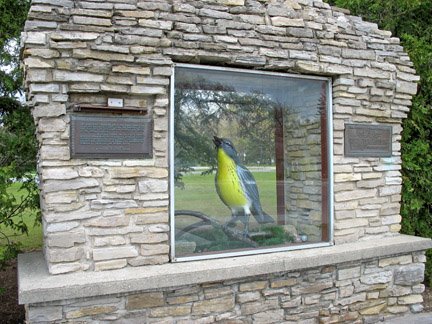
Kirtlands' Warbler
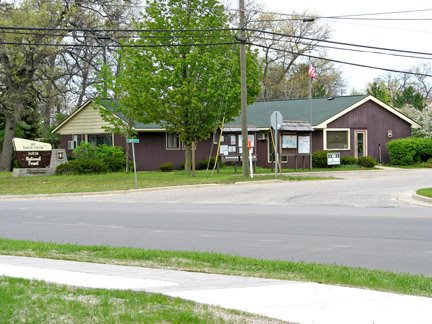
Mio Ranger Station, Kirtland's Warber tour starts here
Monument to Kirtland's Warbler in Mio, MI
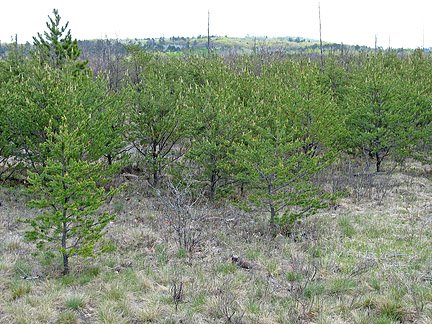
Ideal Kirtland's Warbler habitat of small Jack Pines
Don spots the first Kirtland's Warbler
The 1st Kirtland's was so far away
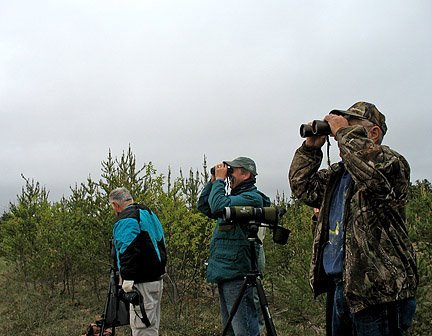
Listening for Kirtland's
Nesting areas are closed to public to protect the birds
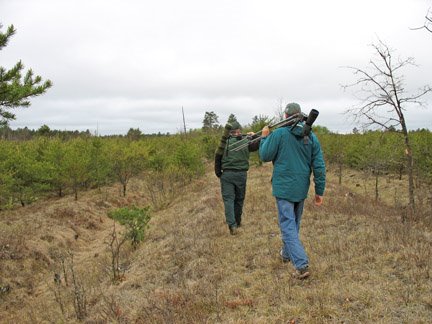
Don walking though prime Kirtland's habitat with ranger
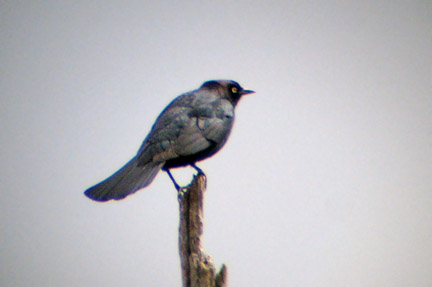
Brewer's Blackbirds are also found in this habitat
and so are amazing Upland Sandpipers
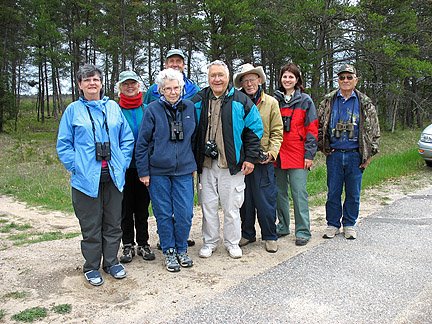
We were the first Kirtland's Warbler tour group of 2006!

After our stop at Magee Marsh, Ohio, we went to Mio, Michigan, located in the upper part of Michigan's lower peninsula, to see the Kirtland's Warbler. Now this is not just any old warbler, this is one of the rarest songbirds in North America. Last year they counted only 1,417 singing males. This is a federally endangered species that nests in just a few places in Michigan's lower and upper peninsula, a little in Wisconsin and Ontario, and nowhere else.

The reason this bird is endangered, is that it requires a very particular habitat of young Jack Pine trees between about 5 and 20 feet tall, and prefers stands of trees that are at least 80 acres or up to 1000 acres. They nest on the ground under the lower branches of the pines. Picky, picky, that's why you wind up as an endangered species. Seriously though, one of the reasons birds become endangered is that they require highly specialized habitats. When those habitats go, due to development or other reasons, the birds do also. Habitat generalists such as say, House Sparrows, have little reason to fear becoming endangered, at least for now.

Jack Pine trees require fire to open their cones and release their seeds. In modern times with greater prevention of forest fires, Jack Pines declined and so did Kirtland's Warblers. There is now a huge federal management program to ensure the continuance of this very special habitat. The Jack Pine stands are managed by seeding, replanting and burning. In addition, Brown-headed Cowbirds, who lay their eggs in Kirtland's Warblers nests and reduce the number of Kirtland's offspring produced, are trapped and removed from the region.

To see the Kirtland's Warblers you need to take a tour offered by the U.S. Forest Service, Mio Ranger Station, Mio Michigan. (There are also tours offered by the U. S. Fish and Wildlife Service out of Grayling, MI.) Show up at the Mio Ranger Station at 7:00 am on your appointed day. We were there the first day they began to lead tours, May 15th. Tours run through July 2nd.

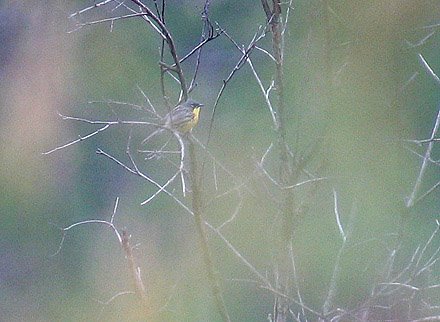
Our group was lead to suitable habitat by leader Phil Huber. We stopped by the roadside and heard a Kirtland's singing down the road behind us. We walked there but could not see it. Phil said to wait awhile, sometimes they pop up and sing from the dead trees sticking above the Jack Pines. Don stood on a little rise and finally spotted our first bird, Hooray! What a beautiful little bird. It was far, more than 200 feet, and obscured by leaves but we viewed it through Phil's scope (and I digiscoped it through the scope). Phil then admitted we were lucky to see it, since this was the first day of the tours and many of the warblers had not yet returned. For the best chance of seeing the warblers you should go between May 20th and June 20th.

We then went to a second area that looked promising and heard 3 more Kirtland's. One of those gave us a better look than the first one (see top photo) but it was still more than 100 feet away. In the area we also heard lots of Nashville Warblers, who also like that habitat. At our final stop we all listened from the road but did not hear anything. We walked in a path and came to an area where the trees were quite low and were treated to a look at an Upland Sandpiper, a very cool shorebird with an unusual call. It was more than 300 feet away viewed through a scope. A Brewer's Blackbird also popped up on a dead snag.
Kirtlands Warbler Festival is held tomorrow on May 20th. Try and go, if not then, then soon, to see this amazing and beautiful warbler, a real survivor.

The photos of birds were digiscoped (I held the Canon powershot camera up to the scope) breaking all the rules for digiscoping which are:
- Digiscope in sunny conditions
- You should be no more that 50 - 75 feet away from small birds, 100 - 150 feet from large birds.
But hey, at least I got some photos.
Lillian's rule:
Be sure and break the rules sometimes.