Search This Blog

Showing posts with label birds. Show all posts

Wednesday, March 27, 2013

The New Stokes Field Guide to Birds: Eastern and Western Region getting 5 Star Reviews!


We're already getting 5 star reviews!
"Don and Lillian Stokes hit it out of the park with their new... guide"
(Thermal Birding)
"The new Stokes regional guides are a must-have for serious birders"
(Amazon)
"This book suits my needs perfectly"
"Jam-packed with some of the best bird photography out there"
"Written and created with Intelligence and exacting care... I highly recommend trying one"
(10,000 Birds)

We have a book Signing today 10 am to 12 noon at Ding Darling National Wildlife Refuge, Sanibel, FL. Come see us! Our The New Stokes Field Guide to Birds: Eastern Region and The New Stokes Field Guide to Birds: Western Region were just published and are available now nationwide at stores and online!


Order Now!


Thursday, February 28, 2013

Birders: The Central Park Effect, a must see, get the DVD.

 Blackburnian Warbler

and Nashville Warbler, two of the beautiful birds shown in the documentary, Birders: The Central Park Effect.

Just saw a showing of the documentary by Jeffrey Kimball called Birders: The Central Park Effect, last night at J.N. Ding Darling National Wildlife Refuge. It's a film about birding and birders in Central Park, NY through the seasons.  It was great, you gotta see it. Beautifully filmed, great footage of birds, wonderful personalities (including Jonathan Franzen) articulately telling why birding grabs them. Like a love poem to birding, it will remind you why you are a birder.
Birders: The Central Park Effect is now available on DVD, click here.

The gorgeous video of warblers made us eager for the eye candy birds of spring migration. By the way,   we will be keynote speakers on Friday, May 10th this year at The Biggest Week in American Birding festival at Magee Marsh, OH, one of the top warbler spots of the country. Hope to see you there. Bring your cameras. I took the above warbler photos there.

Monday, November 19, 2012

Winter Bird-Feeding Tips, How to Keep Your Birds Happy

Goldfinches


Here's Some Advice on Winter Bird Feeding Basics

Brrrrrrr!  When winter temperatures plummet, furnaces are turned on, down parkas and mittens are taken out of storage, and hot cocoa is made on the stove. This how we humans cope with winter, but what do the birds do? Their feathers are their down parkas and their metabolism keeps them warm but they need increased fuel to stoke their furnaces and shelter from wind and cold. Understanding their needs is the first step in setting up your winter bird feeding station.

Where to place feeders

One of the best places to set up feeders in winter is on the south side of a thick stand of evergreens whose branches go from ground level to tree top. This green wall should have as much sunlight hitting it as possible. Not only is it a big solar collector that the birds will love for its warmth, but they can use the dense foliage as protection from predators, shelter from storms, a nightime roost and a place to await their turn at the feeder, or munch a seed recently taken. 

If you do not have this ideal set-up, then be inventive and  create some of its elements. Put your feeders in protected locations that get lots of sun, create a brush pile nearby for cover, plant evergreens, or stand up your discarded Christmas tree near the feeder.


Pine Siskins, Purple Finch,m.


Winter Chow; Supersize me

Because birds have higher metabolic needs in the winter, they consume more calories than in  warmer weather; thus, they need foods that are calorie-rich. Interestingly, one gram of fat provides 11 calories, and one gram of protein or carbohydrate contains only 4 calories.

Here is an interesting list of bird seeds and their protein, fat and carbohydrate content by percentage of weight. 

                                 Protein/Fat/Carbohydrate

black oil sunflower   16/40/38
peanuts   30/48/2.5
thistle   18/32/13.5
millet   11.5/4/6.5
milo   11/3/2.5
Cracked Corn   9/4/2   


So for winter feeding in cold areas, the type of food you provide for is important.

Black-capped Chickadee

Suet cakes contain a high amount of fat so they are a calorie-rich food; so are black oil sunflower, peanuts and thistle. These foods are a good choice for feeder birds such as chickadees, titmice, nuthatches, woodpeckers, finches and cardinals. Offer these seeds in tube and hopper feeders hung above the ground. 

There are other feeder birds, such as Mourning Doves, White-throated Sparrows, White-Crowned Sparrows, and Juncos that normally feed on the ground and whose seed preferences can tend toward carbohydrates. These species will eat seeds such as millet or cracked corn, or mixes containing them. You can offer these birds winter food on platform feeders near the ground, or even sprinkled directly on the ground provided you keep the ground raked clean of any old seed that is not quickly eaten.


Evening Grosbeak, males

In addition to offering food variety to fit the palate of your winter customers, the basic tenet of winter bird feeding is the all-you-can-eat buffet. Basically, keep feeders full so the food is there when they need it. Even though many of your feeder birds will alternate feeding at and then away from your feeders, they especially need supplemental food in severe weather when the wild foods are covered with ice and snow. In these tough times, a good feeder set-up can help their survival. Pay particular attention to filling feeders in mid-afternoon and early morning. This is when birds need to stock up on food and calories to heat their bodies through the cold night and replenish their furnace fuel in the early AM.

Consistency is the key

Once you have the birds coming to you in winter, it is important to be consistent in your feeding program, for they tend to rely in severe weather on the additional supplementation of foods you are offering. So if you go on vacation, see if a friend or neighbor, or hired youngster, will fill your feeders; that is what we do. You may also want to put out larger capacity feeders in winter so they do not have to be filled so often and so there is less chance of them going empty.


Let it Snow

One of the challenges in keeping your winter restaurant open for the birds occurs when there are storms that pile up snow and cover feeders. It is important to keep your feeders free of snow, especially in the portals of tube feeders, ledges of hopper feeders and the tops of platform feeders.  We always go out and knock or wipe the snow off feeders several times during a storm. Another good trick is to hang one of those squirrel baffles shaped like a clear plastic umbrella, above the feeder to shield it from the snow. One of the best snow protectors we have seen was done by someone who had made a giant plastic umbrella out of two big plastic window-well covers mounted back to back. This was held up well off the ground by wooden posts and multiple feeders were mounted under it.

Dark-eyed Junco

Keeping the ground free of snow for ground feeders like White-throated and White-crowned Sparrows, Juncos, Mourning Doves, and even Wild Turkeys, like we have coming to our feeders, takes dedicated shoveling or a snow blower. During one of last winter’s worst storms, we took turns shoveling out a space on the ground under our feeders just about every hour. On our deck we shoveled out spaces under our built in benches and sprinkled seed there for the Blue Jays and Juncos.

Northern Cardinal, f.

In Milder Climates

We are aware that not everyone shivers through winter with snow and cold. Mild climate areas, like California and the southern states, escape the worst weather. In addition to the resident birds, such as Cardinals there, many migrant birds from the North, like Goldfinches, Doves, Catbirds, even an occasional hummingbird, visit feeders there. We have fed birds in Florida in winter for a number of years and it is great fun. While there is not snow, some of the basic practices of bird feeding apply — a diverse menu for both tree-dwelling and ground-dwelling species, providing clean water and good cover, and keeping feeding areas clean. We have even put out oranges in Florida and had catbirds regularly come to them. Maybe they are the same catbirds that breed in our yard in New Hampshire in the summer. We like to think so.

Rewards

One of the biggest rewards of winter feeding, in addition to knowing you are helping the birds survive, is being entertained by all those wonderful, active creatures while you are house-bound. Colorful Cardinals, perky Chickadees, big-eyed Titmice, maybe even a more rare visitor like a Pine Siskin, will line up for your restaurant where there will be standing room only.

This winter, meet your birds’ needs for the right food and shelter and have your own winter bird festival.

Friday, November 16, 2012

Pine Grosbeaks, plus video, Wow!


For most of yesterday we had two female Pine Grosbeaks (the males are mostly red) hanging out in our "Prairie Fire" crabapple trees chowing down. I was amazed how many apples they ate and they seemed to continuously eat for most of the afternoon, like a kid going through the Halloween candy. They were really very tame, not at all bothered by us or the Corgis who ran under the trees. The hardest part of photographing them was to get a clear show through the tangle of apple branches and also to every get a photo of them without applesauce covering their bill!
This is a more northern species who usually is found throughout Canada and up into AK. In irruptive years, such as this one, when so many northern species are coming down into the U.S. due to lack of food in their usual area, Pine Grosbeaks can join the exodus. Pine Grosbeaks are now being reported from numerous locations around our state of NH.
Thus far this fall we have had these irruptive species visit our yard; Pine Siskins, Common Redpolls, Purple Finches, Red-breasted Nuthatches, White-winged Crossbills, and no, Pine Grosbeaks.
We try hard to landscape our property for the birds, using lots of berry and food producing shrubs and trees. It pays off when we get to see such a beautiful species. Let us know if you see any.

Video (handheld) and photo number two shot with the Canon SX HS, the rest with my Canon 1D Mark IV.

Thursday, November 01, 2012

Feeder Birds in Hurricane Sandy Video


I took this video, with my Canon SX 40 HS point-and-shoot superzoom camera,  from inside the house, through the slightly open glass slider, during Hurricane Superstorm Sandy here in southwest NH. It was really interesting to see how the feeder birds coped during the storm. Birds need to eat, so they tried to come to the feeders when they could. The winds were blowing at 20-30 miles an hour during the day, getting much worse, gusting to maybe 50 mph, at night. The birds stayed low in the shrubs and were most protected the lower down to the the ground they were. The Blue Jays had difficulty landing on the feeders and one was able to feed on the lee side of the biggest feeder. The Mourning Doves, Juncos, White-throated Sparrows and one first winter White-crowned Sparrow (big sparrow with plain face and 2 brown stripes on crown), prefer to feed on the ground and thus were most protected from the wind. 
By morning, the bird feeders were knocked down to the ground from the wind. The birds seemed fine and were hopping around waiting for us to upright and fill the feeders.
Luckily we had no other damage, and we still had power. Sending positive thoughts for a fast recovery for all who sustained losses due to the hurricane. Take care.

Wednesday, October 31, 2012

Birds in Superstorm Sandy, what happened to them?

Magnificent Frigatebird

First of all, our hearts go out to the many who suffered losses and are without power due to Hurricane Sandy, renamed Superstorm Sandy. We here in NH were mostly spared some of the most severe effects felt elsewhere, although many tens of thousands are still without power (luckily, we are OK).
For birders, the first rule is to stay safe during a storm. Many birders did venture out at the end of the storm to see what happened to birds. Such a large storm can effect birds by pushing them into coasts, or some actually get caught up in, or entrained, in the storm itself and carried far away from their usual areas. Monster storm Sandy deposited many, many birds in unusual places, including Magnificent Frigatebirds reported from Little Compton, RI and South Dartmouth, MA (possibly the same bird). 

Phil and Don scan the gray sky for unusual birds

Here in inland southwest NH we ventured out yesterday with some other birders and found 2 Laughing Gulls, usually a coastal species, on our lake.

Laughing Gull, winter adult

Henry helps scan also

We joined with Henry and went to a big lake in our town and found 10 Black Scoters  far out on the lake. These sea ducks are usually off the coast of NH.

White-winged Scoters are another type of sea duck that could be effected by a storm.

This is a Wilson's Storm-Petrel, the more commonly seen one from the NH coast. The more rare and similar looking Leach's Storm-Petrel, still in migration, was more a victim of this storm and many were found displaced throughout the storm area. In our state of NH a Leach's Storm-Petrel was seen at big Lake Massabesic, only to be eaten by a Herring Gull!! 
For photos of this amazing event go here.
Many other storm blown birds are being found. Large numbers of Pomarine Jaegers have been reported from NJ, NY and PA. For excellent coverage of the storm displaced birds throughout the Mid-Atlantic and New England Area see John Pushcock's reports on the American Birding Association blog go here
and here.
Also see the live blog updates of storm birds at Nemesis Bird website here.
If you find any unusual storm blown birds in your area, try and document them and report them to your local birding listserve, birding organization and also ebird


Friday, August 31, 2012

Fall Warbler ID Quiz, guess who!

Mystery Warbler 1

Mystery Warbler 2

Mystery Warbler 3

Just for fun, here is a fall warbler mystery bird quiz. Here are some warblers we saw this morning on our property in southwest NH. If you were standing next us this is what you would have seen.
Guess who these fall warblers are. Oh, come on, you can do it!

We will post the answers on our blog tomorrow morning at 7 am, so check back anytime tomorrow to see the answers and discussion. Be the first one to get it right and we will post your name with the answers.
Big hint, if you own our new The Stokes Field Guide to the Birds of North America, look in the warbler section, which has all the all the plumages of the warblers, including fall plumages, with multiple photos per warbler species.
Good Luck.
Send your answers in the comments section, or send us an email here.

Tuesday, November 22, 2011

Turkey photo of the day plus funny bonus photo!

Today's Wild Turkey photo by Lillian, is on page 68 of our new The Stokes Field Guide to the Birds of North America

Yup, Gryff - I think those are Turkeys outside!"

and when our field guide came out, we were sent this funny photo of 2 Vermont Corgis, Gryf and Rugby, who are ID-ing turkeys with their Stokes Field Guide.

Monday, November 21, 2011

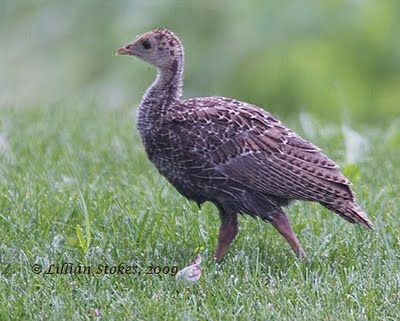
Baby Wild Turkey photo

Baby Wild Turkey (called a poult)

Since this is the week everyone is obsessed with turkeys, I thought I would post a different photo each day of a Wild Turkey. We are lucky to have Wild Turkeys visit our property throughout the year, here in NH, and we get to enjoy seeing them at all different stages of their life cycle, from males displaying in spring, to hens with young (called poults) in summer, to winter flocks consisting of hens and young turkeys of both sexes. Males form their own winter flock.