Showing posts with label birding. Show all posts
Showing posts with label birding. Show all posts
Monday, April 01, 2013
On The Move: Fox Sparrows! Look For Them!


Migration update - Fox Sparrows are on the move and are being reported from many birding listserves. Look for them at your bird feeders. The birds we see in NH have that wonderful foxy color. Not all subsecies of Fox Sparrow are this rufous, some are considerably darker. (See our just published The New Stokes Field Guide to Birds: Eastern and Western Regions for complete subspecies and extensive photos.) One of the eastern subspecies of Fox Sparrow (Passerella iliaca iliaca) is the most rufous. We're always thrilled to get a close look at these large, beautiful sparrows. Look carefully at the sparrows at your feeders and see if you have any Fox Sparrows. They like mixed seed and will often feed on the ground.


Thursday, February 28, 2013
Birders: The Central Park Effect, a must see, get the DVD.

Blackburnian Warbler

and Nashville Warbler, two of the beautiful birds shown in the documentary, Birders: The Central Park Effect.
Just saw a showing of the documentary by Jeffrey Kimball called Birders: The Central Park Effect, last night at J.N. Ding Darling National Wildlife Refuge. It's a film about birding and birders in Central Park, NY through the seasons. It was great, you gotta see it. Beautifully filmed, great footage of birds, wonderful personalities (including Jonathan Franzen) articulately telling why birding grabs them. Like a love poem to birding, it will remind you why you are a birder.
Birders: The Central Park Effect is now available on DVD, click here.
The gorgeous video of warblers made us eager for the eye candy birds of spring migration. By the way, we will be keynote speakers on Friday, May 10th this year at The Biggest Week in American Birding festival at Magee Marsh, OH, one of the top warbler spots of the country. Hope to see you there. Bring your cameras. I took the above warbler photos there.
Wednesday, January 02, 2013
One Good Tern: Common Tern in Sanibel, FL, in Winter!

Common Tern, juv./1st winter seen on Sanibel FL beach, note the dark carpal bar on the wing.

Here's another view, the solid dark on the head goes all round the nape.

Here it is next to the look-alike Forster's Tern which lacks a carpal bar and the black does not go all around the nape.

Terns are tricky, you must look closely to find something different. Here is the Common Tern standing with some Sandwich Terns, which are larger than it and have yellow tips to their bills.
You never know what you'll find, that's the fun of birding. So, on Dec. 16th, when Don and I were looking over a group of terns on Sanibel Island, FL, one in particular caught our eye. It was a Common Tern, which is listed as "rare to very rare during winter" in A Birder's Guide to Florida.
Looking at Terns means you have to sort out subtle clues. This Common Tern is a juv./1st winter bird. The juvenile plumage is kept from Jul.-Nov. according to our The Stokes Field Guide to the Birds of North America. We noticed the dark line, the carpal bar, on its plumage and also the stand out red base to the bill. This tern was smaller than the Sandwich Terns it was sitting with. It might be confused with a Forster's Tern, which is commonly seen here. The Forster's has a relatively longer and thicker bill, longer legs and a distinctive separate black mask over each eye, not connected by solid black around nape as in other similar terns, like Common Tern. Neither the adult nor juv. Forster's Tern would have the dark carpal bar.
In birding, the way to find rarities, is to look closely, very closely. And also to know what the possible rare birds are that could show up in your area. "Chance favors the prepared mind", as the saying goes.
Tuesday, January 01, 2013
What Was Your First Bird of the Year?

Red-shouldered Hawk, adult
Ours was a Red-shouldered Hawk, calling at dawn. It's always so exciting to think you have another whole year to see lots of birds. Just the anticipation of what may show up, what unexpected surprise bird will arrive in your yard, or what rare bird you will see while out birding somewhere, is enough to lift ones spirits and bring a glow of birding hope. What was your first bird of 2013?
Wednesday, October 31, 2012
Birds in Superstorm Sandy, what happened to them?

Magnificent Frigatebird
First of all, our hearts go out to the many who suffered losses and are without power due to Hurricane Sandy, renamed Superstorm Sandy. We here in NH were mostly spared some of the most severe effects felt elsewhere, although many tens of thousands are still without power (luckily, we are OK).
For birders, the first rule is to stay safe during a storm. Many birders did venture out at the end of the storm to see what happened to birds. Such a large storm can effect birds by pushing them into coasts, or some actually get caught up in, or entrained, in the storm itself and carried far away from their usual areas. Monster storm Sandy deposited many, many birds in unusual places, including Magnificent Frigatebirds reported from Little Compton, RI and South Dartmouth, MA (possibly the same bird).

Phil and Don scan the gray sky for unusual birds
Here in inland southwest NH we ventured out yesterday with some other birders and found 2 Laughing Gulls, usually a coastal species, on our lake.

Laughing Gull, winter adult

Henry helps scan also

We joined with Henry and went to a big lake in our town and found 10 Black Scoters far out on the lake. These sea ducks are usually off the coast of NH.

White-winged Scoters are another type of sea duck that could be effected by a storm.

This is a Wilson's Storm-Petrel, the more commonly seen one from the NH coast. The more rare and similar looking Leach's Storm-Petrel, still in migration, was more a victim of this storm and many were found displaced throughout the storm area. In our state of NH a Leach's Storm-Petrel was seen at big Lake Massabesic, only to be eaten by a Herring Gull!!
For photos of this amazing event go here.
Many other storm blown birds are being found. Large numbers of Pomarine Jaegers have been reported from NJ, NY and PA. For excellent coverage of the storm displaced birds throughout the Mid-Atlantic and New England Area see John Pushcock's reports on the American Birding Association blog go here
and here.
Also see the live blog updates of storm birds at Nemesis Bird website here.
If you find any unusual storm blown birds in your area, try and document them and report them to your local birding listserve, birding organization and also ebird
Friday, October 19, 2012
Rare Wood Sandpiper in RI is in The Stokes Field Guide to the Birds of North America!


Lesser Yellowlegs, might be confused with Wood Sandpiper. The Stokes Field Guide to the Birds of North America will help you sort out the differences in the most complete way of any other field guide.
A rare bird, a Wood Sandpiper, is now in Rhode Island and birders are flocking to see it. Although this species is a regular visitor to western AK, it is only a rare vagrant to the Northeast Coast and this is only the 7th time it has appeared in the lower 48! We are happy to say this species is included in our new The Stokes Field Guide to the Birds of North America. It is not included in many other field guides and our guide has the most extensive photos and text on this species of any other guide. We show all of the major plumages of the Wood Sandpiper: summer adult, winter adult, juvenal, and in flight. So, If you are a birder looking for how to identify this rarity, ours is your go-to guide. To quote the Stokes guide,
Wood Sandpiper
Tringa glareola L 8"
“Fairly regular visitor to w. AK; vagrant down West Coast and along Northeast Coast. Shape: Much like Solitary Sandpiper but with slightly longer legs. Primary extension past tertials very short, less than 1/4 bill length (almost length of bill in similar Lesser Yellowlegs).
Ad. Summer: In all plumages, broad whitish eyebrow (from forehead to nape) contrasts with dark caplike crown and dark eye-stripe. Upperparts dark grayish brown with bold white notches along feather edges (similar Lesser Yellowlegs has finer spotting); head and neck finely streaked; breast and flanks lightly barred; legs yellowish green. Bill with paler base (all black and longer and thinner in Lesser Yellowlegs). May bob front or rear of body.
Ad. Winter: Like ad. summer but with muted markings; spotting smaller on upperparts; neck and breast indistinctly streaked and washed with brownish gray. Bill with paler base.
Juv: (Jul-Aug) Like ad. summer but back dark brown with finer buffy spotting.
Flight: Dark wings and back; no wing-stripe; rump white; white tail with narrow barring. Toes extend fully beyond tail.
Hab: Bogs, marshes in summer; inland wetlands in winter. Voice: High-pitched mellow dewdewdew or slowly repeated jit.
Subssp: Monotypic."
Hope you get a chance to see and enjoy the Wood Sandpiper and, if not, keep looking at those Lesser Yellowlegs and Solitary Sandpipers to be sure they are not a rare Wood Sandpiper!
For more photos of the RI bird go here.
and here.
For updates on where to find it go here.
Good Birding!
Thursday, August 16, 2012
Dickcissel, in SW New Hampshire!

Dickcissel, 1st yr. female

landed in a shrub behind our bird feeder.

Photos taken with the Canon SX 40 HS, from a distance, with superzoom, so excuse photo quality.
Property bird #198! That's what we had this morning at Bobolink Farm, our NH property, when this Dickcissel landed about 30 ft. beyond our bird feeder in a tall shrub. We heard a harsh, low-pitched "djeep" call and spotted the bird on top of a nearby willow shrub. I ran inside and grabbed a camera. We keep a list of all the birds we have seen on our property, so it is very exciting for us when a new bird shows up for the first time.
This is an uncommon bird in our neck of the woods, but our new The Stokes Field Guide to the Birds of North America does show it in our area on the range map, within the yellow dotted line, which connotes extralimital range in migration.
The above bird appears to be a 1st year female that has just molted out of its juv. plumage for it is very pale with little yellow wash underneath, appears to essentially have no distinctive reddish brown on the median or lesser wing coverts, has a suggestion of buffy wing bars, and the feathers of the wings show basically no signs of wear. Juveniles are browner overall and have fine dark streaking across their breast and on their flanks: they only keep this plumage until August.

The male, shown here, and photographed in FL in April, (with a Canon 1D Mark IV) has a yellow breast with a central breast dot, black bib, yellowish eyebrow and malar region, white chin and reddish-brown wing coverts.
I wanted to document this new property bird with a photo, so when I ran into the house, the nearest, fastest-to-use camera was the Canon Powershot SX 40 HS, a digital point and shoot "superzoom." My big Canon 1D Mark IV with a big tripod and 500 mm lens would have taken longer to set up, and possibly spooked the bird. The bird did not stay long.
About the photos, (tech-head talk, skip this if you want),
This bird was backlit, at quite a distance from me, on a blowing in the wind shrub. Challenging photography. I used the SX 40 on the AV setting. The middle photo taken at 1/640, f 5.8, ISO 200, focal length 150.5 mm, the digital zoom ration is 195%, file size of photo was 1.94 MB, and photo was cropped. I used the digital zoom menu setting at 2.0x which zooms to a specified factor and shoots with reduced camera shake. The other two photos were taken at 1/1000, f 5.8, 200 ISO, 312% digital zoom ratio. Photos also cropped. There is plus and minus about using this Canon SX 40 camera. The plus is low cost (under $400) lightweight and it can capture birds at a far distance. However, it is often hard to use and you have to zoom in and out to find the bird. It is much easier to get a decent photo of a closer bird with a standard digital SLR (more costly) camera and telephoto lens. But all this is a topic for another blog post.
Sunday, August 12, 2012
Shorebirds Are Migrating Now!


Semipalmated Plovers, top two photos, are migrating

Sanderlings resting during migration

Large group of migrant shorebirds including Semi-palmated Plovers, Semi-palmated Sandpipers, and White-rumped Sandpipers.
What's happening in the world of birding now? Shorebirds are migrating through the northern half of the country and will continue big time through August. Many shorebirds have completed their breeding cycle and are leaving their nesting areas in far northern North America and beginning their journey south. Birders on the NH coast are reporting seeing Semipalmated Plovers, Greater Yellowlegs, and Semipalmated Sandpipers and more. Birders who go to South Beach, off Chatham, Cape Cod, are reporting large numbers of shorebirds such as the ones just mentions plus, Hudsonian and Marbled Godwits, Whimbrels, Willets, Red Knots, Lesser Yellowlegs, Black-bellied Plovers, Sanderlings, Short-billed Dowitchers and more. You can see shorebirds at coastal and inland water locations, so take your binos and see what you can find.
If you are shorebird ID-challenged try our Stokes Beginner's Guide To Shorebirds.
For the full nine yards and THE most complete reference to shorebirds and all other birds, get our best-selling The Stokes Field Guide to the Birds of North America.
Thursday, August 09, 2012
Stokes in Birds and Blooms Magazine

We're in the current issue of Birds & Blooms magazine.

Here are some of our blooms, Cleome and Verbena Bonariensis (loved by hummingbirds and butterflies) with our feeders beyond. We're avid gardeners as well as birders.

And our Eastern Bluebird, male at his favorite mealworm feeder.

Monday, June 25, 2012
Butterflies for Birders!

When the birding slows down look for butterflies! Here's a Monarch Butterfly. They lay their eggs on milkweed and their caterpillars feed on this plant.

Great Spangled Frittillary on Purple Coneflower

Close-up of Great Spangled Fritillary

American Lady Butterfly, told by the two eye spots on underside of the hindwing

Tiger Swallowtail Butterflies are unmistakable

Spicebush Swallowtails can be told from other big, dark swallowtails by their single row of prominent white dots inside the margin of their forewings.
The larvae of Spicebush Swallowtails feed on spicebush and sassafrass.

Pearl Crescent butterfly. Scores are feeding on white clover on our path so we keep the path mowed high to preserve the clover flowers for them.

Mourning Cloaks are widespread across much of North America. They are one of the few butterflies who overwinter as adults, finding protected places in log piles, nooks, or under loose bark, and when they emerge in the spring they look worn, as this butterfly does. They are one of the longest lived butterflies and some may live as long as 10 months. Mourning Cloaks feed on sap and fruit.
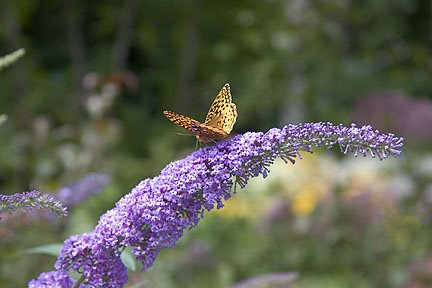 Our butterfly bushes will bloom soon and they're magnets for the butterflies. Here's a Great Spangled Fritillary butterfly on one of them.
We've written two books to help you attract and identify butterflies.Stokes Beginner's Guide To Butterflies, has an easy ID key to help you quickly identify the butterflies you see by size and shape.
 Stokes Butterfly Book gives you plans for a butterfly garden, lists and photos of butterfly plants, and chapters, with color photos, on the identification, behavior and caterpillars of common butterflies. Both are available at amazon.com and stores.
In the middle of the day, when birds become less active, a wonderful thing for birders to do is look for butterflies. Butterflies are colorful flying creatures, just like birds. The identification skills birders already have can be transferred to identifying butterflies. Look at butterflies through your binoculars, no need to catch them in a net.
The hot weather favors butterflies as they need to warm their bodies to fly. They need to get their body temperature up to 85 to 100 degrees Farenheit in order to fly well. Adult butterflies come to flowers for nectar, lay their eggs on special host plants, which can be unique to each species of butterfly. The eggs hatch, larva feed on the plant then turn into a pupa or crysalis from which the adult butterfly will emerge. A complete cycle or generation is called a brood, and butterfly species can go through from just one to as many as four broods per year, depending on the species and the number of warm months. Different butterflies are on the wing at different times during the summer, so you will continue to see new species.
There are about 17,000 species of butterflies in the world. In North America there are about 700 species but only a small fraction are common and likely to be seen by the average person.
When you see a butterfly watch it closely for several minutes. Observe how it flies, its size, shape, and the colors and patterns on its wings, both above and below.
Start by knowing the major families of butterflies that are distinctive. Below are some:
Swallowtails - are our largest butterflies and most have long tails coming off their hind wings.
Whites and Sulfurs - these are all medium-sized butterflies that are predominantly white or yellow.
Gossamer Wings - this group is easy to identify since it includes all of our smallest butterflies, such as the blues, coppers and hairstreaks, and metalmarks. The blues tend to be iridescent blue, coppers are often copper, hairstreaks often have hairlike tails on their hind wings, and metalmarks often have metallic spots on their wings.
Brush-footed Butterflies - this is a large and varied group of medium-sized, generally dark-colored butterflies with such strong and rapid flight they are hard to follow. Their is no one field characteristic, besides their flight, that makes them easy to identify as a group.
Satyrs - these are medium-sized butterflies that are almost all brown, often with darker eye-spots on their wings. They have a weak and bobbing flight and are often seen at woods edges or among grasses.
Skippers - are small butterflies whose flight is extremely rapid and erratic. They are mostly rich brown or orange-brown.
Enjoy the butterflies!
Tuesday, November 22, 2011
Turkey photo of the day plus funny bonus photo!
 Today's Wild Turkey photo by Lillian, is on page 68 of our new The Stokes Field Guide to the Birds of North America
Yup, Gryff - I think those are Turkeys outside!"
and when our field guide came out, we were sent this funny photo of 2 Vermont Corgis, Gryf and Rugby, who are ID-ing turkeys with their Stokes Field Guide.
Subscribe to:
Posts (Atom)