Search This Blog

Thursday, October 13, 2011

Sparrow ID help, take a deep breath

White-throated Sparrows, Zonotrichia albicollis, come in two morphs. One morph has brown head stripes, as here;

the other morph has black-and-white head stripes, as here. There is much individual variation. They all have white throats and are very common at many feeders in winter.

White-crowned Sparrows, Zonotrichia leucophrys, in their first winter have rufous brown head stripes

and no white throat.
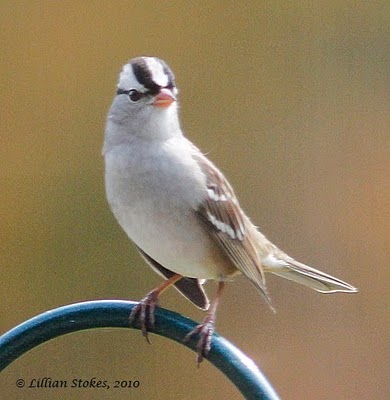
The dramatic adult White-crowned Sparrow has beautiful black head stripes and a white central crown stripe.

White-throated Sparrows are migrating and coming to bird feeders across much of the country now. Somewhat less common here in NH, White-crowned Sparrows are also migrating and coming to feeders. Both these species winter across much of the country and you may have them at your bird feeders all winter. We recently had first-winter White-crowned Sparrows at our feeder amongst the many, many White-throated Sparrows.

These sparrows love to feed on the ground on millet or seed mixes containing millet. We make a special sparrow feeder by building a big brush pile and sprinkling the seed in front and under the pile. It's a sparrow magnet and provides perching spots and cover from predators. The big bonus for us is that we get to see lots of fall sparrows.

If you live in the far western part of the country, you will get lovely Golden-crowned Sparrows visiting your bird feeders. They have a golden forecrown, surrounded on the front and sides by black or brown.

All these sparrow species are in the genus Zonotrichia. We discussed the characteristics of the sparrows in the Melospiza genus as stated in our new The Stokes Field Guide to the Birds of North America. In our guide, p. 656, we discuss the Zonotrichia genus and say these are "large deep-bellied, broad-necked sparrows with a fairly small conical bill, rounded crown and fairly long, slightly notched tail." In addition to White-throated, Golden and White-crowned Sparrows, the Zonotrichia genus includes Harris's Sparrows.

Tip: Look at these sparrows through your binoculars at your bird feeder and learn the characteristics of the shape of each genus. You will get better at ID-ing them and it will set you up to learn the sparrows in other genera.

Sparrow ID, Melospiza Sparrows

Lincoln's Sparrow, Melospiza lincolnii

Song Sparrow, Melospiza melodia

Swamp Sparrow, Melospiza georgiana

Swamp Sparrow, Melospiza georgiana

Sparrow ID can be challenging, to say the least. At the Dead Creek WMA in VT, we once saw this lovely Swamp Sparrow, hanging out appropriately, in a swampy area at the edge of the water. Birds are often habitat dependent and thus the Swamp Sparrow's name.

This is a subtly beautiful sparrow with a strongly marked face, russet wash along flanks and reddish-brown on crown, wings and tail.

Swamp Sparrows are in the genus Melospiza, along with Song and Lincoln's Sparrows. In our new The Stokes Field Guide to Birds of North America, in addition to individual thorough species accounts with multiple photos per species, we have colored boxes where we give helpful Identification Tips and an overview for many of the bird families. Look for these in our field guide.

For Sparrows, in the new Stokes guide p. 656, we say,

"Sparrows are small birds with short conical bills and varied-length tails. They are birds of primarily grasslands, fields, and open edges, where they feed mostly on seeds and some insects. Most are brownish with streaked backs, and they can look quite similar. Fortunately there are several large genera that have subtle but distinctive shapes. Becoming familiar with these shapes can help you place an individual sparrow into one of these groups, or genera; then you can look for plumage clues to complete your identification.

Species ID: There are 12 genera of sparrows in North America. Only 5 have 3 or more species, and these are the ones that are most useful to know to use in this generic approach.

* Melospiza: Medium-sized to large sparows with rather average proportions: they are slightly deep-bellied and have a medium-sized bill, rounded crown, and fairly long rounded tail. These sparrows are easily seen in brushy areas and marshes; when flused or curious they tend to fly up to higher perches for long periods and give short alarm calls. Some (Song Sparrow) come regularly to bird feeders. Includes Song, Lincoln's, and Swamp.


Wednesday, October 12, 2011

Red-bellied Woodpecker in fall

View From our Deck

We had this gorgeous male Red-bellied Woodpecker visit our feeder. This is not a common woodpecker species here in southwestern NH. We are at the upper end of it's breeding range, although it has occurred north of here in winter.

Keeping with the red theme, the Red Maple leaves are peaking now in their most vibrant fall colors. We walk around oooh-ing and aaah-ing.

Red Maples, lit like glowing embers, spill reflections on the pond we live on. It's peak leaf peeking, soon to be over. There's nothing like the fall colors in New England. Enjoy.

Friday, October 07, 2011

The Bird Year Movie 6 trailers & more

The Big Year is a comic movie directed by David Frankel, releasing nationwide Oct 14th, based, roughly, on the book of the same name, The Big Year by Mark Obmascik, about a competition called the Big Year, an informal birding competition to see which birder can see or hear the largest number of species of birds in a given area in one year. It stars 3 guys, (Steve Martin as Stu Preissler, Owen Wilson as Kenny Bostick, and Jack Black as Brad Harris), each undergoing his own personal crises — one a mid-life, one a late-life, and one a no-life crises. Stu and Brad team up to try and beat Kenny's North American record of 732 species. Advance word is that this is a funny movie, reason enough to go. We are eager to see it. The case is out, so far, how it portrays birding. If it gets more people interested in birds and birding, then great.
Here are the trailers, with a few explanations. for the non-avid birder.

The Big Year - Official Trailer


The original trailer pitches the movie to the largest possible audience, (not mentioning the word birding), as big adventure and a friendly competition between 3 guys. The "bird fallout" is a real thing and does occurs when a group (of sometimes very large numbers) of migrating birds are grounded due to weather conditions, such as strong north winds blowing on the Texas Coast so that northward migrating birds in spring, who have just crossed the Gulf of Mexico, are forced to land.

The Big Year- Stu and Brad Scare Kenny


Stu and Brad get Kenny worried that his record will be broken.
Evidently Kenny thinks his record is safe, but then has a wake-up call. In the book The Big Year, in 1998, three different birders, Sandy Komito, Al Levantin and Greg Miller (who is still an active birder see Greg's website here) chased Sandy's record of 721 birds but Sandy then set a new North American record of 745 birds.
Is anyone challenging that record today? Yes, at least one birder, named John Vanderpoel, who has a blog, is attempting a Big Year and as of Oct. 6th he has seen 726 species. There's still time to break the record. By the way, a Big Year area covered here means the American Birding Association area of the 49 Continental U.S. States including Alaska, and Canada and the French islands St. Pierre and Miquelon, plus adjacent waters to a distance of 200 miles from land or half the distance to a neighboring country, whichever is less. Excluded are Bermuda, the Bahamas, Hawaii, and Greenland.
Many people do their own Big Year. It can mean how many birds seen in one year in a single US state, or Canadian Province, or hey, make up your own idea, and see how many birds you can see in one year in your own back yard!

The Big Year - Stu's Advice


The Big Year, Sea Sick Stu


Kenny tries to get Stu seasick on an ocean birding trip. Lots of birders go on pelagic trips out into the ocean to see cool birds. Besides gulls, birders are particularly eager to see pelagic birds, such as Albatrosses, Shearwaters, Petrels, or Storm-Petrels. If you do go, here are some hints to prevent getting seasick, such as don't eat a big greasy breakfast of eggs, home fries, and lots of bacon. On pelagic birding trips they may "chum", or drop fish parts over the side, to lure in fish eating birds.

The Big Year - The Bridge


A Pink-footed Goose, a rare bird, has been spotted at the end of the narrow boardwalk. Kenny runs ahead of people, Stu and Brad wait and let the explorer scouts pass by them and miss the bird. Birders doing a big year must drop everything in an instant to race to a rare bird sighting. There is always the risk they will miss the bird. Birders well know the feeling of elation in seeing a rarity and the letdown of a miss.
In the birding world there is much discussion as to how birders should act, especially around a rare bird event. It is important to not stress or scare the bird, or behave badly towards other people, or break laws. The American Birding Association has a birders code of ethics, which every birder should know.
Birders will pick apart the accuracy of this movie in terms of the birds. Will the movie have the right species of bird in the right habitat? Probably not always. Greg Miller was a birding consultant to this movie, and often on the set, but ultimately, the producers and directors decide what they think makes a good movie, bird inaccuracies aside. Would a Pink-footed Goose (a species from Iceland and Greenland that sometimes appears in the northeast U.S. in winter), be found near a Calliope Hummingbird, a small hummingbird of the West? Unlikely.

The Big Year - Audubon Clip,


Go see the movie and let us know how you like it.

Monday, October 03, 2011

Lincoln's Sparrows are migrating!

Lincoln's Sparrow (Melospiza georgiana), note buffy cinnamon wash on breast. They can often have a breast dot, so do not confuse them with Song Sparrows. Lincoln's Sparrows are in the genus Melospiza, along with Song and Swamp Sparrows.

Lincoln's Sparrow

Sparrows are beginning to show up here in southern NH, with many White-throated Sparrows, as well as Lincoln's, Savannah, Field, Chipping and Song Sparrows being seen. Juncos have barely shown up yet.

Lincoln's Sparrows, an uncommon migrant here, are always a treat. I love their subtle colors (yeah, I know all sparrows, just about, have subtle colors, but humor me here), with that pale buffy cinnnamon wash on the breast. Ooooh. Saw some yesterday and today in our yard.

Lincoln's Sparrows breed north of us, in boglike areas and shrubby streamsides, across much of Canada, into Alaska, and down into mountains of the West. They winter on the West Coast and much of the lower quarter of the U.S. You can see them in many places in the U.S. during their migration. Get those binos out and start looking!

Friday, September 30, 2011

Warblers on the Move


Black-throated Green Warbler

Northern Parula

Yellow-rumped Warbler. The yellow rump is not always showing. This is one of the most abundant migrating warblers, learn it well.

Warblers are coming through here in southern NH. In the last week we have seen
Northern Parula, Nashville, Yellow-rumped, Magnolia, Black-throated Green, and Orange-crowned Warblers and lots of Common Yellowthroats.

Get your binos out, look in your yard, parks, woods, just about anywhere now for these jewels. For ID help use our The Stokes Field Guide to the Birds of North America for the most complete photos and info., or, Stokes Field Guide to Warblers if you are an intermediate or beginner.


Tuesday, September 27, 2011

Cute Corgis & Bubbles Congrats

Bubbles, (Ch. Llandian's Champagne On Ice)

We own 2 Pembroke Welsh Corgis, Phoebe and Abby, and we adore them. Abby's sister is the famous Bubbles who, recently, was runner up to the Best of Breed winner at the Pembroke Welsh Corgi Club of America National Specialty show, quite an honor. Congratulations to Bubbles and all the other winners at the show.

Bubbles has also recently won several regional Corgi specialty dog shows. She is only 3 years old and has a long show career ahead of her. I love taking photos of Corgis, as well as birds. Bubbles is so photogenic and embodies Corgi beauty.

Here is Bubbles and her sister Pearl as puppies. Pearl is also a show dog and almost has her championship.

Phoebe is showing puppy Bubbles all about pumpkins.

Our Corgis, Phoebe (the lawyer), left, and Abby (the party planner), right. Phoebe is cousin to Bubbles and Abby. Abby is litter sister to Bubbles and Pearl. We were fortunate to get these beautiful Corgis, who have great temperaments, from Dianne Connolly's Llandian kennel. Tip: if you want a Corgi get one from a reputable breeder from the PWCCA.

We got Abby at 10 weeks of age and she has always looked up to Phoebe as top dog and her mentor.


"Down", "Stay", Good Dogs!


Monday, September 26, 2011

Hummingbirds Are Migrating, Bye Bye

Ruby-throated Hummingbird at Nasturtium flower

Hummingbirds are migrating and many Ruby-throated Hummingbirds have left New England and are on their way south and out of the U.S. Many western hummingbirds are also migrating and will leave the country for the winter. I took this photo of a Ruby-throated Hummingbird recently in my veggie garden, sipping a nasturtium. It was magic. The hummingbird was lit in the early morning sun. Not an easy shot to get, as it was flying freely, and only hovering for seconds at the flowers. What I like about this is that it captures a wild moment in natural light. Most hummingbirds have left NH, where we live, by now. We will miss them.

We will miss on of the favorite ways we get to be with hummingbirds, and that is watching them come to our hummingbird feeders which we place within 10 feet of our chairs on the deck. We can hear the buzz of the wings and see their throats move as they lick up the nectar at about 13 licks per second. For us, hummingbirds are one of the great joys of the summer. Plant late blooming flowers, such as nasturtiums and Salvia "Lady in Red" and keep up feeders until hard frost for migrating hummingbirds.

Thursday, September 22, 2011

Curlew Sandpiper in NH, Yes!

Curlew Sandpiper

Curlew Sandpiper, front view

Chasing a rare bird is always an adventure. You never know if when you get there, the bird will be gone. The worst scenario is when you arrive and a bunch of assembled birders, who have just seen the bird, greet you with "you just missed it."
So we were lucky when we went to the NH coast a few days ago, to find the rare Curlew Sandpiper, the bird was just where it was supposed to be. We had wonderful views and I got photos.
There are only 5 previous records for this bird in NH. There is an excellent account of this bird, with 5 photos, including one in flight, in our new The Stokes Field Guide to the Birds of North America, the most complete photo guide ever published. Quote:

Curlew Sandpiper
Calidris ferruginea L 8 1/2"

Rare Asian vagrant to the East and West Coasts; casual inland.
"Shape: Like Dunlin but with slightly longer legs and neck and a finer-tipped more evenly downcurved bill. Wing tips extend beyond tail tip; primary projection past tertials about as long as lore (Dunlin's wing tips fall short of tail tip, primary projection shorter than lore.) Ad. Summer: M. dark brick-red head, neck and underparts except for white undertail coverts with dark spots; white eye-ring. F. finely mottled black and white with traces of reddish brown on face, scapulars, and belly; whitish eyebrow. Dark legs. Ad. Winter: Unmarked gray above. Head, sides of breast, and neck finely streaked with gray and white; central breast usually clear; prominent whitish eyebrow (indistinct in similar Dunlin) contrasts with dark crown. Dark legs. Similar Stilt Sandpiper has longer and yellowish legs. Juv: (Jul. - Nov.) Upperparts grayish brown with fine buff margins to feathers, creating scaled appearance. Breast with buffy wash and some darker fine streaking along sides. Dark legs. Similar Stilt Sandpiper has longer and yellowish legs. Flight: Bold white wing-stripe; white rump, gray tail. Toes project just past tail. Hab. Wet tundra in summer, mudflats, beaches, shorelines in winter. Voice: Rapid burst of ch'd'deet ch'd'deet given on breeding grounds.
Subspp: Monotypic. Hybrids: Sharp-tailed Sandpiper (hybrid called "Cooper's Sandpiper"), Pectoral Sandpiper (hybrid called "Cox'x Sandpiper").

We have more information in our new guide and we're proud of it. A birder needs extensive information when a bird like this shows up in his/her area to aid in ID. Will you be ready to ID the Curlew Sandpiper?

Tuesday, September 20, 2011

5,290 Hawks, Pack Monadnock, NH

Hawk watchers l. to r., Henry (official counter), Tom, Katrina, Don, Lillian, Rod, David, Lily, Janet. In front, Ken, Francie

On Sunday, 9/18/11 we, and many others, were at Pack Monadnock Raptor Migration Observatory, run by NH Audubon, to witness their historic, record-setting, hawk migration flight. We had 5,290 raptors migrate over our heads, almost all of them Broad-winged Hawks. This made the season's total of migrating hawks, so far, to over 10,000 raptors, thus hence the sign and happy faces. It was awesome!

Broad-winged Hawk, adult. Thousands glided by overhead.

Broad-winged Hawks migrate in groups, riding thermals of warm air, then gliding to the next thermal, as a way of conserving energy on their long journey to their wintering areas in Central and South America.

A rising group of Broadwings is called a "kettle". One of the kettles we saw contained over 1,000 hawks.

The hawks peel off at the top of the kettle and ride to the next one. At one point we all stood in awed silence as many hundreds glided right over our heads, just filling the sky. It was such a powerful and emotional sight, of all those hawks, driven by instinct, going together on their perilous migration journey.

We have been watching migrating hawks each fall for over 30 years. It's a wonderful addiction, which, as someone on the mountain said, "there is no cure".

Thursday, September 15, 2011

Common Yellowthroat peek-a-boo


Popping up, in the fall foliage,

a Common Yellowthroat looked around, then dove down, while the

"Karma Corona" Dahlia approved.

One of the fall migrants in our garden recently was this Common Yellowthroat, f. , peeping from behind the fall foliage, a usual move from this skulky, don't-let-the-photographer-get-a-full-body-photo little warbler. Get to know this bird well. It's a common migrant. Note the pale eye-ring, brownish cheeks contrasting sharply with the yellowish throat, buffy yellow breast. Not visible is the yellow undertail coverts. A 1st winter male would begin to show a little black on the face, the beginning of what will become his raccoon mask as an adult. Common Yellowthroat adult males are bright yellow with a raccoon-like mask. This warbler breeds across much of North America in dense, brushy areas often near water.

Warblers and hawks are migrating big time now.

Monday, September 12, 2011

Prime Time for Hawk MIgration Now

Hawk migration is happening now
Broad-winged Hawk, adult. Has thick, black-and-white tail bands.

The hawks are coming! The hawks are coming! We're entering prime hawk migration time for birders in the northern and eastern half of the U.S. Some hawks, such as Sharp-shinned and Cooper's Hawks, Merlins and American Kestrels, will move by flapping, but Broad-winged Hawks, an abundant migrant, travel by using rising thermals. Weather conditions of clear and sunny, with mild north or northwest winds, should produce ideal conditions for Broad-winged Hawk migration. Most of the northeast hawk-watch sites will seen many Broad-winged Hawks this fall. There are still many more hawks to migrate out of New England, so plan on looking.

Here are some tips for watching hawks:

1. Prime Broad-winged Hawk migration in the North is Sept. 11 to 25, in the South (TX) it is Sept. 25th to Oct. 10.

2. Prime Sharp-shinned Hawk migration in the Northeast is Sept. 1 to Oct. 10, in the Mid-Atlantic States it is Sept. 10 to Oct. 20, in the West it is Sept. 11 to Oct. 31.

3. Hawks usually move most under sunny skies with mild northwest, north or northeast winds. Broad-winged Hawks require thermals to move.

4. Go hawk-watching at one of the many "official" hawk-watch sites here. Or find your own by going to a hill, mountain, or tall structure available to you that has good views to the north, because that is the direction the hawks are coming from.

5. Bring binoculars that are at 8 power, or even 10 power if you have them. Scan slowly back and forth across the sky at different heights to find the hawks. Most hawks will be fairly far away and some may look like specs. Learn hawk shapes at a distance to identify them.

6. Here's a brief look at the most common hawks you will see:

Broad-winged Hawk, adult

Broad-winged Hawk, juvenile

* Broad-winged Hawks. These are medium-sized hawks, 16" long, with broad wings, and soar together in groups. Look for the broad black-and-white tail bands seen on the adults, usually visible even at a distance. Juvenile Broad-winged Hawks have thin tail bands and dark streaking that is usually heaviest on the sides of the breast.


* Sharp-shinned Hawks. These are small, about Blue Jay-sized, 12" long, hawks in the accipiter group. They migrate mostly singly with flap-flap-flap glide flight and have short rounded wings and a somewhat long tail that has a squared end.


* Cooper's Hawks. These are extremely similar to Sharp-shinned Hawks, and are a tricky ID challenge, but are somewhat larger, 17" long, with a longer, rounded tail and larger, longer head and similar flight pattern.

* American Kestrels. These are a type of falcon. They are smaller than a Sharp-shinned Hawk, about 10 1/2" long, with pointed wings and a long tail and fly mainly with continuous flapping.

* Merlins. Very similar to a Kestrel but darker and larger, about 12" long. Has broad, pointed wings and a somewhat shorter tail than a Kestrel. Flies swiftly and strongly. See yesterday's blog entry for details on Merlin vs. Kestrel ID.

* Turkey Vultures. Very large, about 27" long, all black birds that constantly soar with their wings held in a V.

7. Keep track of your numbers and turn them in to your local bird or hawk-watching organization.

8. For more complete information on identifying hawks see our all new national photographic guide, The Stokes Field Guide to the Birds of North America. It has 3,400 images and is the most complete photo guide available.


Friday, September 09, 2011

Learn to ID Juvenile Hawks in Flight

Juvenile Hawks in Flight

Broad-winged Hawk, juvenile

It ain't easy to ID juvenile hawks. It ain't always easy to indentify adult hawks either, but that's another story. We had posted a photo of a juvenile Broad-winged Hawk in flight and one of our blog readers asked if it wasn't really a Red-tailed Hawk juvenile. So that prompted this post.
Here are some of my photos of juvenile Broad-winged, Red-tailed and Red-shouldered Hawks and their differences.

The juvenile Broad-winged Hawk is variable. The above bird is lightly streaked on the flanks and belly. It has a has a thin center stripe on the center of the throat (in some cases the throat can be all white). The underwings have narrow dark bars on the primaries and secondaries, dark tips to the primaries and a hint of a dark trailing edge to the wings. The tail has numerous dark bands, which may be narrow, or thicker, with a dark band at the tip.

Broad-winged Hawk, juvenile

This is a darker individual with more heavy barring on the underparts. You can see rectangular pale panels on the underside of the wings, more visible when the bird is backlit, as here.

Red-tailed Hawk, juvenile, "Eastern"

Here's a Red-tailed Hawk, juvenile. Note the dark mark, called the patagial bar on the leading edge of the wings, a great ID clue. The throat can be white or, on more heavily marked birds, have narrow streaks. There are scattered dark marks on the undering coverts, sometimes looking like a comma. There's a white unmarked breast. The dark belly streaks form a "belly band," another great ID clue. There are numerous, dark, thin tail bands and there may or may not be a wider band at the tip.

Red-tailed Hawk, juvenile

Here's another view of the same bird. You can see the belly band, and dark patagial mark on the leading edge of the wings. Juvenile Red-tails have a large pale panel on the outer edge of the upperwing, seen from above.

Red-shouldered Hawk, juvenile

One of the distinguishing marks is the pale, tawny, crescent-shaped mark on the outer edge of the top of the wing, showing clearly in the above photo. This can also look like a translucent crescent when viewed from below and backlit. This is very different from the rectangular panel on the wings of the juvenile Broad-winged Hawk, or the rectangular panel on the Red-tailed Hawk seen on the top of the wing.

Red-shouldered Hawk, juvenile

The wing crescent is slightly visible on the underwing in the above photo. The breast, belly and flanks have dark marks. Throats can be white with a middle streak, or have more streaks, or all dark with a white edge.

As we said, it ain't easy, but looking closely at birds and photos helps you see new things and prepares you better for the next time you're birding and encounter these birds.

For further, more detailed information about hawks see our new field guide, The Stokes Field Guide to the Birds of North America.


Photos of Broad-winged Hawk and Red-tailed Hawk taken in the Northeast in Sept. Red-shouldered Hawk photographed in Florida in Jan.