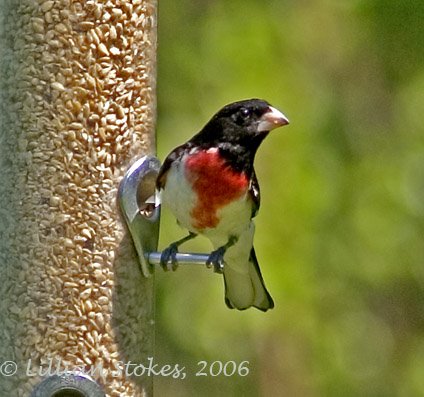
 Today a Rose-breasted Grosbeak, male, at the feeder. We were with friends who had never seen one, so a life bird for them.
Monday, May 29, 2006
Rose-breasted Grosbeak
Today a Rose-breasted Grosbeak, male, at the feeder. We were with friends who had never seen one, so a life bird for them.


Fishing Tale

Fishing guy to friends after he gets home....."You should 've seen what I got, a big one... it must have been over 1000 lbs."
This is a sight we witnessed with some good friends who were visiting yesterday. A Moose swam out across the cove in front of Bobolink Farm and swam right near a fishing boat, probably much to the amazement of the fisherman. Our friends don't get to see Moose much, so this was quite a treat for all of us. We were watching through binoculars and a scope.
If you look closely you can see small spikes of antlers on the Moose, making this a bull Moose. Antler growth starts in spring and continues through summer. For older bulls, it is completed by August and September. Moose mate in fall. Antlers are shed from December through March. There is no way to know the age of the moose by counting the points on the antlers. You can tell the age of a Moose by the diameter at the base of the antler which gets larger each year. Bull Moose calves have only short spikes their first fall. Yearling and 2-year-old bulls can have either simple spikes or branched antlers.
As we keep saying, you never know what surprises are going to happen at Bobolink Farm.
Photo © Lillian Stokes, 2006
Saturday, May 27, 2006
Catbird seat
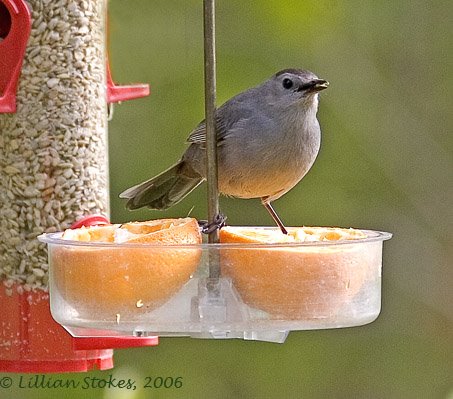
 We have a pair of Gray Catbirds that come to the feeder and eat the oranges we have put out for the Orioles. Of course, the Orioles are ignoring the oranges. The Catbird pair stays close to one another and when one is on the oranges, the other waits nearby in the bushes. Catbirds love to nest in shrubby edges, which we have lots of. Wonder if they will bring their young to the fruit once then have fledged.
All photos © Lillian Stokes, 2006
Friday, May 26, 2006
Bobolink Flying
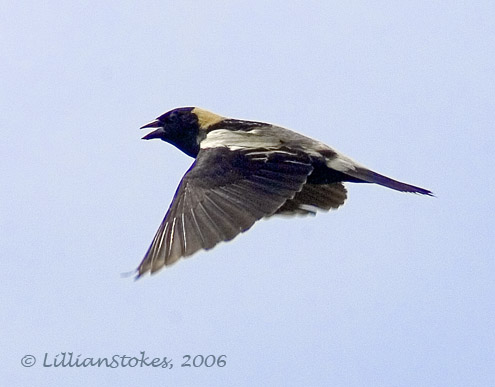 Today I photographed this male Bobolink doing a display flight over our hayfield.
Photo © Lillian Stokes, 2006
Thursday, May 25, 2006
Eggs-actly right
 Here is an eggshell I found on the ground today, not far from our Eastern Phoebe's nest. It is possible that this is the eggshell from a newly hatched Phoebe chick (they have white eggs) and the parents removed the shell from the nest. There is a chip out of one side and that
may be where the parent's bill carried it. It was lying on the dirt, hence the black flecks in the shell. I put it on a blue plate to photograph it.
You can tell by looking at it, that it came from a successfully hatched young and was not an egg gotten by a predator. Eggs that have come to harm, if there is anything left, are usually irregularly broken, smashed in, or are in pieces.
This eggshell is cracked evenly around the large end of the egg. When a baby bird is in the egg, just before it will emerge, it begins to "pip", or crack the egg. The chick has an "egg tooth" on its bill (lost soon after it is born), a specialized little tooth with which it begins to peck at the shell from inside in order to get out of the shell. It also has a hatching muscle on the back of its head that gives it the thrusting power to break through the egg. The chicks head is in the large end of the egg and gradually the chick turns in the egg and, using the egg tooth, cracks the egg evenly all around. Then the blunt end falls away and the baby bird emerges from the egg.
So this shell is evidence that this chick emerged exactly right.
Photo © Lillian Stokes, 2006
Wednesday, May 24, 2006
Night Images, May 24
Images from the end of the day.
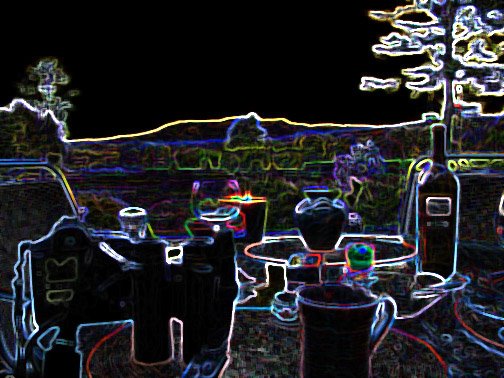 Dinner at dusk on the deck overlooking the mountain. Photo was put through Adobe Photoshop CS, filter, artistic, stylize, glowing edges.
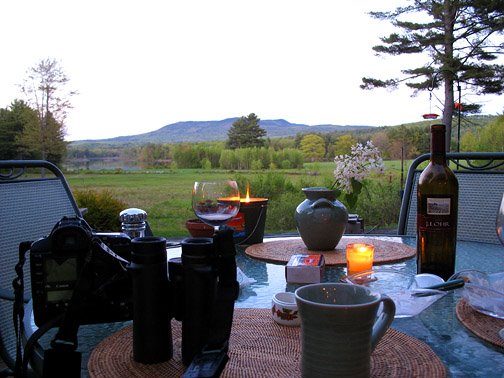 Same image; after dinner photo taken at 7:20 pm with Canon Powershot A 610, no flash
 3 Black ducks digiscoped far away on the pond, leave a silver wake, cutting across the luminous reflection of the spring foliage.
 7:25 pm image of our Yellow Ladies Slipper, no flash. We originally got this Yellow Ladies Slipper from the New England Wildflower Society, more than 10 years ago, and moved it with us to Bobolink Farm. It has 11 blossoms.
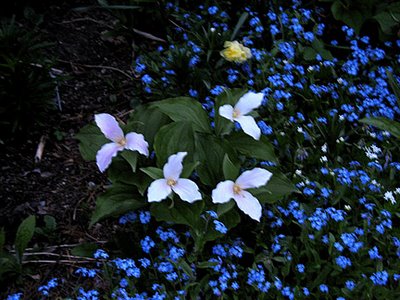 Our White Trillium looks luminous at dusk
All photos © Lillian Stokes, 2006
Monday, May 22, 2006
Gorgeous gorgets
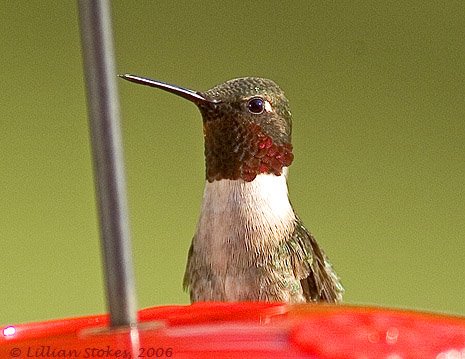 Hummingbirds have amazing colors on their beautiful throats. The throat area is called the gorget. Interestingly, the feathers on the gorget are specialized and only the outer third of each feather is iridescent. This part of the feather contains layers of minute structures called platelets that are filled with tiny air bubbles. These structures partially reflect back light, causing the brilliant shining colors of reds, purples and blues seen on hummingbirds. The iridescent parts of the feathers of the gorget are flat, and so reflect light in just one direction. So for you to see the full iridescent color of the gorget, the sun must be striking the feathers head on. If not, the feathers will look dusky or even black.
You can see this on this male Ruby-throated Hummingbird at our feeder, who had his head turned away from the sun. The feathers on the side of his gorget have more of the sun reflecting off them and look ruby; the feathers on the front of his gorget look dusky or even black.
When male hummimngbirds display to female hummingbirds, they face the sun, which reflects the full beautiful color of their gorgets. We saw this male yesterday displaying to a female and flying back and forth in front of her in a deep arc flight path, his brilliant red gorget gleaming. We're sure she was impressed!
Photo © Lillian Stokes, 2006
Sunday, May 21, 2006
Pot Of Gold
 Rainbow after the thunderstorm today at Bobolink Farm, our pot of gold.
Photo © Lillian Stokes, 2006
Saturday, May 20, 2006
Flamingoed!
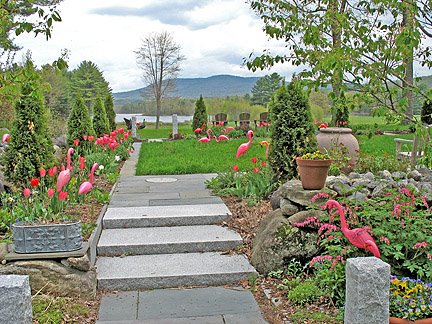
We came back from our trip to see that we had been overrun by an exotic species — we'd been flamingoed! Actually our good friends played a joke on us. The flamingos were everywhere and matched our pink tulips.
 They were drinking out of our bird bath
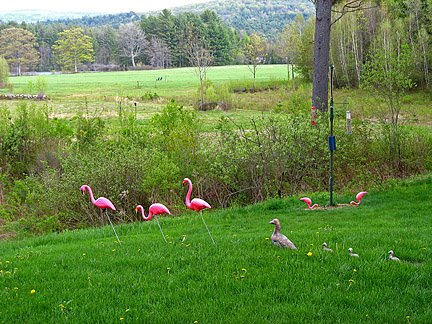 and eating at our bird feeder
 and cavorting in the shrubbery.
These are obviously not real flamingos. To see real flamingos you either have to go to a zoo or animal park. Sometimes, you might see an escapee from these places. If you want to see wild Greater Flamingos, you need to go to Everglades National Park in Florida where occasionally, wild birds from the Bahamas fly by.
As to the domestic flamingo flock that visited us — who knows where they will turn up next.
Friday, May 19, 2006
Kirtland's Warbler, endangered species
 Kirtlands' Warbler
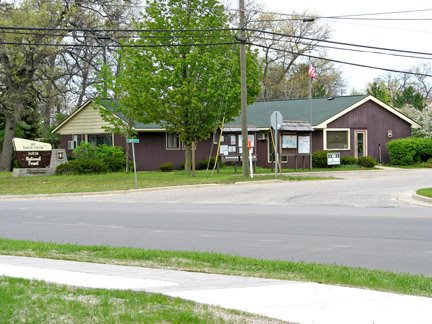 Mio Ranger Station, Kirtland's Warber tour starts here
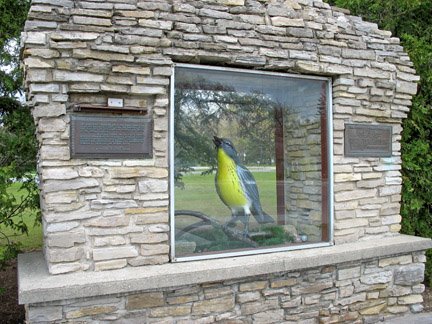 Monument to Kirtland's Warbler in Mio, MI
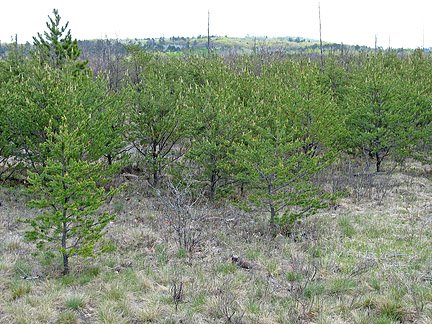 Ideal Kirtland's Warbler habitat of small Jack Pines
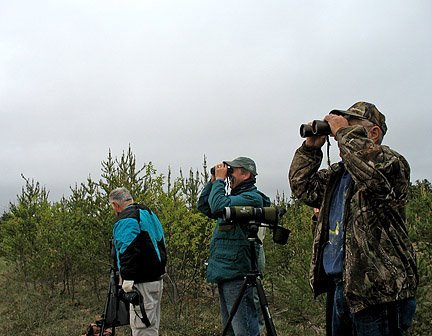 Don spots the first Kirtland's Warbler
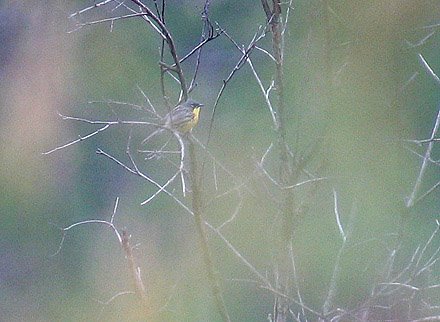 The 1st Kirtland's was so far away
 Listening for Kirtland's
 Nesting areas are closed to public to protect the birds
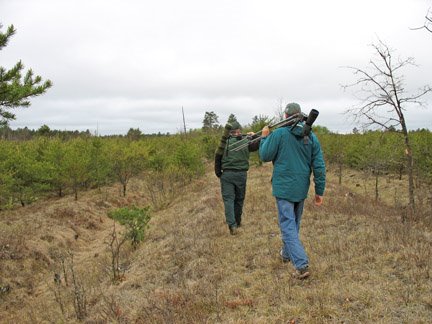 Don walking though prime Kirtland's habitat with ranger
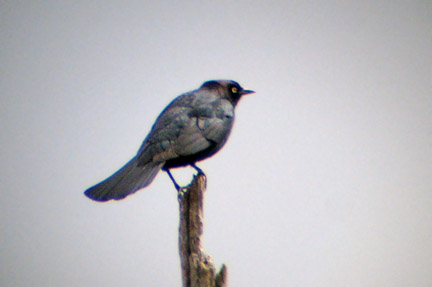 Brewer's Blackbirds are also found in this habitat
 and so are amazing Upland Sandpipers
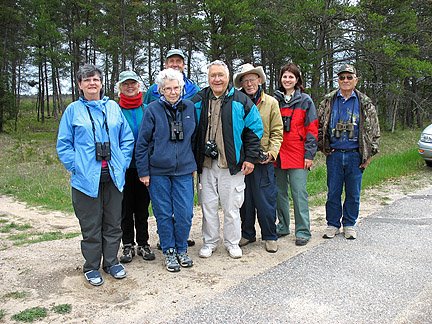 We were the first Kirtland's Warbler tour group of 2006!
After our stop at Magee Marsh, Ohio, we went to Mio, Michigan, located in the upper part of Michigan's lower peninsula, to see the Kirtland's Warbler. Now this is not just any old warbler, this is one of the rarest songbirds in North America. Last year they counted only 1,417 singing males. This is a federally endangered species that nests in just a few places in Michigan's lower and upper peninsula, a little in Wisconsin and Ontario, and nowhere else.
The reason this bird is endangered, is that it requires a very particular habitat of young Jack Pine trees between about 5 and 20 feet tall, and prefers stands of trees that are at least 80 acres or up to 1000 acres. They nest on the ground under the lower branches of the pines. Picky, picky, that's why you wind up as an endangered species. Seriously though, one of the reasons birds become endangered is that they require highly specialized habitats. When those habitats go, due to development or other reasons, the birds do also. Habitat generalists such as say, House Sparrows, have little reason to fear becoming endangered, at least for now.
Jack Pine trees require fire to open their cones and release their seeds. In modern times with greater prevention of forest fires, Jack Pines declined and so did Kirtland's Warblers. There is now a huge federal management program to ensure the continuance of this very special habitat. The Jack Pine stands are managed by seeding, replanting and burning. In addition, Brown-headed Cowbirds, who lay their eggs in Kirtland's Warblers nests and reduce the number of Kirtland's offspring produced, are trapped and removed from the region.
To see the Kirtland's Warblers you need to take a tour offered by the U.S. Forest Service, Mio Ranger Station, Mio Michigan. (There are also tours offered by the U. S. Fish and Wildlife Service out of Grayling, MI.) Show up at the Mio Ranger Station at 7:00 am on your appointed day. We were there the first day they began to lead tours, May 15th. Tours run through July 2nd.
Our group was lead to suitable habitat by leader Phil Huber. We stopped by the roadside and heard a Kirtland's singing down the road behind us. We walked there but could not see it. Phil said to wait awhile, sometimes they pop up and sing from the dead trees sticking above the Jack Pines. Don stood on a little rise and finally spotted our first bird, Hooray! What a beautiful little bird. It was far, more than 200 feet, and obscured by leaves but we viewed it through Phil's scope (and I digiscoped it through the scope). Phil then admitted we were lucky to see it, since this was the first day of the tours and many of the warblers had not yet returned. For the best chance of seeing the warblers you should go between May 20th and June 20th.
We then went to a second area that looked promising and heard 3 more Kirtland's. One of those gave us a better look than the first one (see top photo) but it was still more than 100 feet away. In the area we also heard lots of Nashville Warblers, who also like that habitat. At our final stop we all listened from the road but did not hear anything. We walked in a path and came to an area where the trees were quite low and were treated to a look at an Upland Sandpiper, a very cool shorebird with an unusual call. It was more than 300 feet away viewed through a scope. A Brewer's Blackbird also popped up on a dead snag.
Kirtlands Warbler Festival is held tomorrow on May 20th. Try and go, if not then, then soon, to see this amazing and beautiful warbler, a real survivor.
The photos of birds were digiscoped (I held the Canon powershot camera up to the scope) breaking all the rules for digiscoping which are:
- Digiscope in sunny conditions
- You should be no more that 50 - 75 feet away from small birds, 100 - 150 feet from large birds.
But hey, at least I got some photos.
Lillian's rule:
Be sure and break the rules sometimes.
Wednesday, May 17, 2006
Ottawa NWR, Magee Marsh
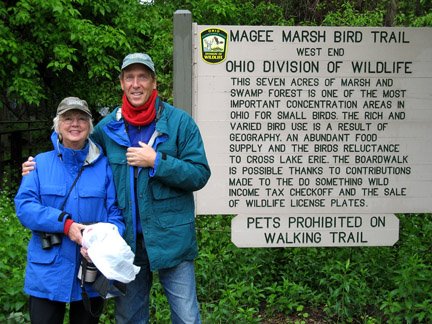
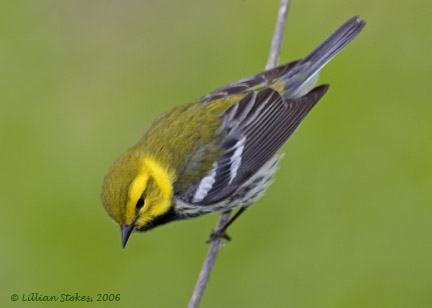 Black-throated Green Warbler
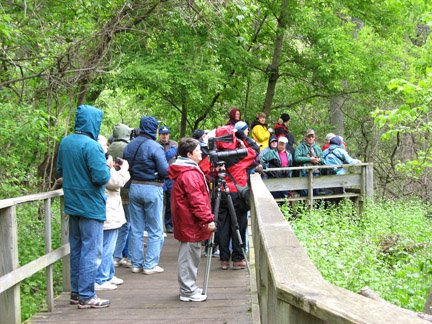 Boardwalk at Magee Marsh Wildlife Area
 Daisy, our dog, begging for potato chips during lunch in the parking lot.
 At Ottawa, NWR
 Signing binoculars
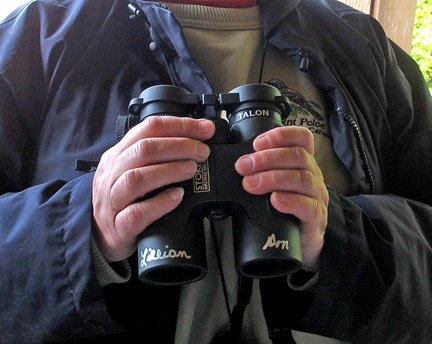 Customer with signed "Stokes Birding Series" Talon binoculars
Magee has a boardwalk through a small woods, right next to the lake. So the migrating warblers and other birds stop in this small woods to rest and because they are hesitant to cross the lake, especially in bad weather. So bad weather for birds, might mean good birding for birders. There were crowds of birders and standing room only for the warbler show.
On May 13th we did a book signing at Ottawa National Wildlife Refuge and introduced people to our line of Stokes Birding Series binoculars. By customer request, we even signed some people's binoculars!
Monday, May 15, 2006
Crown Jewels
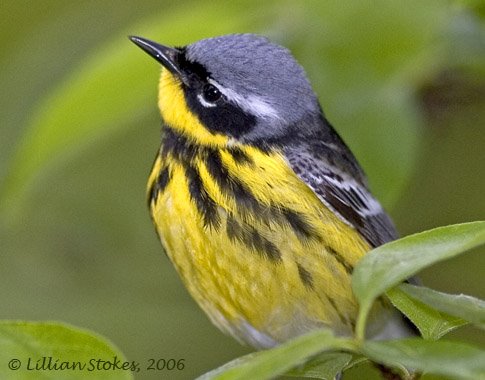 Magnolia Warbler
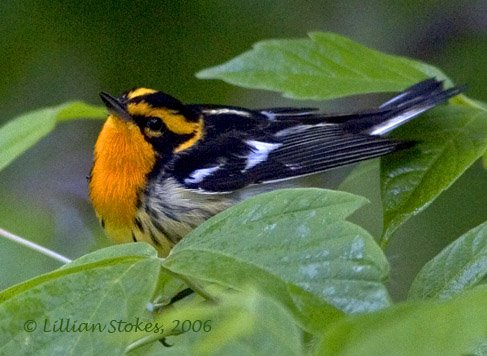 Blackburnian Warbler
 Golden-winged Warbler
 Cape May Warbler
 Black-and-white Warbler
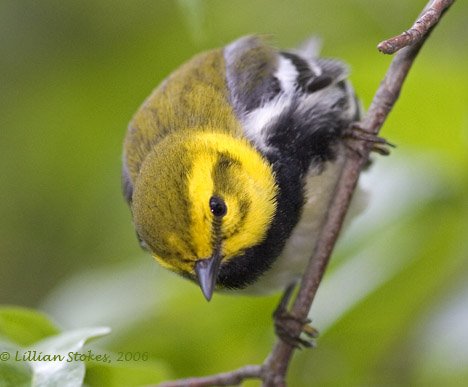 Black-throated Green Warbler
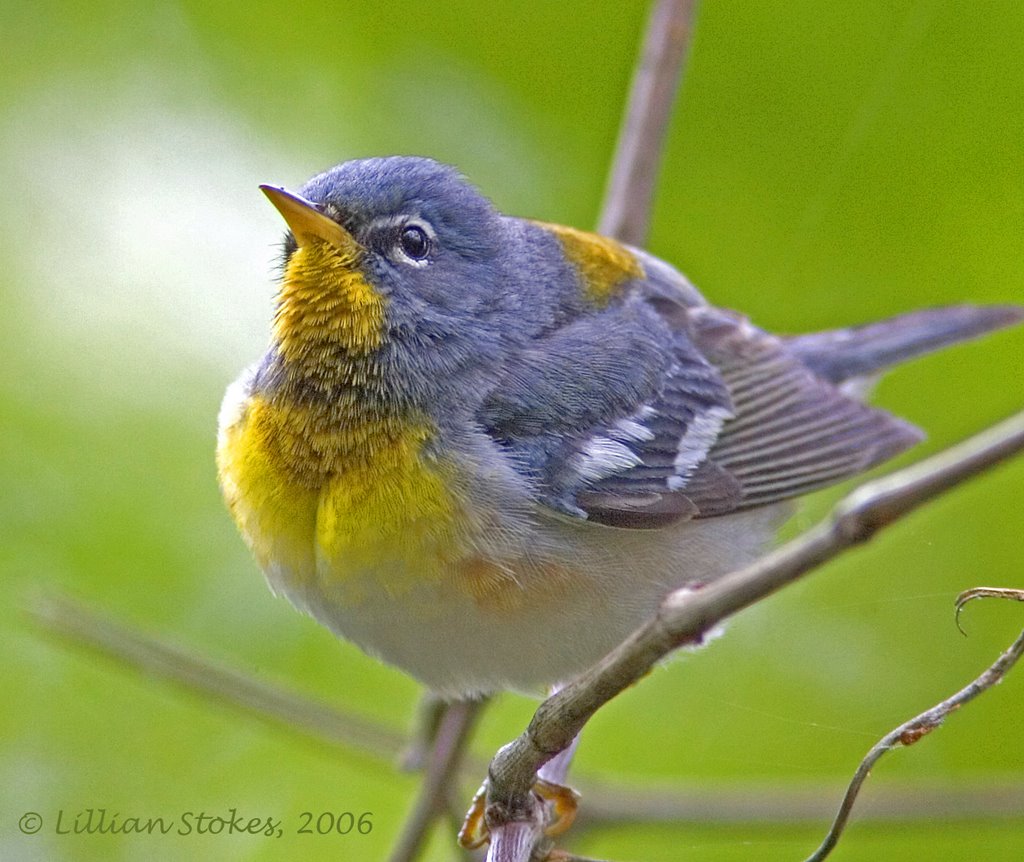 Northern Parula
 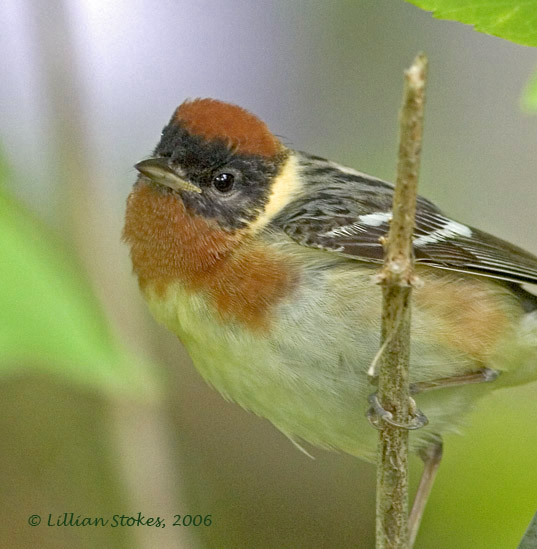 Bay-breasted Warbler
 Nashville Warbler
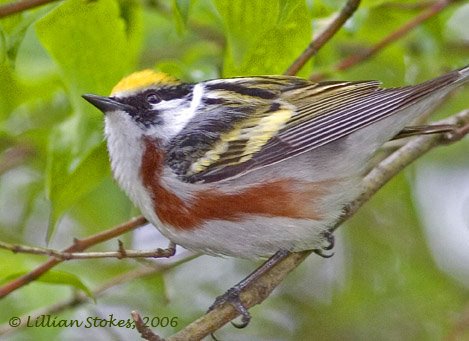 Chestnut-sided Warbler
 Black-throated Blue Warbler
Warblers are the crown jewels of the avian world. They are some of the most exquisitely colored of all the birds. We were lucky to see so many (over 24 species of warblers) on our recent trip to Magee Marsh Wildlife Area/Crane Creek State Park and Ottawa NWR . Here are some of Lillian's photos. Since it was cold, rainy and windy, many of the warblers were down low in the trees which made for great photo ops. Not so good for the warblers, who were searching for insects, made inactive by the weather.
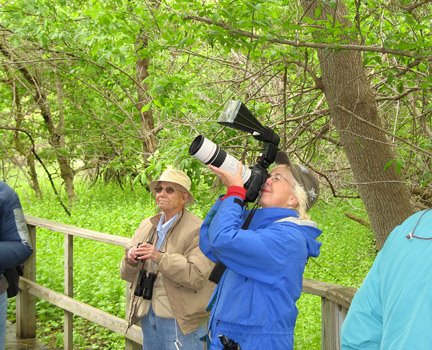 The challenge of the photography was the low light conditions. I used my Canon 1D Mark II camera set on higher ISO's, up to 800 ISO sometimes. I had a Canon 300 mm IS (image stabilized) lens and used fill flash set on -2/3. Photos were cropped in Photoshop CS.
What I like is the intimate quality of images, showing real birds, not in "field guide" portrait poses, as they went about their serious business of foraging for food, the fuel to take them to their breeding grounds. Hope they arrive in good condition.
All warbler photos © Lillian Stokes, 2006
Saturday, May 13, 2006
Warblers! May 13
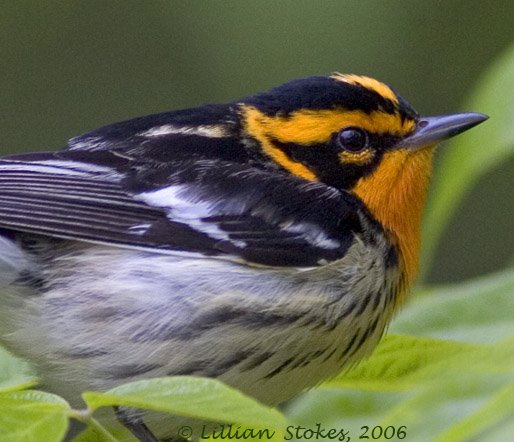
 Hi there, today we have been at Ottawa, NWR, and Magee Marsh Wildlfe Area/Crane Creek State Park, in Ohio. These are some of the best birding hotspots in the eastern part of the country at this time of year, especially for migrating warblers. The birding has been fabulous! The warblers are everywhere, many low in the trees. The weather has been cold and rainy, making photography challenging. Here is a preview of a few photos of Blackburnian Warblers, one of Lillian's favorite warblers. When we get back in a few days, we will have lots more photos for you, so stay tuned.
All photos © Lillian Stokes, 2006
Subscribe to:
Posts (Atom)