Search This Blog

Wednesday, October 30, 2013

23 Red-shouldered Hawks, yes!

Red-shouldered Hawk, adult


What do you get if you go hawk watching at this time of year? If conditions are favorable, then you get Red-shouldered Hawk migration!
Yesterday we saw 23 Red-shouldered Hawks going over Pack Monadnock Raptor Migration Observatory in Peterborough, NH. Great Fun!

Thursday, October 17, 2013

Sparrow ID Help Is On The Way! Here's How To ID Them At Your Feeders


White-throated Sparrows, Zonotrichia albicollis, come in two morphs. One morph has brown head stripes, as here;

the other morph has black-and-white head stripes, as here. There is much individual variation. They all have white throats and are very common at many feeders in winter.

White-crowned Sparrows, Zonotrichia leucophrys, in their first winter have rufous brown head stripes

and no white throat.

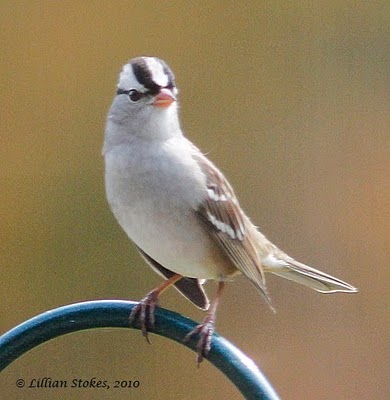
The dramatic adult White-crowned Sparrow has beautiful black head stripes and a white central crown stripe.

Sparrows are migrating big time. White-throated Sparrows are coming to bird feeders across much of the country now. Somewhat less common here in NH, White-crowned Sparrows are also migrating and coming to feeders. Both these species winter across much of the country and you may have them at your bird feeders all winter. We recently had first-winter White-crowned Sparrows at our feeder amongst the many, many White-throated Sparrows.

These sparrows love to feed on the ground on millet or seed mixes containing millet. We make a special sparrow feeder by building a big brush pile and sprinkling the seed in front and under the pile. It's a sparrow magnet and provides perching spots and cover from predators. The big bonus for us is that we get to see lots of fall sparrows.

If you live in the far western part of the country, you will get lovely Golden-crowned Sparrows visiting your bird feeders. They have a golden forecrown, surrounded on the front and sides by black or brown.

All these sparrow species are in the genus Zonotrichia. We discussed the characteristics of the sparrows in the Melospiza genus as stated in our new The Stokes Field Guide to the Birds of North America, the most complete photographic guide available. In our guide, p. 656, we discuss the Zonotrichia genus and say these are "large deep-bellied, broad-necked sparrows with a fairly small conical bill, rounded crown and fairly long, slightly notched tail." In addition to White-throated, Golden and White-crowned Sparrows, the Zonotrichia genus includes Harris's Sparrows.

Tip: Look at these sparrows through your binoculars at your bird feeder and learn the characteristics of the shape of each genus. You will get better at ID-ing them and it will set you up to learn the sparrows in other genera.

Sparrow ID, Melospiza Sparrows

Lincoln's Sparrow, Melospiza lincolnii

Song Sparrow, Melospiza melodia

Swamp Sparrow, Melospiza georgiana

Swamp Sparrow, Melospiza georgiana

Sparrow ID can be challenging, to say the least. At the Dead Creek WMA in VT, we once saw this lovely Swamp Sparrow, hanging out appropriately, in a swampy area at the edge of the water. Birds are often habitat dependent and thus the Swamp Sparrow's name.

This is a subtly beautiful sparrow with a strongly marked face, russet wash along flanks and reddish-brown on crown, wings and tail.

Swamp Sparrows are in the genus Melospiza, along with Song and Lincoln's Sparrows. In our new The Stokes Field Guide to Birds of North America, in addition to individual thorough species accounts with multiple photos per species, we have colored boxes where we give helpful Identification Tips and an overview for many of the bird families. Look for these in our field guide.

For Sparrows, in the new Stokes guide p. 656, we say,

"Sparrows are small birds with short conical bills and varied-length tails. They are birds of primarily grasslands, fields, and open edges, where they feed mostly on seeds and some insects. Most are brownish with streaked backs, and they can look quite similar. Fortunately there are several large genera that have subtle but distinctive shapes. Becoming familiar with these shapes can help you place an individual sparrow into one of these groups, or genera; then you can look for plumage clues to complete your identification.

Species ID: There are 12 genera of sparrows in North America. Only 5 have 3 or more species, and these are the ones that are most useful to know to use in this generic approach.

* Melospiza: Medium-sized to large sparows with rather average proportions: they are slightly deep-bellied and have a medium-sized bill, rounded crown, and fairly long rounded tail. These sparrows are easily seen in brushy areas and marshes; when flused or curious they tend to fly up to higher perches for long periods and give short alarm calls. Some (Song Sparrow) come regularly to bird feeders. Includes Song, Lincoln's, and Swamp.

Our big book, The Stokes Field Guide to The Birds Of North American is now available for your convenience in two regional guides that are lighter and more portable. The New Stokes Field Guide to Birds: Eastern and Western Regions recently came out and can be bought at amazon.com and your local bookseller. Get them for they contain multiple photos of each species of sparrow and will help you with identifying and and enjoying your sparrows more.


Wednesday, October 16, 2013

Bonaparte's Gull, So Special

Bonaparte's Gull in winter plumage

Diving under to catch prey. Look at the dramatic pattern of the white edge on the front of the wing.

Looking down for fish

We went to the coast of NH to bird recently and were treated to some special moments with Bonaparte's Gulls which were feeding close to shore.
These beautiful, delicate, small gulls remind me of doves with their rounded head. They were feeding very near the shore by pumping their feet to stir up little prey, then quickly diving under to catch it. These gulls can be found near lakes, coasts, estuaries in many parts of the country in migration and winter. They nest in Canada and AK in conifers around boreal lakes and marshes. These birds have black heads during breeding.
Look for them this fall and winter.
Photos taken with Canon SX 50 HS

Tuesday, October 08, 2013

Palm Warblers Are Migrating Now


"Yellow" subspecies of Palm Warbler photographed in NH in fall

"Western" subspecies of Palm Warbler photographed in winter on Sanibel Island, on the west coast of southern FL

In addition to many sparrows such as, White-throated, White-crowned, Song, Chipping, Swamp and Lincoln's Sparrows we have migrating through here in NH, there are some Palm Warblers, top photo above. These late migrating, beautiful warblers have yellow breasts and deep yellow undertail coverts. They constantly wag their tail up and down, a nice giveaway to their identification. These bright "yellow" Palms are the eastern subspecies of Palm Warbler (Dendroica palmarum hypochrysea) and breed from central Quebec east. They winter along the Gulf Coast, from LA to northern FL.

The "western" subspecies of Palm Warbler (Dendroica palmarum palmarum) breeds from Ontatio west, across to parts of the Yukon and ne. British Columbia and winters in the Southeast, down through south FL. Some may also winter on the West Coast. This subspecies has very little yellow on the breast but still has the bright yellow undertail coverts. There is a breeding zone south of James Bay where they intergrade. So this gives you some idea of why Palm Warblers may look different, depending on which area of the country you are in.

We enjoy watching the Palm Warblers on our property forage near the ground in the goldenrods along our "warbler edge", the edge of our field that faces south, and is the place where we see the most warblers in spring and fall migration.

For more on the subspecies of Palm Warbler as well as how to identify fall warbers, see our The Stokes Field Guide to the Birds of North America, the best-selling photographic field guide available.

Thursday, October 03, 2013

Monarch Butterfly Population Crash

Monarch Butterfly populations are dropping rapidly. This one was in my garden just now.

This was a second Monarch, near the first, nectaring on Verbena bonariensis. You can see this one has worn or damaged wing tips.

Just photographed these Monarch Butterflies in my garden. They have become rare as hen's teeth here in NH with reports of population crashes in many other places in the country as well. There were two in the garden just now and they were nectaring on Verbena bonariensis, which I plant a lot of just for the butterflies.
Some think the population drop is due to a loss of milkweed, their larval host plant. That is the only plant on which they lay their eggs and their caterpillars eat the milkweed then pupate and turn into the adult butterfly. Milkweed has gotten wiped out in the midwest due to pesticides as well as drought last summer. Monarchs go to Mexico to overwinter in a few mountain pine forests and those places are also under threat from logging.
So sad to think their populations are plummeting, not sure what the future holds for them. But also so special to have two in my garden today. Safe journey.

Sunday, September 15, 2013

1,334 Hawks Over Pack Monandnock, NH, more to come

Broad-winged Hawk against cloudy sky migrating over Pack Monadnock Raptor Observatory, NH yesterday

Don, and Henry Walters, right, official hawk counter for the site, scan the skies for hawks

Julie, holding Laurel, and Phil Brown talk to the crowd gathered to witness the annual release of a rehabilitated hawk.

Yesterday, 1,334 hawks, most of them Broad-winged Hawks, migrated past Pack Monadnock Raptor Migration Observatory in Peterborough, NH. It was a good time and this is peak migration for Broadwings. A large crowd came up to see the annual release of a rehabilitated hawk event, sponsored by NH Audubon. Many more hawks are still to come, and there will be a big push of Broad-winged Hawks during the next few days. So grab your binos and get out to look!
All photos taken with Canon SX 50 camera, the Broadwing taken on "sports mode."

Tuesday, September 10, 2013

The Hawks are Coming, The Hawks are Coming!! How to ID Them


Broad-winged Hawk, an abundant migrant

Broadwings migrate in large groups (called "kettles") rising up on thermals.


The hawks are coming! The hawks are coming! We're entering prime hawk migration time for birders in the northern and eastern half of the U.S. Look for a high pressure weather front with northerly, mild winds, that's the conditions hawks need to migrate and the end of this week and into next week looks like it will have some good weather for migration. Some hawks, such as Sharp-shinned and Cooper's Hawks, Merlins and American Kestrels, often fly singly and move under a variety of conditions, but Broad-winged Hawks, an abundant migrant, go in groups and migrate by using rising thermals. Most of the northeast hawk-watch sites are gearing up to count the numbers of migrants and report the statistics to the Hawk MIgration Association of North America website. On their website, you can join this organization, keep track of the number of migrants, and also find a hawk watching site near you.

Here are some tips for watching hawks:

1. Prime Broad-winged Hawk migration in the North is Sept. 11 to 25, in the South (TX) it is Sept. 25th to Oct. 10.

2. Prime Sharp-shinned Hawk migration in the Northeast is Sept. 1 to Oct. 10, in the Mid-Atlantic States it is Sept. 10 to Oct. 20, in the West it is Sept. 11 to Oct. 31.

3. Hawks usually move most under sunny skies with mild northwest, north or northeast winds. Broad-winged Hawks require thermals to move.

4. Go hawk-watching at one of the many "official" hawk-watch sites. Or find your own by going to a hill, mountain, or tall structure available to you that has good views to the north, because that is the direction the hawks are coming from.

5. Bring binoculars that are at 8 power, or even 10 power if you have them. Scan slowly back and forth across the sky at different heights to find the hawks. Most hawks will be fairly far away and some may look like specs. Learn hawk shapes at a distance to identify them.

6. Here's a brief look at the most common hawks you will see:

Broad-winged Hawk, adult

Broad-winged Hawk, juvenile

* Broad-winged Hawks. These are medium-sized hawks, 16" long, with broad wings, and soar together in groups. Look for the broad black-and-white tail bands seen on the adults, usually visible even at a distance. Juvenile Broad-winged Hawks have thin tail bands and dark streaking that is usually heaviest on the sides of the breast.


Sharp-shinned Hawk

* Sharp-shinned Hawks. These are small, about Blue Jay-sized, 12" long, hawks in the accipiter group. They migrate mostly singly with flap-flap-flap glide flight and have short rounded wings and a somewhat long tail that has a squared end.

Cooper's Hawk


* Cooper's Hawks. These are extremely similar to Sharp-shinned Hawks, and are a tricky ID challenge, but are somewhat larger, 17" long, with a longer, rounded tail and larger, longer head and similar flight pattern.

American Kestrel


* American Kestrels. These are a type of falcon. They are smaller than a Sharp-shinned Hawk, about 10 1/2" long, with pointed wings and a long tail and fly mainly with continuous flapping.

Merlin


* Merlins. Very similar to a Kestrel but darker and larger, about 12" long. Has broad, pointed wings and a somewhat shorter tail than a Kestrel. Flies swiftly and strongly. See yesterday's blog entry for details on Merlin vs. Kestrel ID.

Turkey Vulture


* Turkey Vultures. Very large, about 27" long, all black birds that constantly soar with their wings held in a V.

7. Keep track of your numbers and turn them in to your local or national bird or hawk-watching organization.

For more on how to identify hawks, see our new best-seller, The Stokes Field Guide to the Birds of North America which has fantastic multiple photos of all the hawks, including them in flight. It is also available as regional editions, The New Stokes Field Guide to Birds: Eastern Region and The New Stokes Field Guide to Birds: Western Region.

Friday, September 06, 2013

Goldfinches and Purple Coneflower, Winning Combination!

American Goldfinch, male, eating Purple Coneflower seeds

American Goldfinch with fledgling

Fledgling getting fed

This is the time of year our American Goldfinches flock to our Purple Coneflower, which is starting to go to seed. Above is one very enterprising fledgling goldfinch who landed on the Purple Coneflower, begged from its father, and was rewarded with coneflower seeds fed by its dad.

American Goldfinches are late nesters and the young have recently left the nest. They will continue to be fed by their parents for a variable amount of time, which can be up to a month. Listen for their distinctive "chipee, chipee, chipee" calls. Eventually they will learn to feed themselves and we have already seen a few young goldfinches helping themselves to the seeds of coneflower and some of the other flowers in our garden. Purple Coneflower is such an attractive plant. We enjoy the flowers and then the goldfinches relish the seeds — win-win!

We plant our extensive gardens with many plants and flowers to attract birds. At this time of year goldfinches are eating the seeds of Purple Coneflower, Verbena bonariensis, rudbeckias, and sunflowers. Later they will feast on the seed heads of Joe-Pye Weed and asters.

Gardening Tip: To attract more birds leave up the seed heads of your flowers! This will attract finches and sparrows such as Chipping, Song, White-troated, and White-crowned Sparrows. Enjoy!!

For more ideas on bird-friendly plants see our Stokes Bird Gardening Book.

Monday, August 26, 2013

Common Nighthawks, 2,202! - Epic flight!!

Common Nighthawk, male. Males have a white throat, white subterminal primary bar on wings and a white band on the tail. 

Common Nighthawk, female. Females have a buffy throat, smaller white primary bar and no tail band.

Common Nighthawk, male

Common Nighthawk, female

Common Nighthawk, male

Common Nighthawk, male

We were so fortunate Sat. night to witness historic Common Nighthawk migration here in NH and saw 2,202 birds in one night. We have gotten good flights before, but last night blew away our previous high count (1,058 in one night.) We live on a dammed-up section of a river, where the river flows north and nighthawks often follow river valleys on migration. We count from our deck and were joined Sat. night by our friends, Phil and Julie Brown and Henry Walters. Of the 2202 birds we saw, 1,772 were flying north, 430 flew south.

Common Nighthawk numbers have been declining in the Northeast so it was very exciting so see so many of them that night.

We also looked last night and saw about 250 nighthawks. This is still peak Common Nighthawk migration time, so get out and look. The best time to see them is at the end of the day from about 5 pm to dark.

Photos were taken with my Canon 1D Mark IV and the 300mm lens plus 1.4 teleconverter.

Friday, August 02, 2013

What Bird Is This?


What bird is this you may wonder. It sure does't look like a Red-winged Blackbird. Where's the red, where's the black?

This is a juvenile Red-winged Blackbird. The term “juvenile” refers to the first full plumage that a bird has when leaving the nest. You can see that this bird looks a little like an adult female, but has a more rich golden-buff ground color to its body and head (an adult female has a paler, whiter ground color to its body and head). Also, young birds at this time of year (late summer) have all new fresh feathers with little or no wear; adult birds at this same time have worn feathers, often looking very frayed at the edges. In juvenile plumage, the male and female Red-winged Blackbird look alike.

This juvenile bird will go through a molt from July to November, replacing most of its feathers. When done, male and female will look different, the female streaked brownish and whitish and the male more blackish with paler mottling. See page 717 of our The Stokes Field Guide to the Birds of North America for photos and descriptions of these birds.

It's amazing how much you can learn about birds and increase your bird ID ability, just by looking closely at the birds in your yard. Now is a good time to be on the lookout for juvenile birds.

For descriptions of Juvenile birds and the timing of how long they keep their juvenile plumage, see our new field guides,


and its regional versions,

It is great fun, and a challenge, to keep learning about birds!!

Thursday, August 01, 2013

What's Happening Now with Birds in August, What You Should Know!


Hummingbirds are migrating big-time in August and into Sept. This Ruby-throated Hummingbird is visiting our Lady-in-Red Salvia. Both adult hummers and young ones are beginning to move and their populations are at peak. Keep your hummingbird feeders clean (clean every 2-3 days in hot weather so no black mold grows in feeders) and filled with fresh nectar and enjoy the hummingbird parade.

Here are resting Sanderlings.

Shorebirds are starting to migrate and will continue big time in Aug. Many shorebirds have completed their breeding cycle and are leaving their nesting areas in far northern North America and beginning their journey south. Birders on the NH coast are reporting seeing Semipalmated Plovers, Greater Yellowlegs, and Semipalmated Sandpipers. MA birders who go to South Beach, off Chatham, Cape Cod, can see large numbers of shorebirds such as the ones just mentions plus, Hudsonian and Marbled Godwits, Whimbrels, Willets, Red Knots, Lesser Yellowlegs, Black-bellied Plovers, Sanderlings, Short-billed Dowitchers and more. You can see shorebirds at coastal and inland water locations, so take your binos and see what you can find.

Here are some resting shorebirds, mainly Semi-palmated Sandpipers, Semi-palmated Plovers and a few White-rumped Sandpipers, in a parking lot on the NH coast, trying to get much needed rest. These little birds must travel very far to their wintering grounds south of the U.S. They need to stock up on food to fuel them, and get some rest also. There are so little places left for them, this parking lot by a fishing coop must do today. To learn to ID shorebirds, do it by shape and size. If you are a beginner or intermediate get our Stokes Beginner's Guide to Shorebirds, sooo easy. For the full nine yards and THE most complete reference, get our best-selling The Stokes Field Guide to the Birds of North America or the regional versions, The New Stokes Field Guide to Birds: Eastern and Western Region.

Semipalmated Plover

Semipalmated Plovers are migrating

Nestling Eastern Phoebes from a second brood

Being fed by their parent

Backyard birds are on their second and third broods. Some birds nest only once but many, such as Cardinals, House Wrens, Bluebirds, Eastern Phoebes, and more can nest two or even three times, especially in southern areas.

Here are nestling Eastern Phoebes in our barn, here in NH. The nest is on one of the lights in the rafters, just the kind of sheltered ledge that Phoebe's like as a nesting spot. This is the second brood of this pair who we think is the same pair that have nested in this same spot for the last 3 years. The nestlings are so cute and waiting to be fed by the parent.

Two days later they fledged into the big world. They will be fed for up to 3 more weeks by their parents. Then they will be on their own, having find their own food, survive the dangers of their first migration, then return to the north and find mates and breeding territories of their own. Quite a big challenge they have ahead of them.

So much is happening in the world of birds in August so get out, go birding!!

Tuesday, July 23, 2013

Baby Owls!

Here's a photo of baby Great Horned Owls I took in Florida. They had moved out onto the branch from their nest. During the sixth to eighth week after they hatch, young Great Horned Owls leave the nest and may perch on nearby branches before taking their first flights. It can sometimes happen that the young leave the nest earlier because of a flimsy nest or other disturbance and in that case they may perch on the ground at the base of the tree and the parents bring them food. After the young fledge and can fly, they stay perched in the territory and wait for food to be brought to them. At nine to ten weeks of age they begin sustained flights and may follow after the parents and call loudly. They gradually develop their flying ability and learn how to hunt. At five months they are ready to live on their own and parents and young disperse off the territory. So cute at this age, then they grow up to be one of the fiercest avian predators in the woods.