 One of our favorite summer birding things to do in summer is to go see Atlantic Puffins off the coast of Maine. We have done this a number of times. There are several places to go, including Machias Seal Island. That's where I took the above photo. The best times are from June thru mid-August. You need to take a tour boat that has the permits to land there. When you land, you go to very small wooden shacks that are blinds with little windows that you can look out of, to photograph and watch the puffins close by. This is to create the least disturbance to the birds. It is an amazing thrill to see these little "Parrots of the Sea" up close and personal. Call in advance for the tours.
Tuesday, July 26, 2011
Puffin Fun
One of our favorite summer birding things to do in summer is to go see Atlantic Puffins off the coast of Maine. We have done this a number of times. There are several places to go, including Machias Seal Island. That's where I took the above photo. The best times are from June thru mid-August. You need to take a tour boat that has the permits to land there. When you land, you go to very small wooden shacks that are blinds with little windows that you can look out of, to photograph and watch the puffins close by. This is to create the least disturbance to the birds. It is an amazing thrill to see these little "Parrots of the Sea" up close and personal. Call in advance for the tours.

Friday, July 22, 2011
Hot Weather Help for Birds: 10 Tips to Keep Them Cool

Birds need water to drink,

and bathe.

"Hey, where's the towel and the frozen daquiris?"

An extra roof cools off the bird house below.


This baby American Robin cooled off the only way it knows how, by panting. Birds have no sweat glands and so cool themselves by rapid respiration with their mouths open

I used the mister setting on the hose to cool off the robin nest by misting the air and foliage above.

Hummingbird Feeder with shade roof
In this extremely hot weather gripping much of the nation, here's some tips to keep your feathered buddies cool:
a bird bath. You can even use any wide flat container for a bird bath, such as the lid of a trash can or a large saucer that it used under a flowerpot.
2. Choose a bird bath that is shallow and has a non-slip surface. Small birds do not like to bathe in deeper water. You can add flat rocks to a bird bath that is too deep in order to create a shallow ledge for small birds to land on to drink and bathe.
3. Add a dripper, bubbler or to your bird bath. The sound of moving water will be a magnet for the birds and alert them to the presence of a water source.
4. Keep the water in your bird bath cool by adding ice cubes several times a day, or refilling
the bird bath with a hose.
5. Birds will feel safer if the bird bath is placed in a more open area so no predators can hide nearby. Provide a stake or branch placed in the ground near the bird bath, if no landing places exist near it, so birds have a place to wait their turn at the bath.
6. Air condition your bird houses. We nail on a piece of plywood, using long nails and only nailing them part way into the original roof. This leaves an airspace between the two roofs of about an inch. The second roof shades the first roof plus the airspace between the roofs acts as an insulator, keeping the bird house cooler. In some cases we have just shaded the roof of a bird house with piece of cardboard.
7. Misters are coolers. Misters can be bought to attach to a bird bath, or clip to shrubs near a bath. They spray a fine mist that birds can fly though, or rub against the wet shrubbery. Hummingbirds will often fly through misters, or even a garden sprinkler.
8. Use a mister on a hose. Our hose has a mist setting on the nozzle. We have misted the foliage and area above a robin nest to cool off the babies in extreme heat.
9. Think Shade. Birds will seek out shady areas and lie low in the worst heat of the day. If you do not have shade on your property plant some shade trees and big shrubs. Place bird feeders in a shady area during summer.
10. Shade hummingbird feeders. Place them in shade. Some feeders, such as our Stokes Select Jubilee Hummingbird Feeder, pictured above, comes with its own shade/rain roof, including and ant moat on the roof. You can buy also by baffle-type shields and hang them above a feeder. Don't forget to change your hummingbird nectar solution every 2 days in really hot weather.
And tips for you....
Stay out of the sun and heat in the middle of the day, wear a hat and sunscreen when you do go out, and at the end of the day, after you have taken care of the birds, have a cold beer or some Prosecco,,,aaahhh!
Tuesday, July 19, 2011
Butterflies for Birders

Monarch Butterfly. They lay their eggs on milkweed and their caterpillars feed on this plant.

Great Spangled Frittillary on Purple Coneflower

Close-up of Great Spangled Fritillary

American Lady Butterfly, told by the two eye spots on underside of the hindwing

Tiger Swallowtail Butterflies are unmistakable

Spicebush Swallowtails can be told from other big, dark swallowtails by their single row of prominent white dots inside the margin of their forewings.

Spicebush Swallowtail underside. This Spicebush Swallowtail was sipping nectar from our purple bee balm flowers right in front of our deck. You can see the long mouthpart extending into the tube. The larvae of Spicebush Swallowtails feed on spicebush and sassafrass.

Pearl Crescent butterfly. Scores are feeding on white clover on our path so we keep the path mowed high to preserve the clover flowers for them.

Mourning Cloaks are widespread across much of North America. They are one of the few butterflies who overwinter as adults, finding protected places in log piles, nooks, or under loose bark, and when they emerge in the spring they look worn, as this butterfly does. They are one of the longest lived butterflies and some may live as long as 10 months. Mourning Cloaks feed on sap and fruit.
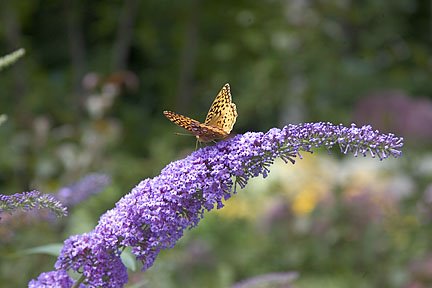 Our butterfly bushes will bloom soon and they're magnets for the butterflies. Here's a Great Spangled Fritillary butterfly on one of them.

We've written two books to help you attract and identify butterflies. Stokes Beginner's Guide To Butterflies, has an easy ID key to help you quickly identify the butterflies you see by size and shape.
 Stokes Butterfly Book gives you plans for a butterfly garden, lists and photos of butterfly plants, and chapters, with color photos, on the identification, behavior and caterpillars of common butterflies. Both are available at amazon.com and stores.
When the birding is slow, and it's the middle of the day, a wonderful thing for birders to do is look for butterflies. Butterflies are colorful flying creatures, just like birds. The identification skills birders already have can be transferred to identifying butterflies.
Look at butterflies through your binoculars, no need to catch them in a net.
The hot weather favors butterflies as they need to warm their bodies to fly. They need to get their body temperature up to 85 to 100 degrees Farenheit in order to fly well. Adult butterflies come to flowers for nectar, lay their eggs on special host plants, which can be unique to each species of butterfly. The eggs hatch, larva feed on the plant then turn into a pupa or crysalis from which the adult butterfly will emerge. A complete cycle or generation is called a brood, and butterfly species can go through from just one to as many as four broods per year, depending on the species and the number of warm months. Different butterflies are on the wing at different times during the summer, so you will continue to see new species.
There are about 17,000 species of butterflies in the world. In North America there are about 700 species but only a small fraction are common and likely to be seen by the average person.
When you see a butterfly watch it closely for several minutes. Observe how it flies, its size, shape, and the colors and patterns on its wings, both above and below.
Start by knowing the major families of butterflies that are distinctive. Below are some:
Swallowtails - are our largest butterflies and most have long tails coming off their hind wings.
Whites and Sulfurs - these are all medium-sized butterflies that are predominantly white or yellow.
Gossamer Wings - this group is easy to identify since it includes all of our smallest butterflies, such as the blues, coppers and hairstreaks, and metalmarks. The blues tend to be iridescent blue, coppers are often copper, hairstreaks often have hairlike tails on their hind wings, and metalmarks often have metallic spots on their wings.
Brush-footed Butterflies - this is a large and varied group of medium-sized, generally dark-colored butterflies with such strong and rapid flight they are hard to follow. Their is no one field characteristic, besides their flight, that makes them easy to identify as a group.
Satyrs - these are medium-sized butterflies that are almost all brown, often with darker eye-spots on their wings. They have a weak and bobbing flight and are often seen at woods edges or among grasses.
Skippers - are small butterflies whose flight is extremely rapid and erratic. They are mostly rich brown or orange-brown.
Wednesday, July 13, 2011
Dragonflies for birders

Halloween Pennant dragonfly, so aptly named, and one of my favorites. We have hundreds in our fields right now.

Widow Skimmer
 Widow Skimmer. The most colorful dragonflies with patterns on their wings are often in the Skimmer family of dragonflies.
When the birding slows down in summer and birds are quiet in the middle of the day, birders turn to watching dragonflies, that's what we do. Dragonflies are active on warm days, the hotter and sunnier the better. Dragonflies are stunningly beautiful, have cool names, and are abundant in fields, lakes, streams, shores, many of the places people go in summer.
Here are a few tips to enjoy and identify them.
1. Use your binoculars to spot them, if you have close focusing binos, even better.
2. Some dragonfly males patrol territories along ponds, lakes, and streams. Females mate with them then lay their eggs on emerging vegetation. If you see 2 dragonflies flying in tandem, this is a precursor to mating. In the wheel positon, mating is occurring.
3. Some dragonflies are more perchers, others more fliers, that can be a clue to their ID. Different perchers have different ways of perching, again an ID clue.
4. In general, some of the most obvious, colorful, and patterned-wing dragonflies you see are in the Skimmer family, so look in that section of our book.
5. Different species of dragonflies are on the wing at different times during the summer, so you will constantly see new ones.
6. Male, female and immature dragonflies of the same species can look different, just like birds.
We (along with dragonfly experts Blair Nikula and Jackie Sones) produced a book,Stokes Beginner's Guide To Dragonflies in order to quickly help you get into enjoying these marvelous insects. We worked out an easy key and lots of color photos. Take it and binoculars along with you the next time you go to the lake, river or stream. We take it with us in the canoe whenever we go out in the summer. Enjoy!

Friday, July 08, 2011
Robin Splish-Splash

Splish-Slpash-Splash

Splash-Splash-Splash

Ruffle-Ruffle

"Ahhh, that felt good!"
An American Robin enjoying our new bird bath, which has a bubbler in the center, is shallow, just deep enough, and has a non-slip bottom. That is why so many bird love it. By the way, most birds bathe in the same ritualistic way by dipping their heads, letting the water flow over their backs, then vigorously flapping their wings to drive the water under their feathers. Feather maintenance is soo important when you only have one pair of clothes,
Saturday, July 02, 2011


Tuesday, June 28, 2011
Tree Swallow fledging


We have 15 pairs of Tree Swallows nesting here, in NH, and now some have young fledgling young from their boxes. When Tree Swallow young leave their box they can fly and feed themselves. However, for the first few days they may land on the nest boxes of other Tree Swallows and try and beg on last meal from any adult they see, including their parents, basically creating a lot of chaos.
That is what is happening here. A newly fledged Tree Swallow has landed at the entry to the nest box of a pair that have their own young still in the nest. The fledged Tree Swallow is at the entrance hole, blocking the way. It is browner than the adults, has a lighter bill and they have a vague wash of darker color on their upper breasts. Its mouth is open, hoping for a tasty morsel.
The adults who have the box want no part of this youngster and it soon left and flew to another box and tried the same trick with no luck.
After fledging the Tree Swallows join with adults into large flocks and make their way to coastal and other water habitats and feed. They make their way down the coast, eating Bayberries and, in the South, Wax Myrtle berries in winter. They also eat insects.
In Florida, in winter, we have seen flocks of thousands of Tree Swallows, moving around, staying there until their spring migration north. We always wonder as we look at one of the birds in the flock, if it was born here, at Bobolink Farm, our NH home. We like to think so.
Monday, June 20, 2011
Rose-breasted Grosbeak again!
 Can one get enough of Rose-breasted Grosbeaks? I think not. They are strikingly gorgeous. We're lucky because we have this male, and also a female, visiting the feeders regularly. They must be nesting nearby, although we do not know where. Maybe they will bring the fledglings to the feeder.
One of the things we look at is the bib of red on the male. It is a slightly different shape for each bird, making it possible to often recognize individuals.
Rose-breasted Grosbeaks breed in the upper quadrant of the eastern half of the U.S. and much of Canada and winter south of the U.S., so people can see them in migration.
Sunday, June 19, 2011
Happy Father's Day

Hairy Woodpecker, Dad, feeding his fledgling offspring at our feeder.
HAPPY FATHER'S DAY TO ALL YOU DADS!!
Wednesday, June 15, 2011


Monday, June 13, 2011
Kingbirds plus ID tips

Eastern Kingbird breeds across much of the eastern 2/3 of the U.S. and Canada

Western Kingbird breeds in the western half of the country

Scissor-tailed Flycatcher, juv.

Scissor-tailed Flycatcher, female. They breed mainly in the south-central area of the U.S. but can wander far.

Fork-tailed Flycatcher is rare and breeds in Cent. and S. America and is a vagrant to anywhere in North America, mostly to eastern North America.

They have really long tails!

Fork-tailed Flycatcher in flight
Eastern Kingbirds breed on our pond here in NH, building their nest in the Buttonwood shrubs at the edge of the water. These big flycatchers sit on perches and fly out to catch insects in the air. We love to bring our binos in our canoe or kayaks and watch the kingbirds flying out over the water. Known for their fierce personality, they were given the scientific name, Tyrannus tyrannus, hence the joke that they are too (two) tyrannical.
If you live in the West, you will see their relative the Western Kingbird, which has a gray head and back and yellow on the belly. Amazingly, we once had a Western Kingbird show up on our property here in southwest, NH, way out of it's range, but they are know to wander far and wide.
Here are our Identification Tips to Kingbird Species ID, from page 477 of our new, best-selling, "The Stokes Field Guide to the Birds of North America"
"Kingbirds are fairly large flycatchers that belong to the genus Tyrannus. Most have rather large thick bills and medium-length tails, and they tend to perch conspicuously as they look for insects. Two species, the Fork-tailed and Scissor-tailed Flycatchers, have extremely long tails; four species, Tropical, Couch's, Cassin's, and Western Kingbirds, are similarly colored, with grayish heads and bright yellow bellies; the remaining three species, Thick-billed, Gray, and Eastern Kingbirds are mostly dark gray above and white below. In this group, look closely at the length and thickness of the bill and the patterns of colors on the breast and belly.
Tuesday, June 07, 2011
Loons!


NH has lots of Common Loons and we just can't get enough of them. They breed on many of the lakes in the NH region. Tonight we are speaking at Squam Lakes Natural Science Center in Holderness, NH where loons are a favorite bird. We are doing a talk and book signing for our new filed guide, The Stokes Field Guide to the Birds of North America. I will be showing many of my images from the guide, including many of NH's birds, including loons! We will see some of you there.
Monday, June 06, 2011
Smile for Today :)
 This is our Corgi Abby. She is making us smile today, and everyday. Does your dog make you smile?
Thursday, June 02, 2011
What's Up at Bobolink Farm
 Rose-breasted Grosbeak, female, comes frequently to feeder, she may be breeding nearby.
 Hairy Woodpecker, male (right) taking hulled sunflower back to his nest to feed young. Mr. Cardinal comes for a seed and feeds Mrs. Cardinal as part of courtship and breeding.
 Cosy pair of Gray Catbirds, who love the oranges! We have 3 pairs of nesting Catbirds
Lots going on here at Bobolink Farm, our NH home of 48 acres. Breeding birds are everywhere, with many taking advantage of our bird feeders. It's a great time of year to sit on our deck and watch the show around us. So many baby birds in the works.
Subscribe to:
Posts (Atom)