Search This Blog

Thursday, July 21, 2016

Butterflies for Birders!


Monarch Butterfly. They lay their eggs on milkweed and their caterpillars feed on this plant.


Great Spangled Frittillary on Purple Coneflower


Close-up of Great Spangled Fritillary

American Lady Butterfly, told by the two eye spots on underside of the hindwing

Tiger Swallowtail Butterflies are unmistakable

Spicebush Swallowtails can be told from other big, dark swallowtails by their single row of prominent white dots inside the margin of their forewings.
The larvae of Spicebush Swallowtails feed on spicebush and sassafrass.


Pearl Crescent butterfly. Scores are feeding on white clover on our path so we keep the path mowed high to preserve the clover flowers for them.

Mourning Cloaks are widespread across much of North America. They are one of the few butterflies who overwinter as adults, finding protected places in log piles, nooks, or under loose bark, and when they emerge in the spring they look worn, as this butterfly does. They are one of the longest lived butterflies and some may live as long as 10 months. Mourning Cloaks feed on sap and fruit.
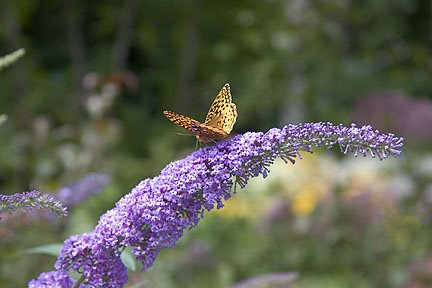

Our butterfly bushes will bloom soon and they're magnets for the butterflies. Here's a Great Spangled Fritillary butterfly on one of them.


We've written two books to help you attract and identify butterflies.Stokes Beginner's Guide To Butterflies, has an easy ID key to help you quickly identify the butterflies you see by size and shape.


Stokes Butterfly Book gives you plans for a butterfly garden, lists and photos of butterfly plants, and chapters, with color photos, on the identification, behavior and caterpillars of common butterflies. Both are available at amazon.com and stores.


When the birding is slow, and it's the middle of the day, a wonderful thing for birders to do is look for butterflies. Butterflies are colorful flying creatures, just like birds. The identification skills birders already have can be transferred to identifying butterflies.
Look at butterflies through your binoculars, no need to catch them in a net.

The hot weather favors butterflies as they need to warm their bodies to fly. They need to get their body temperature up to 85 to 100 degrees Farenheit in order to fly well. Adult butterflies come to flowers for nectar, lay their eggs on special host plants, which can be unique to each species of butterfly. The eggs hatch, larva feed on the plant then turn into a pupa or crysalis from which the adult butterfly will emerge. A complete cycle or generation is called a brood, and butterfly species can go through from just one to as many as four broods per year, depending on the species and the number of warm months. Different butterflies are on the wing at different times during the summer, so you will continue to see new species.

There are about 17,000 species of butterflies in the world. In North America there are about 700 species but only a small fraction are common and likely to be seen by the average person.

When you see a butterfly watch it closely for several minutes. Observe how it flies, its size, shape, and the colors and patterns on its wings, both above and below.

Start by knowing the major families of butterflies that are distinctive. Below are some:

Swallowtails - are our largest butterflies and most have long tails coming off their hind wings.

Whites and Sulfurs - these are all medium-sized butterflies that are predominantly white or yellow.

Gossamer Wings - this group is easy to identify since it includes all of our smallest butterflies, such as the blues, coppers and hairstreaks, and metalmarks. The blues tend to be iridescent blue, coppers are often copper, hairstreaks often have hairlike tails on their hind wings, and metalmarks often have metallic spots on their wings.

Brush-footed Butterflies - this is a large and varied group of medium-sized, generally dark-colored butterflies with such strong and rapid flight they are hard to follow. Their is no one field characteristic, besides their flight, that makes them easy to identify as a group.

Satyrs - these are medium-sized butterflies that are almost all brown, often with darker eye-spots on their wings. They have a weak and bobbing flight and are often seen at woods edges or among grasses.

Skippers - are small butterflies whose flight is extremely rapid and erratic. They are mostly rich brown or orange-brown

Enjoy the butterflies as well as the birds!

Tuesday, June 28, 2016

Eastern Bluebird mama and baby


This female Eastern bluebird is coming to our dried mealworm feeder and bringing her fledgling who perches on the edge while she feeds it. Such a help to her and soon her fledgling will learn to come on its own, a big help to it as it makes its way in the world. So special and such fun to watch!

Monday, June 20, 2016

Going Cuckoo! Black-billed Cuckoos are secretive birds...


Black-billed Cuckoos are being seen now, they eat lots of caterpillars, are secretive and breed in forest habitats across much of the upper two-third of the U.S. from MT east and into southern Canada. Listen for their low pitched cu cu cu cu call. We saw one yesterday gleaning caterpillars at a forest edge. Tell them from the similar Yellow-billed Cuckoo by their black bill and red-eye ring. Yellow-billed Cuckoo has a yellow lower mandible and yellowish eye-ring and its breeding range extends across much of the eastern two-thirds of the U.S. Look for them now!

Tuesday, May 24, 2016

Brown Thrasher, imitates other birds songs, repeating phrases twice!


We don't get many Brown Thrashers here in SW NH, so it's always a treat when one shows up. This one arrived yesterday and foraged under our bird feeder. Brown Thrashers have the most extensive breeding range of all the thrashers and breed throughout much of the eastern two-thirds of the U.S. and on into southern Canada. Most of the other thrashers (Long-billed, Bendire's, Curve-billed, California, Crissel, LeConte's, Sage) have breeding ranges that mainly occur in the western half of the country). Brown Thrashers habitat is thickets, shrubs and woodland edges. Thrashers belong to the family Mimidae (including Gray Catbird and Northern Mockingbird) who are know for imitating other birds' songs. The Brown Thrasher sings a long series of musical phrases and harsh notes repeated in pairs, usually containing imitations of other birds. Tell it from a Gray Catbird who usually repeats phrases once and a Northern Mockingbirds who usually repeats phrases three or more times. Fun!
To learn birds' songs get our best-selling Stokes Field Guide to Bird Song CDs, Eastern and Western Region available on amazon.com

Saturday, May 14, 2016

Wilson's Warbler, yes!


Wilson's Warbler was just singing in our trees just now. This is a rare warbler for us to see on our property here is SW NH. Such a treat!

Wednesday, May 11, 2016

Bobolinks Returned Today!


Bobolinks returned to our NH property today. These wonderful birds breed in our fields. We make sure our farmer cuts the hay at the end of Aug. so to spare the Bobolink nests.

Monday, May 09, 2016

Orioles have Arrived, Put Our Oranges for Them!


Baltimore Orioles have just arrived here in SW NH and they are hungry! The cool, delayed spring means food is more scarce. You can help them by putting out orange halves which they love. They will also eat suet and grape jelly. When the weather warms their usual food such as insects and blossoms will become available and they may not use feeders as much.

Tuesday, April 19, 2016

Pine Warbler Eating Suet!


Wow, this morning saw a newly arrived, beautiful, male Pine Warbler. In past years we have had them eating suet at our bird feeder. Smart bird, as there are fewer insects and other food available at this time of year. Later in the morning he was singing his trilled song from, you guessed it, our pine tree. Yup, Pine Warblers nest in pine trees here in southwest NH.
Also goes to show how suet attracts many species of birds beyond the usual feeder crowd. We have seen Pine Warblers eat suet, hulled sunflower seed and home made suet meal.
This is the first warbler to appear here so far, can't wait to see more.

Thursday, April 07, 2016

Warbler Migration and More Happening Now!


Prothonotary Warbler, male

Prothonotary Warbler, female

Hooded Warbler, male

Hooded Warbler, male

Northern Parula Warbler, female

White-eyed Vireo

Cave Swallow

White-eyed Vireo

Red-eyed Vireo


Eye candy migrant warblers and more are coming into TX, FL and other Gulf Coast States. Soon they will come to you..

Spotted Sandpiper - with Spots!


A spotted Sandpiper - with spots! All winter they are missing the spots in their plumage. Now, the spots appear in the breeding plumage. Such a cool bird. They walk while constantly bobbing their tail. They have a breeding strategy called polyandry where the female establishes and defends a territory and mates with up to four males. The male incubates the eggs and cares for the young. Spotted Sandpipers breed across much of North America near rivers, streams and other waterbodies. They winter along the coasts of North America. I photographed this one recently at J.N. Ding Darling NWR, Sanibel, FL. It will migrate soon.

Tuesday, April 05, 2016

It's Raining Blue! - Indigo Buntings!


It's raining blue birds - Indigo Buntings. Groups of them kept coming into the Sanibel, FL lighthouse two days ago after migrating across the Gulf of Mexico, quite a feat! We could see 5 and 6 in the same tree at a time. These beautiful birds will continue on their journey north to their breeding grounds mainly in the eastern two-thirds of the country. They nest in early-successional areas with shrubs and small trees, edges, old fields and roadsides. Look for them soon in your area. 
If you want to learn how to identify the many newly arriving bird species in your area, get our new guides,

The New Stokes Field Guide to Birds, Eastern and Western Regions

Monday, March 28, 2016

Gray Kingbirds Have Arrived!!


Gray Kingbird migrants were coming into Sanibel today, a few at the lighthouse and this one was on the wires near the East End Deli. They are  in the flycatcher family of birds, hence the sitting on wires and flying out to catch insects as this one did. This species mainly breeds in coastal FL and a little into coastal AL and GA. What a treat to see these arrive!! Migration is just gearing up, lots more warblers and songbirds to come.

Thursday, March 24, 2016

Swainson's Warblers are Migrating, rare bird!


Swainson's Warblers are one of the least commonly seen migrants warblers here on Sanibel, FL. This one was seen today at the Sanibel Lighthouse park, a stopping and refueling place for migrants that cross the Gulf of Mexico. They mainly breed in swampy deciduous woods and, at higher elevations, along rhododendron-lined streams in the southeastern portion of the country. What a thrill to see this unusual warbler.

Tuesday, March 22, 2016

Barn Swallow Migration is Beginning!


Barn Swallow migration is beginning! I (Lillian) photographed these beauties yesterday at the Sanibel Lighthouse, FL. Strong fliers they feed on aerial insects. They winter in much of Central and South America then return to breed in much of North America. They nest mainly in barns and build a nest of mud and grasses. Look for them soon!
To lean how to identify more birds with all the latest information and over 2,000 photos see our best-selling new books,


Monday, March 21, 2016

Why is the Cardinal Attacking My Window or Car Mirror?? Here's Why


Cardinal male attacking his reflection in a parked car mirror. We frequently get asked this time of year "why is the cardinal pecking at my window, or mirror". Birds do not know about reflections so, for a bird defending its territory, it sees its reflection and thinks it is another of its species attacking back. This is not a good thing. The bird wastes energy and could potentially mildly hurt itself. The way to prevent it is to remove the reflection from the birds viewpoint and cover the outside of the window with screening, cloth, or something, or in the case of a car mirror, a paper bag or cloth, or move the car. Once breeding is well underway, a birds territorial defense will wane and this behavior will diminish.

Thursday, March 03, 2016

Great White Pelican at Ding Darling NWR, 1st N.A. Record, or Escapee?


Great White Pelican mania continues at J.N. Ding Darling NWR, Sanibel FL. First North American record or escapee? Here's the latest. No (AZA) zoos in this country are missing any Great White Pelicans. Great White Pelican authority Sheila Murphy, of the American Zoological and Aquarium Society and Senior Bird Keeper at the San Diego Zoo did a census last week of Great White Pelicans at all 10 AZA facilities who house this species and determined no Great White Pelicans were missing. Zoos band and may microchip their pelicans and this female Great White Pelican has no bands on her legs. So the speculation mounts as to where she came from. Great White Pelicans breed in Africa, Asia and Europe. She was last seen at Ding on Tuesday, when she flew off (see my photo of her taking flight) and joined a small group of White Pelicans headed east. Birders are trying to relocate her. The Florida Ornithological Society Records Committee is reviewing this report and will meet in August to discuss it. They will be looking at the zoo records and other places that may have kept these birds in captivity. If no sources they research are missing any Great White Pelicans then maybe she will go down in history as a record of the first wild Great White Pelican who made it to North America. How lucky for us she showed up at Ding Darling NWR. This story is to be continued.