Search This Blog

Thursday, April 02, 2015

Great Migration Sanibel, FL already, eye-candy warblers

Prothonotary Warbler, male

Prothonotary Warbler, female

Hooded Warbler, male

Hooded Warbler, male

Northern Parula Warbler, female

White-eyed Vireo

Cave Swallow

White-eyed Vireo

Red-eyed Vireo

Eye candy migrant warblers and more have come into the Sanibel Lightouse park on Sanibel Island, in SW Florida already. Still so many more to come.

Saturday, March 28, 2015

Migration Mania Sanibel, FL, Swainson's Warbler and more!

Hooded Warbler, male

Hooded Warbler, female

Cave Swallow

Swainson's Warbler

Migrants continued coming into Sanibel lighthouse park, FL today. The highlights were the Swainson's Warber a rare, skulking, back in the underbrush bird, also a Cave Swallow which landed on a shed roof. Hooded Warblers were everywhere! And this is just the beginning of migration!

Friday, March 27, 2015

Warbler Migration Starting, Worm-eating, Kentucky Warblers in Sanibel, FL!

Worm-eating Warbler

Kentucky Warbler

Hooded Warbler

Barn Swallow and Tree Swallow above.

Good migrants were coming into Sanibel Lighthouse Park Sanibel, FL and east end today. Worm-eating Warbler and the Kentucky Warbler were the highlights. The lighthouse also had Hooded, Prairie, N. Parula, Palm Warblers and Red-eyed Vireo, Blue-headed Vireo, Indigo Buntings, Northern Rough-winged, Barn, Tree Swallows, Summer Tanager (heard.) In the east end of Sanibel in a friend's yard we had Yellow-throated Vireo, Blue-headed Vireo, White-eyed Vireo, and Red-eyed Vireo, female Hooded Warbler, Summer Tanager, Eastern Kingbird. Challenging photography conditions in the dark light and birds were feeding and well into the foliage. Birds were still coming in ahead of the storms. (Canon SX 50 photos in Sports Mode).The strong SW 24 mph winds blowing now with thunderstorms will turn to strong NW winds tomorrow and may keep some of these migrants here, or ground new ones.

Thursday, March 26, 2015

Beautiful Breeding, Feeding, Flying Birds of the Venice Rookery, FL

Anhinga, male

Great Egret

Great Egret nestlings, looking for their parent

Who arrived and fed them regurgitated fish

and them left to find some more food.

At the Venice Area Audubon Rookery, Venice, FL today, birds were flying, preening, nesting, feeding babies. There is an island in a lake, famous for birders and photographers, where many species of herons breed. The area is open to the public and from Jan. thorough April it is staffed by volunteers from the Venice Area Audubon society who have binoculars and spotting scopes for visitors to use and they help identify and give information about the birds. It is a fabulous place for bird photography.

Wednesday, March 25, 2015

Amazing Burrowing Owl Response to Cooper's Hawk!


I was photographing a Burrowing Owl on Cape Coral, FL, from a distance, when a Cooper's Hawk flew directly at the owl and swiped at it. The Owl's response was to fly quickly low and away from its burrow onto the ground some distance away and puff itself up as much as it could. It walked around puffed up for some time. The hawk flew beyond into a far distant tree. The owl came back near its burrow and went underground. Not perfect photos, but it shows the amazing behavior we had never seen before. Lucky Owl!

Tuesday, March 24, 2015

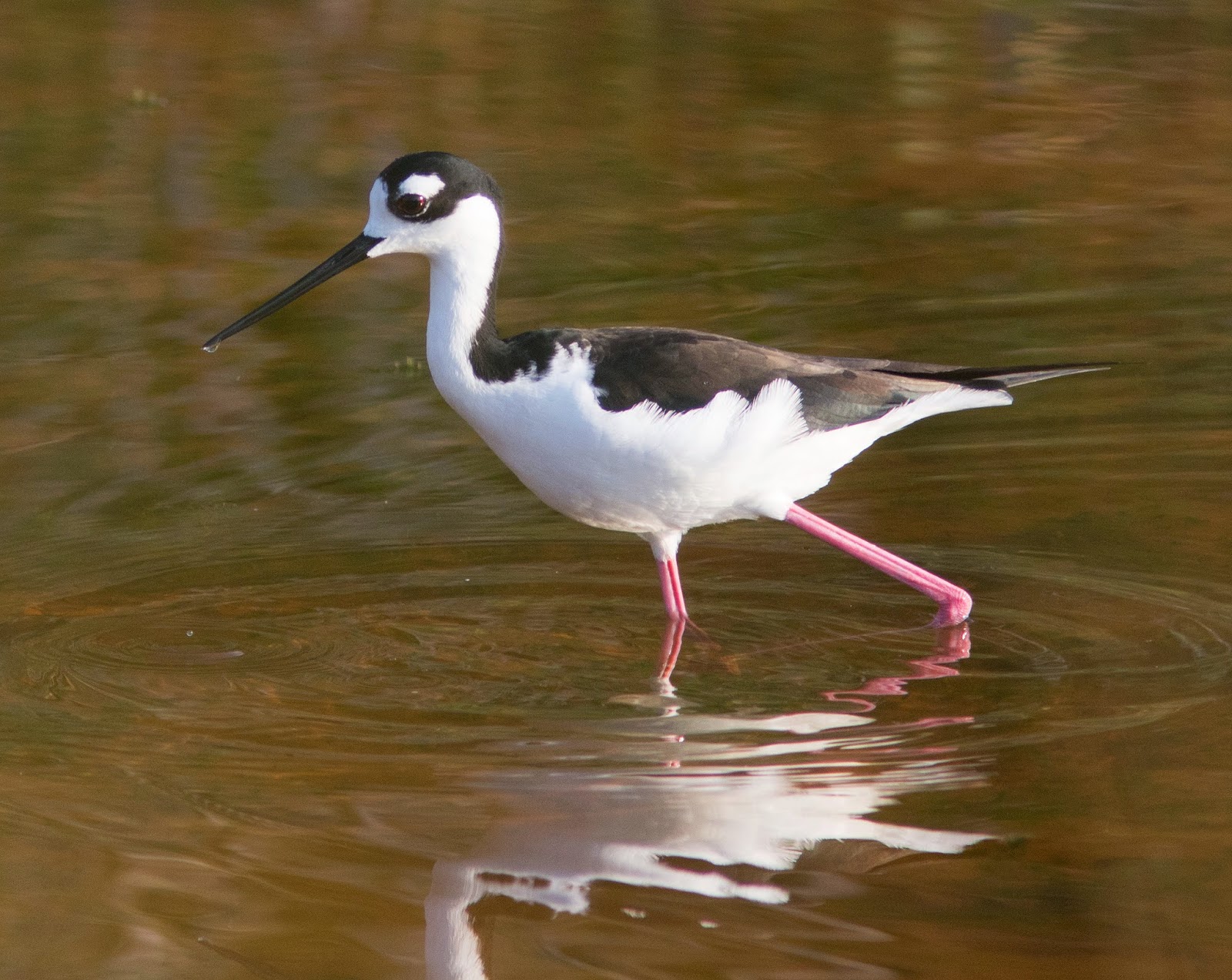
Beautiful Black-necked Stilts have just arrived!

Black-necked Stilt, male

Black-necked Stilt

Black-necked Stilt, preening

Black-necked Stilt, female

Black-necked Stilts have just arrived here on Sanibel, FL and elsewhere. Such a beautiful shorebird! The male has a jet black back and female has a more brownish back. Their most outstanding feature is the bubble-gum-pink long legs which enable this bird to wade out into deeper water to get insects off the water surface. Stilts are mostly coastal in eastern and Gulf states but can be found on inland lakes and marshes of the Midwest and West. The nest is a scrape or mound of vegetation placed near water. The female lays 3-4 eggs and incubation takes 25 days. When the young hatch they are fully feathered and can feed themselves, the parents job is mainly to protect them. By the way, if you want to know this type of breeding and nesting information, which is great to know to enjoy birds more, you  should pick up a copy of our new The Stokes Essential Pocket Guide to the Birds of North America, it has all that information as well as all new photos and great ID info. Available now at online booksellers, bookstores and wild bird stores (just ask.)


Thursday, March 19, 2015

Pileated Woodpecker Female Exploding From Nest!

Pileated Woodpecker exchange at the nest. the male arrives and the female explodes out of the hole past him.

then she flies off

to go feed

an he sits in the nest hole guarding the precious eggs, waiting for her to come back.

Pileated Woodpeckers are breeding now on Sanibel, FL. and we have seen several nests. The amazing thing is most of the Pileateds are in the same stage of breeding. They have just completed excavating their nest holes and are laying eggs, from 3-5. They will incubate for about 15 days and then the eggs will hatch. The young will then be fed in the nest for 28-32 days, then leave. 
Breeding information like this, as well as beautiful photos and ID info. is included in our new The Stokes Essential Pocket Guide to the Birds of North America, now available on amazon and in stores, just ready for spring!


Saturday, March 14, 2015

FL State High School Nature Photo Contest Winners


Here I am today with the winners of the Florida high school "Ding" Darling &Theodore Cross" nature photography contest, for which I was one of the judges (as well as NY photographer Arne Svensen and refuge biologist Jeremy Conrad). There were 430 entries from 20 high schools in the state with a resulting 3 winners (from l., Emily Huffman, 2nd place, Mathew Boutelle, 1st place, and Savannah Crowe, 3rd place) and 12 honorable mentions. This a photo of the winning images which will reside in the visitor's center at Ding Darling NWR for a year. There were lots of nice prizes including a new Canon DSLR camera. Here's also a photo of Janet Del-Valle and her proud mom, she was one of the honorable mention photographers and here was her photo of birds in flight which she titled "Family is Love". The students were all wonderful and talented and it was such a treat for me to meet and talk with them. I got to speak and told them how great it was that they were showing how important the natural environment was through their photography. What a happy day!

Sunday, March 08, 2015

Sanibel FL, Beach Bird bonanza!

Line up of, from left to right, Semipalmated Plover, Snowy Plover, Piping Plover

Piping Plover

Snowy Plover

Lesser Black-backed Gulls, from left, near adult, 3rd year and adult.

Large numbers of Royal Terns, and many Sanderlings.

Sanibel Beach, yesterday had so many birds on low tide. The best part was seeing the three plover species lined up.
The Piping Plover, was the more rare plover to find on the Sanibel, FL beach. Populations of Piping Plovers are considered Endangered or Threatened mostly due to disturbance from people and habitat loss. Even though Piping Plovers can be found in nearby Ft. Myers on Bunche Beach, they rarely come over to Sanibel. They winter on the southern Atlantic and Gulf coasts and breed on the Atlantic coast, northern Great Plains and along the Great Lakes. Snowy Plovers nest on Sanibel and their numbers are small but holding up. We have seen as many as 12 on one area of the each at the eastern end of the island. Lesser Back-backed Gulls are are considered an uncommon gull but a number winter here and elsewhere in FL. We saw 8 near the plovers. Such a treat to see so many wonderful beach birds together!

Tuesday, March 03, 2015

Reddish Egret, the rarest wading bird in North America!


Reddish Egret, J.N. Ding Darling NWR, Sanibel, FL recently, doing it's typical "drunken sailor" hunting behavior to catch fish. This is the rarest wading bird in the country according to authorities, with populations dropping. Research (by the Avian Research and Conservation Institute) on these birds is going on at J. N. Ding Darling NWR, with some (not this one) being fitted with satellite transmitters so more can be learned about its movements, habitat and feeding needs. Reddish Egrets need a relatively rare foraging habitat: just the right depth of water, a clear, firm sea bottom, the right tidal movement, and the right kind of small fish. They also need undisturbed nesting areas. Of the ones studied at Ding Darling so far, they have learned that these birds are very local in their movements, not moving very far. (Canon SX 50 camera in Sports Mode photos). We have seen 6 at a time foraging in Ding, so that is prime habitat for them, good thing it's protected!

Wednesday, February 25, 2015

Purple Martins are Back in Florida

Purple Martin, male

Purple Martin, female

Purple Martin houses

Purple Martins have been spotted in Florida. Soon, they will be coming your way. If you live in the East and are near water, put up housing for them. For houses and more info go to,
Purple Martin Conservation Association.

Purple Martins breed in every state east of the Rocky Mountains and in scattered locations in the West. To attract martins, check in a field guide to be sure you are in their breeding range, then put the right martin house in the right habitat. 

Purple Martins who breed from the Rocky Mountains East can be attracted to multi-compartment houses or clusters of gourds. In most of their breeding range in the West, martins nest singly in natural cavities and it is difficult to attract them to artificial housing. In the Northwest, however, you may be able to attract them to single unit houses or gourds. 

Habitat

Put up housing at least 40 feet away from tall trees and within 100 feet of buildings. They actually prefer to nest near human habitations.

Be sure there is open area within 1 or 2 miles where the martins can feed. Being near water is helpful, though not strictly necessary.

Do not allow high vegetation to grow at the base of the pole on which the house is mounted; predators could hide there.

Do not use wires to connect the house to the ground, as it would provide a way for predators to climb up.
Housing

Housing should be mounted on a tall pole (approximately 10-12 feet tall or higher).

Multi-compartment aluminum houses are inexpensive, durable, low-maintenance, and lightweight.

Multi-compartment wooden houses insulate very well, and wood is easy to work with. However, they require regular maintenance. They must be painted white.

Single-hole natural gourds are inexpensive and spacious inside, and their tendency to swing in the wind repels Starlings and House Sparrows. However, these gourds are not as durable as the multi-compartment houses. They must be treated with copper sulfate, sanded, and painted white. Plastic gourds are a good alternative to natural gourds and are now widely available.

For monitoring and cleaning, housing should be easy to raise and lower, and there should be easy access to the nesting compartments.

Entrance holes should be 2 inches in diameter and 1 inch above the floor of the compartment.Compartments should be at least 6" wide and 9-12" deep. Larger compartments are generally better but may attract Starlings.

Houses should be painted white; if you wish, you can use oil-based white stain instead of paint, as it is longer lasting and does not peel.

Housing should be well ventilated, should keep compartments dry, and should drain out any water that might get in. It should insulate the birds from heat and cold, and should not turn in the wind, as this may disorient the birds and cause them to abandon the colony.

Be sure to protect the house from predators. Put a baffle on the support pole-this is an inverted metal cone 36-40 inches in diameter or a length of stovepipe, which prevents predators from climbing the pole. Or put 4-6 feet of 6" diameter PVC pipe around the base of the pole so predators like snakes cannot climb up. Owls and crows can be prevented from taking the martins by placing vertical bar "owl guards" across the front of the housing.
Attraction Techniques

If you are putting up a new house, you will be trying to attract subadults—birds that were hatched last year. They arrive 4 to 6 weeks later than the adults; check the map for the approximate arrival dates of adults. Subadult martins are the ones that colonize a new area. Adult martins generally just return to the same area they nested before.

Play a recording of the Purple Martin dawnsong at your housing site; this will attract subadult birds, so play it at the time of year when they are arriving in your area. Early in the morning is the best time, from about 3:30 to 6:30 AM; use a timer or an endless-loop tape player.

Keep the holes closed off until the martins arrive. Many commercial manufacturers sell caps that press into the holes. This will keep Starlings and House Sparrows from using the compartments for roosting or early nesting. Open the holes when you first see martins arriving.

Martins may be more comfortable entering housing that looks as though it has been used before. To create this impression, build a low wall of mud just inside the hole of each compartment. You can also put pine shavings or pine needles on the floor of the compartments.
Monitoring
It is important to monitor your nests once a week, after you have attracted martins. Monitor only during good weather, between late morning and early afternoon, while most martins are out feeding. Record numbers of birds, eggs, and nestlings. Stop checking when nestlings are 20 days old.

Resources
For complete information on attracting and enjoying Purple Martins, see Stokes Purple Martin Book.

Monday, February 16, 2015

Beauty at Ding Darling NWR

Roseate Spoonbill, Tricolored Heron

Great Blue Heron

Don, Lillian, Ken Burgener (founder of Carefree Birding tours), and Dawn and Jeff Fine.

Went birding today at J.N. Ding Darling National Wildlife Refuge, Sanibel, FL and the birds were numerous. Here's a Roseate Spoonbill next to a Tricolored Heron, a study in pink and blue. And a Great Blue Heron posed so cooperatively near the road with the beautiful water as a backdrop. Ran into some fun birding folks as well.