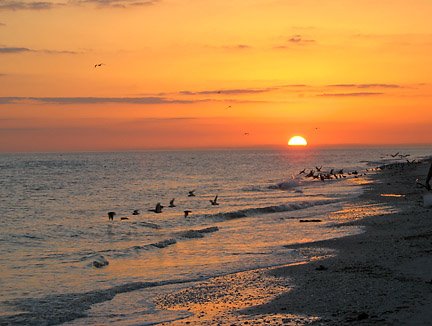
 Today we leave Sanibel. We had a wonderful winter and saw, and photographed!, many lovely birds. Onward to St. Mark's National Wildlife Refuge and a trip to the midwest, weather permitting. Don't know what our access to the internet will be for the next several days, but we will get back to you as soon as we can.
Friday, March 31, 2006
Bye Sanibel
Today we leave Sanibel. We had a wonderful winter and saw, and photographed!, many lovely birds. Onward to St. Mark's National Wildlife Refuge and a trip to the midwest, weather permitting. Don't know what our access to the internet will be for the next several days, but we will get back to you as soon as we can.


Thursday, March 30, 2006
Ding Darling
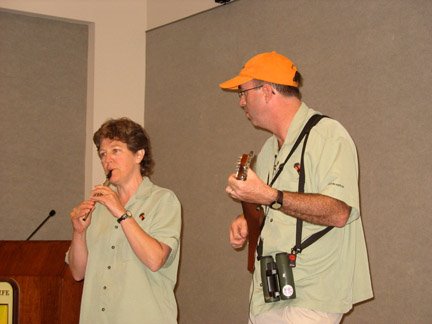
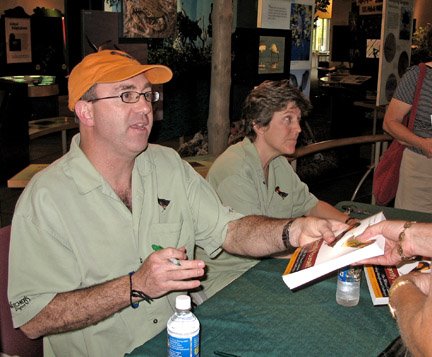 Today at Ding Darling National Wildlife Refuge we went to a talk on identifying birds given by Bill Thompson, III, editor of Bird Watcher's Digest, and his wife, the wonderful bird artist Julie Zickefoose. Later we went out to dinner with them.
Bill and Julie are very musical and entertained the audience with several bird-themed songs. Our favorite was "Mommas Don't Let Your Babies Grow Up to Be Cowbirds." After their talk they signed copies of their book "How To Identify Yourself."
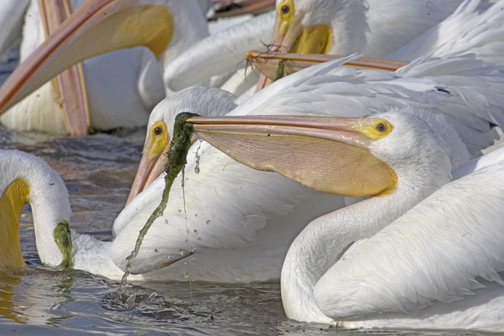
 While Ding Darling is still a haven right now to lots of migrating birds, it and the surrounding waters of San Carlos Bay, are having issues with unusually large amounts of algal growth, possibly due to excessive polluted water releases from Lake Okeechobee that go down the Caloosahatchee River into the bay and refuge. Many organizations such as PURRE, and others are working hard now to address this issue.
Tomorrow we leave Sanibel and head to St. Mark's National Wildlife Refuge in the panhandle of FL., then on to see Prairie Chickens in IL.
Wednesday, March 29, 2006
More Pileated Woodpeckers in Flight
Here are some more Pileated Woodpeckers in flight that I photographed on Sanibel Island, FL. These four photos were taken on 2/26/05.
 Photo 1
 Photo 2
 Photo 3
 Photo 4
 Photo 5
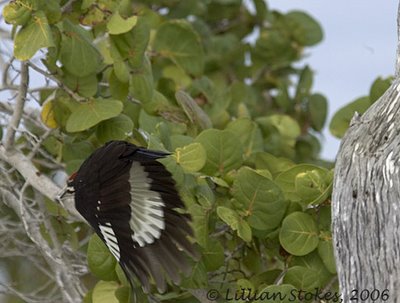 Photo 6
Photos of Pileated Woodpeckers © Lillian Stokes, 2006
 Photo 1
 Photo 2
 Photo 3
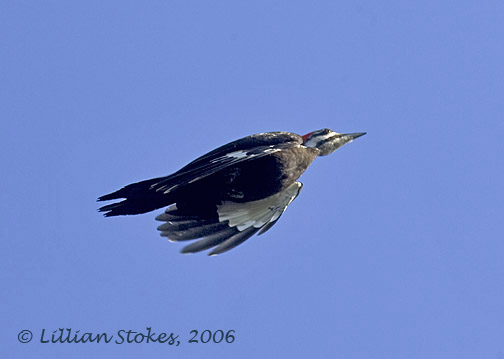 Photo 4
These next two photos were taken on 1/20/05
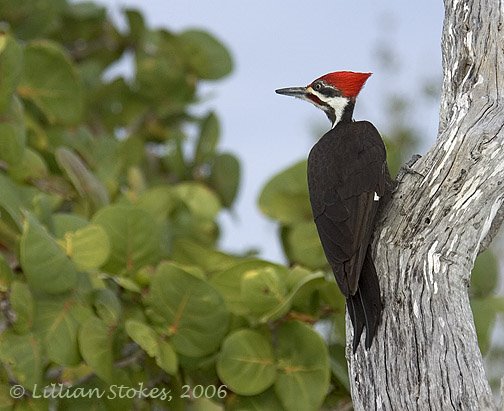 Photo 5
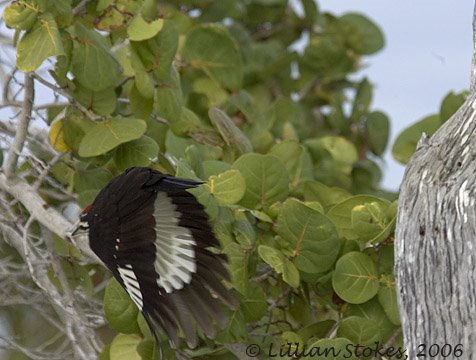 Photo 6
Photos of Pileated Woodpeckers © Lillian Stokes, 2006
Monday, March 27, 2006
Pileated Woodpeckers
These photos of Pileated Woodpeckers were taken on Sanibel Island last year and this year. They are of the subspecies D. p. pileatus, which lives in the Southeast. They were all photographed with the Canon 1D Mark II, which has an 8.5 frames per second shooting speed (according to Canon) with either the 1-400 IS mm lens, or 400 mm f/5.6 lens. It is interesting to see what a Pileated looks like in flight.
Here is a Pileated at rest on a tree, taken 1/20/05
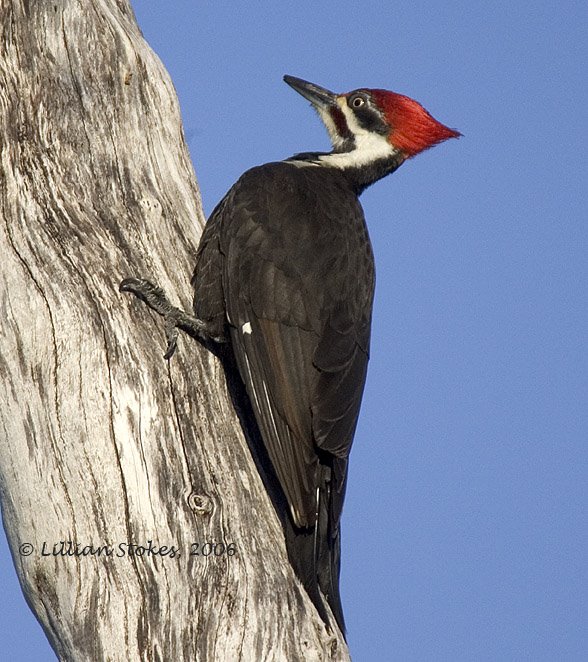 Photo 1
These next three images were taken on 1/25/05. They may not be an exact sequence of wings flaping. Photos 2 and 3 were taken in the same recorded second of the camera (according to the camera's metadata.) Photo 4 was taken a second later. There may have been intervening shots that we did not keep since there can be up to 8.5 frames per second with the Mark II.
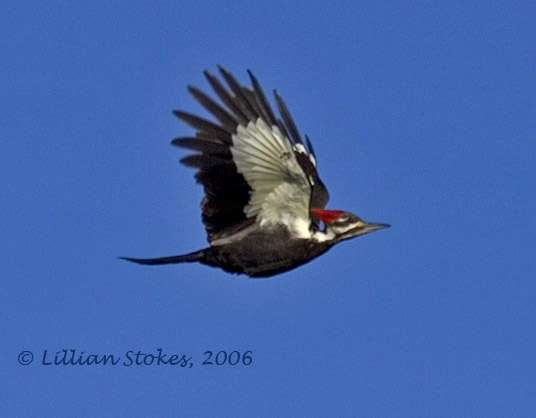 Photo 2
 Photo 3
 Photo 4
These next 4 images were taken on 1/20/05. Photos 5, 6 and 7 were all taken in the same recorded second of the camera (according to the camera's metadata.) Photo 8 was taken in the next second. Again, they may not be an exact sequence.
 Photo 5
 Photo 6
 Photo 7
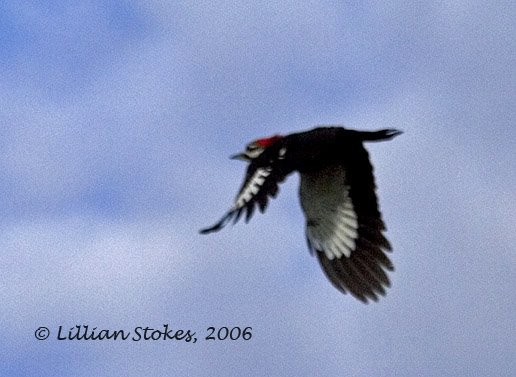 Photo 8
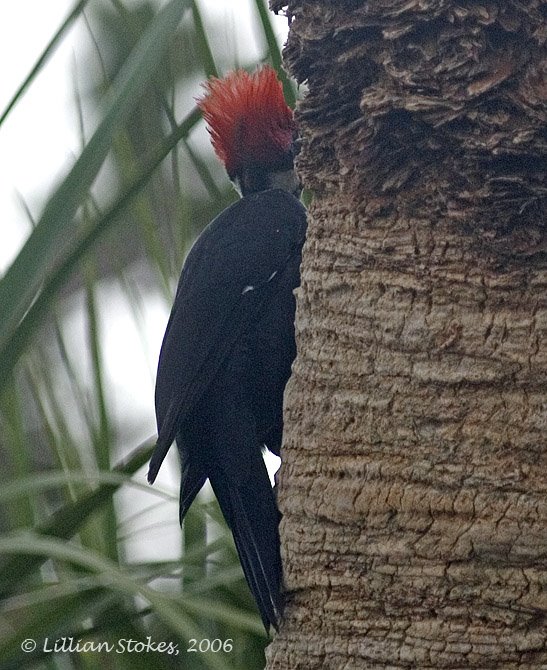 Photo 9
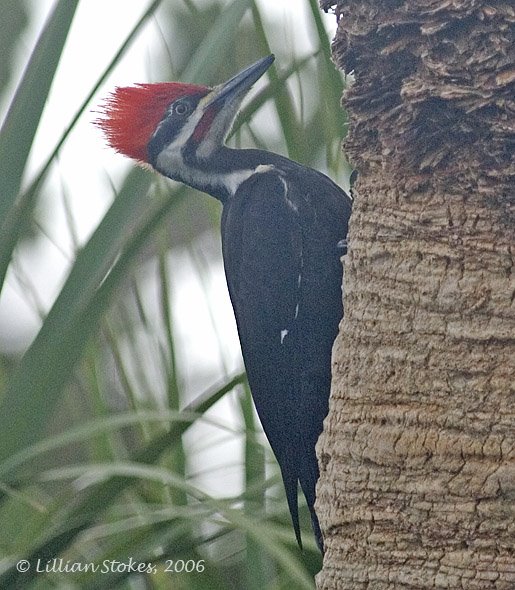 Photo 10
 Photo 11
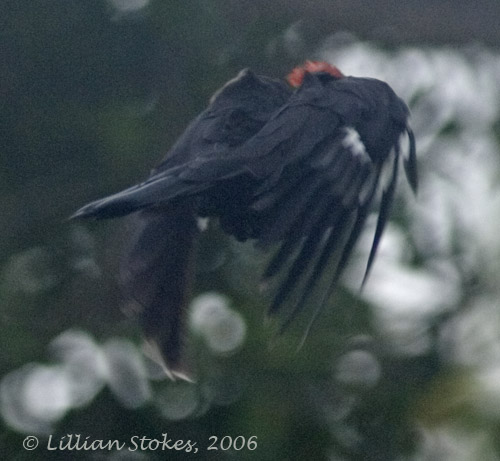 Photo 12
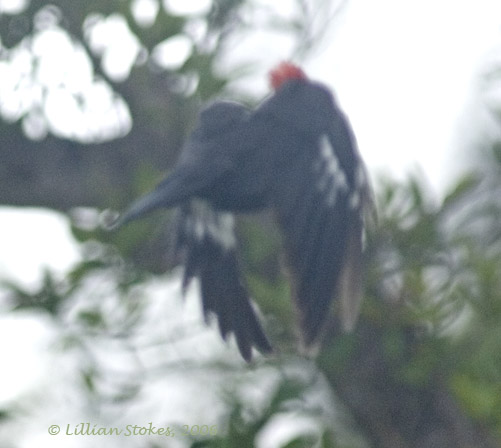 Photo 13
 Photo 14
 Photo 15
 Photo 16 (telepone lines are slightly visible)
 Photo 17 (telephone lines still visible)
 Photo 18
Pileated Woodpecker photos © Lillian Stokes, 2006
Happy Landing

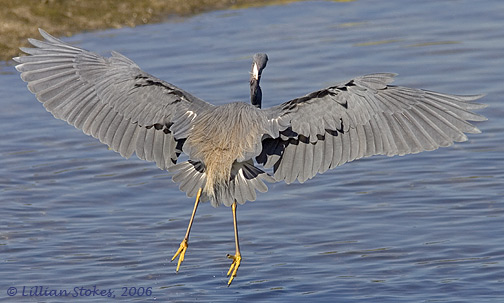

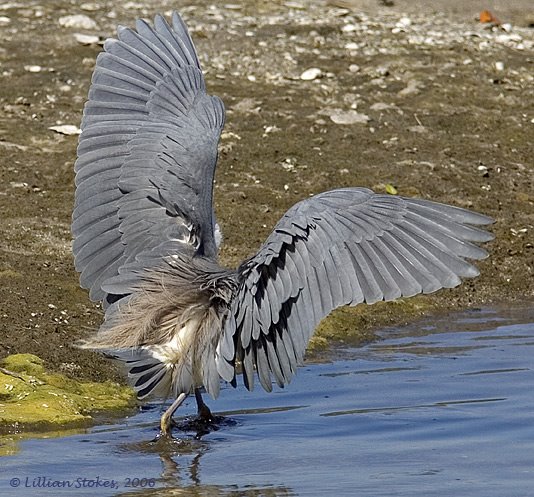 One of the tricks to photographing birds in flight, is to anticipate their movements before they take off. This Tri-colored Heron looked like it might be ready to move, so I got on the bird and let my Canon camera's autofocus do the rest as it took off. When we see every feather in freeze frame, it makes us notice new things, such as the white at the base of the tail in the third photo. As with the Great Blue Heron in the photos from yesterday, the lore, or facial skin between the eye and the base of the bill on this Tri-colored Heron, is bright blue due it being in breeding plumage. The Tri-colored Heron is sometimes misidentified as a Little Blue Heron, but the white belly is a give-away.
Photos of Tri-colored Herons © Lillian Stokes, 2006
Sunday, March 26, 2006
Great Blue
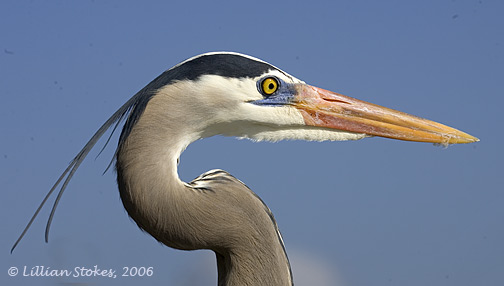 Here is a photo of a Great Blue Heron in breeding plumage. Notice the blue lore in front of the eye.
 I photographed this other Great Blue Heron on Captiva Island today. It was standing on the rail of a deck at a restaurant and seemed oblivious to the patrons. Notice the blue tone on the lore and upper bill. Great Blues are magnificent birds.
Photos © Lillian Stokes, 2006
Saturday, March 25, 2006
Fly By
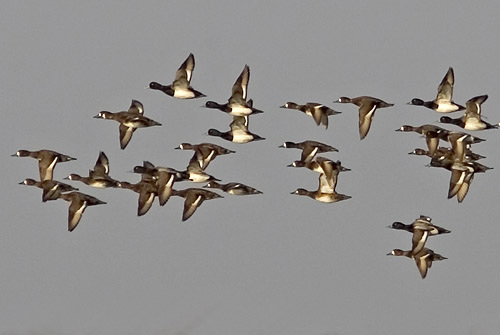 (click on image for larger version )
 We recently went with the Sanibel Captiva Audubon Society on a sunset cruise boat ride, run by Tarpon Bay Explorers Nature Tours, to the rookery islands in Tarpon Bay. One of the highlights was seeing a group of over 50 Lesser Scaup flying by.
Photos © Lillian Stokes, 2006
Friday, March 24, 2006
Safe Journey
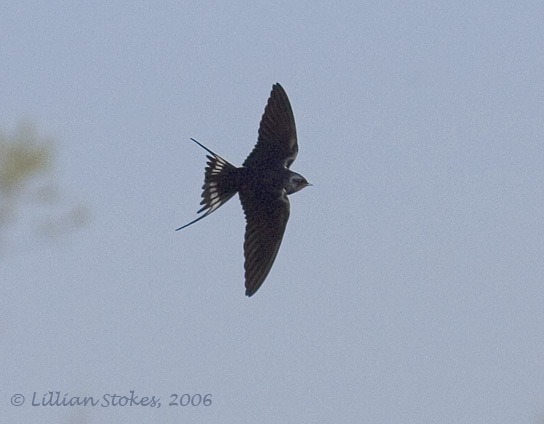 Yesterday, late in the day, we saw two migrating Barn Swallows heading north along the beach. Hurray, spring is coming. Safe journey, Barn Swallows. Come and nest in our barn in NH at "Bobolink Farm."
Wednesday, March 22, 2006
Daisy Dog
For those of you who are fans of "Daisy", our Pembroke Welsh Corgi,
here are some "Daisy Moments" .....
here are some "Daisy Moments" .....
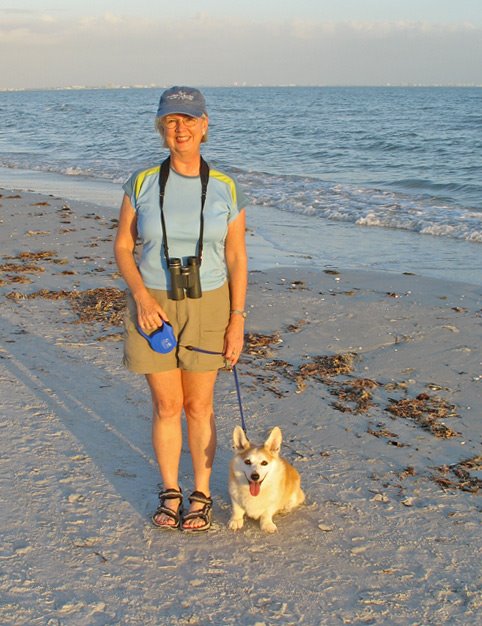 Good Dog
 Salty Dog
 Smart Dog
Photos of Daisy, © Lillian Stokes, 2006
Tuesday, March 21, 2006
Room With a View


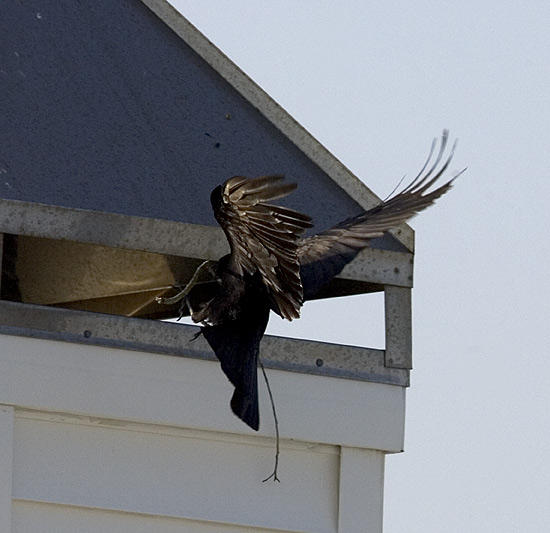
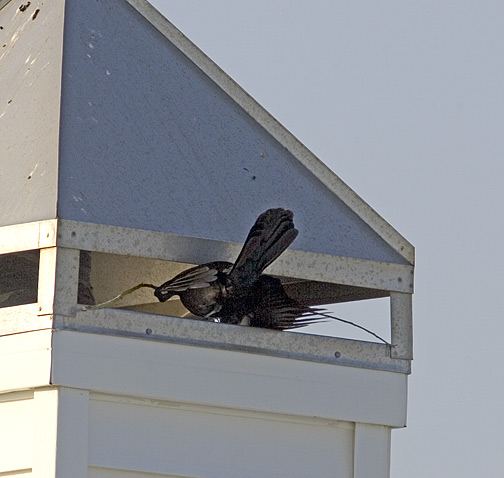 As if Fish Crows weren't funny enough — with their "Uhn-Uhn"..."Uh-Huh" calls, we name them "the bird who can't make up its mind." Add to this a funny nesting place.
We're sitting drinking coffee and all of a sudden we see a Fish Crow fly in with nesting material in its bill and disappear into our neighbor's covered chimney! We look at one another thinking simultaneously, "did you see what I just saw....they're building a nest in there!!"
Evidently there is enough space for a Fish Crow nest, a nice roof over their heads and a great view of the surrounding area. They can probably see the ocean from there. Wonder what their real estate taxes will be.
Fish Crow photos © Lillian Stokes, 2006
Monday, March 20, 2006
Just Ducky
 One of the wonderful things about photographing birds is that it makes you spend extended time with birds, and in so doing gain an intimate glimpse into their lives and behavior. I loved watching this pair of Mottled Ducks that seemed so synchronized, they could even feed in the same area within inches of each other, maybe on the same plant. Kinda like sharing a piece of cake with your spouse or significant other, one plate, 2 forks — now that takes synchrony. LQS
Mottled Duck photo © Lillian Stokes, 2006
Sunday, March 19, 2006
Share Birding
 We had a wonderful time introducing our friends Beth and James Aponovich to birding. They picked it up very quickly. As artists they have great instinctive skills that aided in their birding — the ability to judge relative size and shape and appreciation for striking visual moments.
 James liked the way that the yellow eyes of sleeping White Pelicans peek above a mountain of white feathers.
 Beth enjoyed watching bird behavior and the delicate plumes of Snowy Egrets.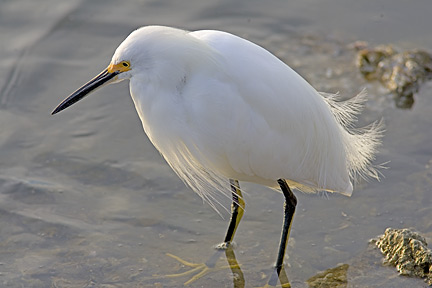
 They had fun checking off the birds they saw (over 53 species in a few days) on their checklists, most of them "Life birds" for them.
By introducing people to birding you hope to ignite a spark that will lead them to a deeper interest and appreciation of the beauty of birds.
Share birding with someome you know.
All photos © Lillian Stokes, 2006
Subscribe to:
Posts (Atom)